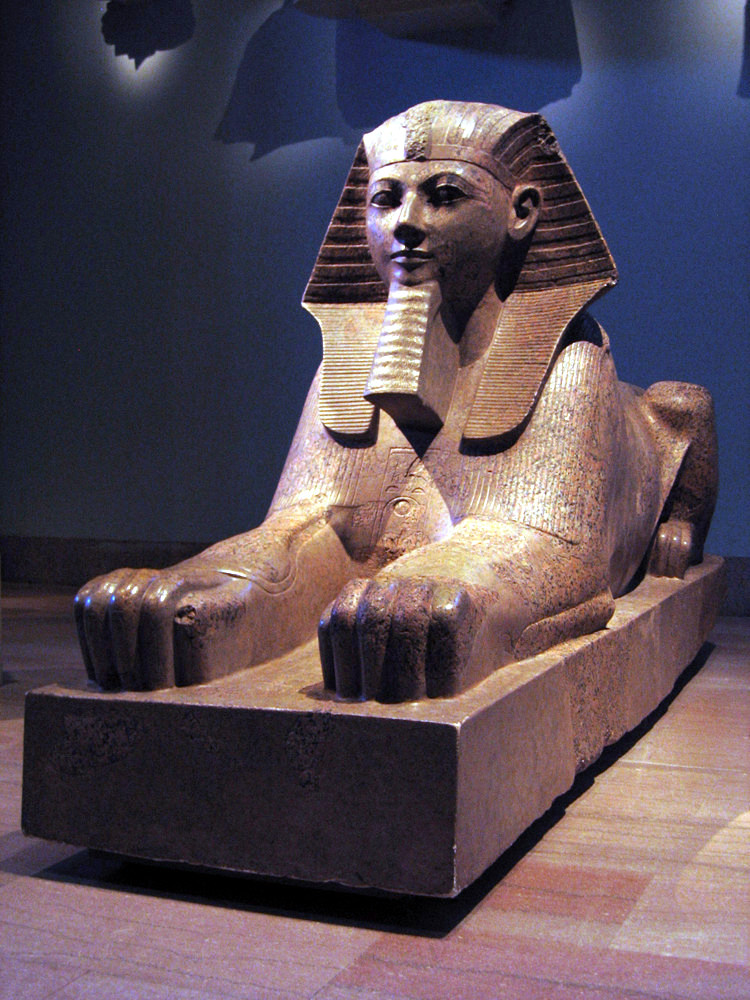
Hatshepsut
d. 1458 BC
- Died
- 1458 BC
- House
- 18th Dynasty
Biography
Few rulers of ancient Egypt have required as much retrospective explanation as Hatshepsut (d. c. 1458 BC), the daughter of Thutmose I and Queen Ahmose who governed as a female pharaoh for some two decades. Married to her half-brother Thutmose II, she bore him a daughter, Neferure. When he died around 1479 BC, the throne passed to his young son by a secondary wife, Thutmose III, and Hatshepsut assumed the regency as the boy's stepmother and aunt. Within about seven years she had gone further, adopting the full fivefold titulary of a king and ruling alongside her nephew as the senior partner.
Her kingship was framed with care. Official texts claimed the god Amun as her father and asserted that Thutmose I had designated her his heir; royal statuary showed her in the traditional regalia of a male pharaoh, including the false beard, while inscriptions sometimes retained feminine grammatical forms. Her reign emphasized prosperity and piety over conquest, though limited military activity in Nubia is attested. Its most celebrated enterprise was the expedition to Punt in about her ninth year, a trading voyage down the Red Sea that returned with incense, ebony, exotic animals, and live myrrh trees, all recorded in relief on her monuments.
Building defined her reign. Her mortuary temple at Deir el-Bahri, Djeser-djeseru, rises in colonnaded terraces against the Theban cliffs and remains one of Egypt's most distinctive buildings; her steward Senenmut, an official of unusual prominence, was closely involved in her projects. At Karnak she erected obelisks of exceptional size, one of which still stands.
Hatshepsut died around 1458 BC, and Thutmose III continued into a long and successful sole reign. Late in that reign her names and images were systematically erased from many monuments. Once read as the revenge of a resentful stepson, the proscription's late date has led most scholars to see it instead as a dynastic measure, perhaps securing the succession of Amenhotep II by removing the precedent of a woman's kingship. The erasure failed in the long run: modern excavation has restored her to her place among the dynasty's major rulers.
Updated June 2026 · How we research
Connections across houses
Place Hatshepsut in the wider world of ruling houses.
Recommended Reading
Affiliate disclosure: the links below go to Amazon searches. As an Amazon Associate, Dynastica earns from qualifying purchases.