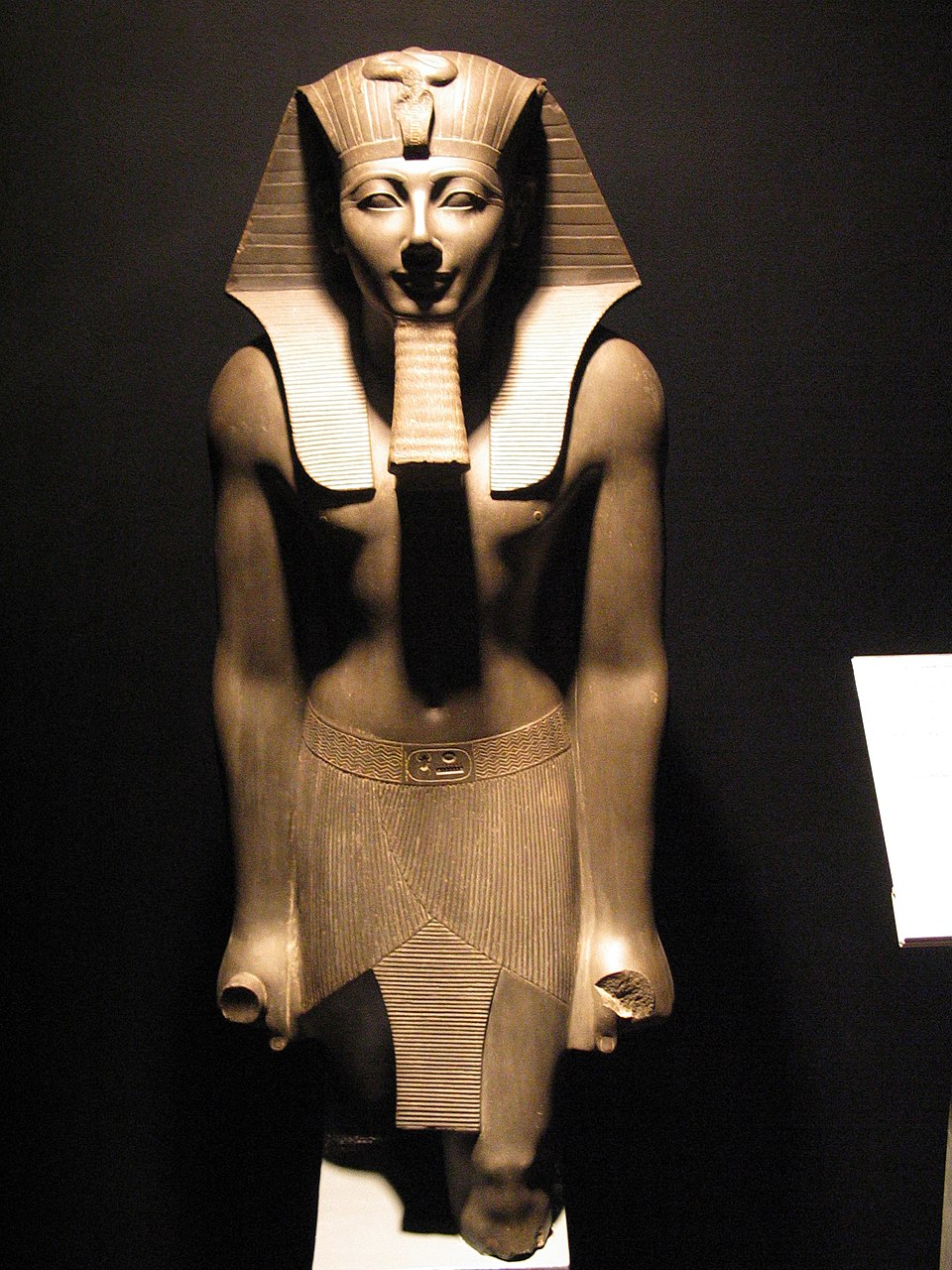
Thutmose III
d. 1425 BC
- Died
- 1425 BC
- House
- 18th Dynasty
Biography
Thutmose III (d. c. 1425 BC) spent the first two decades of his kingship in the shadow of his stepmother and then ruled alone for over three more, building the largest empire Egypt ever held. The son of Thutmose II and the secondary wife Isis, he acceded as a child around 1479 BC, with Hatshepsut, his father's widow and half-sister, first as regent and soon as senior co-ruler. Whatever he thought of the arrangement, he emerged from it trained in war and administration, and on her death around 1458 BC he took sole control.
He moved immediately. In his first independent campaign he marched into Canaan against a coalition of Syrian rulers gathered at Megiddo, choosing a direct approach through the narrow Aruna pass against his officers' advice and catching the enemy unprepared. The city fell after a months-long siege, and the victory established Egyptian dominance over the Levantine city-states. Over roughly twenty years he led some seventeen campaigns, recorded in the Annals inscribed at Karnak — an unusually detailed account of ancient warfare. Their climax came when he crossed the Euphrates on prefabricated boats hauled overland to strike at Mitanni, setting up a stela beside that of his grandfather Thutmose I. The 19th-century Egyptologist James Henry Breasted called him the "Napoleon of Egypt," a label that has endured.
His empire was administrative as well as military: garrisons, loyal vassals, and the education of Syrian princes' sons at the Egyptian court secured what the campaigns won. Tribute and trade funded extensive building, above all at Karnak, where his Akh-menu festival temple included reliefs cataloguing the plants and animals encountered abroad.
Late in his reign the names of Hatshepsut were erased from many monuments, a proscription now generally connected with securing the succession rather than personal hatred. He appointed his son Amenhotep II co-regent shortly before his death around 1425 BC and was buried in the Valley of the Kings in tomb KV34, its walls inscribed with the Amduat. His mummy was among those recovered from the Deir el-Bahri cache in 1881.
Updated June 2026 · How we research
Connections across houses
Place Thutmose III in the wider world of ruling houses.
Recommended Reading
Affiliate disclosure: the links below go to Amazon searches. As an Amazon Associate, Dynastica earns from qualifying purchases.