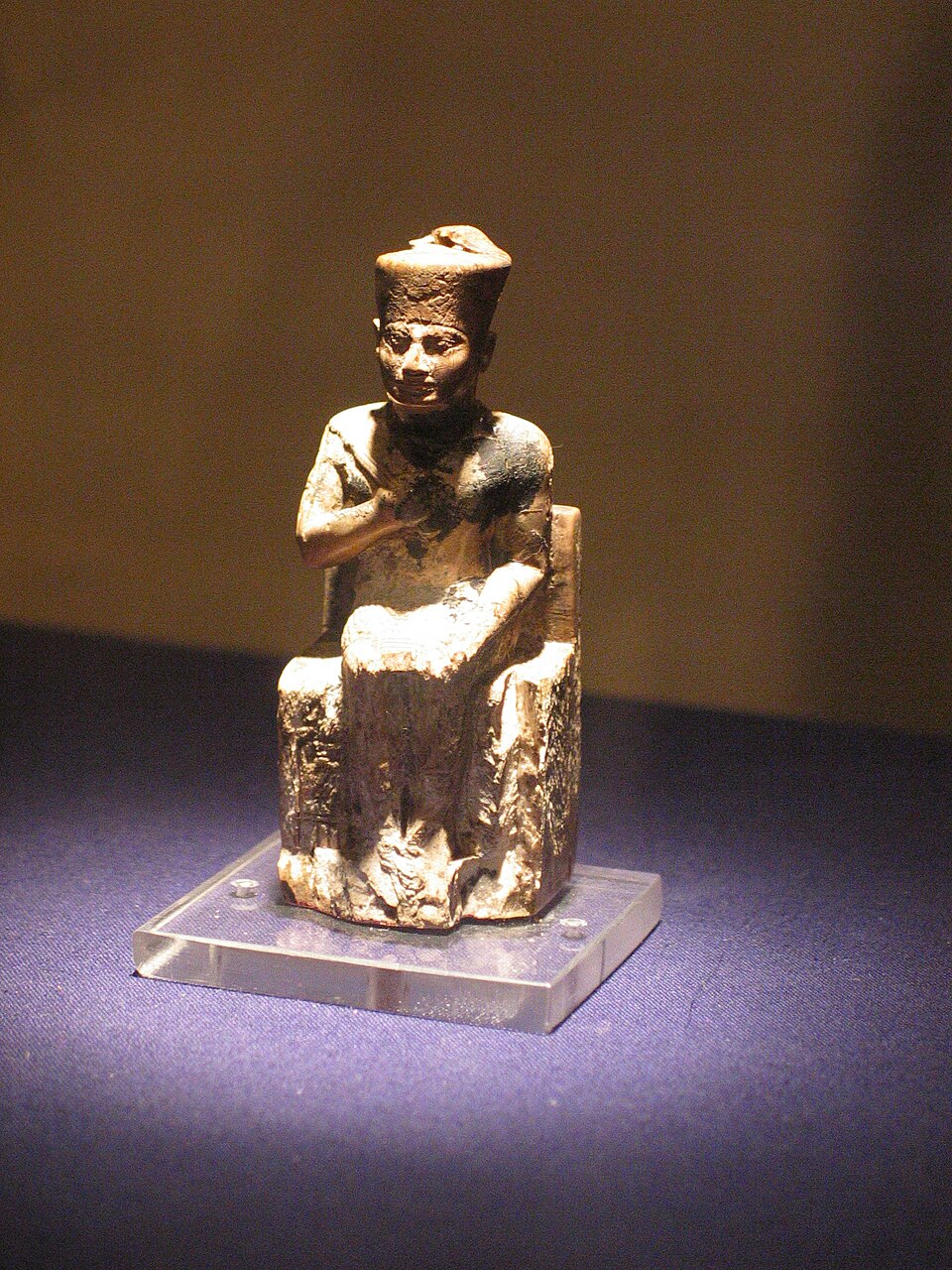
Khufu
d. 2566 BC
- Died
- 2566 BC
- House
- 4th Dynasty
Biography
Khufu, known to the Greeks as Cheops, was the second king of Egypt's Fourth Dynasty and the builder of the Great Pyramid of Giza, the largest Egyptian pyramid and the only one of the Seven Wonders of the ancient world still standing. He was the son of Sneferu, the dynasty's founder, and of Queen Hetepheres I; some Egyptologists question whether the tie to Sneferu was biological, but not the succession. Modern chronologies place his reign in the early twenty-sixth century BC, often given as roughly 2589 to 2566 BC. The Turin king list allots him twenty-three years, Herodotus fifty, and Manetho sixty-three; dated papyri from Wadi al-Jarf and quarry graffiti suggest a longer reign than the Turin figure, and most scholars now reckon between twenty-three and twenty-nine years.
His name, short for Khnum-khuf, means "Khnum protects me." Only one securely identified likeness survives, a small ivory statuette from Abydos, found in 1903 and now in Cairo, showing him seated in the Red Crown. Rock inscriptions at Wadi Maghareh in Sinai record expeditions for turquoise and copper, and his vizier Hemiunu, a nephew, is credited with directing the pyramid works.
The Great Pyramid, Akhet-Khufu, "Horizon of Khufu," originally rose about 146 meters (481 feet) on a base about 230 meters square, built of some 2.3 million blocks and cased in polished limestone. Its granite-lined burial chamber, Grand Gallery, and unfinished subterranean chamber are unmatched in earlier architecture. Three small queens' pyramids stood beside it, and his mother's hidden shaft lay nearby. Excavated workmen's quarters show a labor force organized and fed by the state rather than enslaved, as later legend had it.
Khufu married Meritites I and Henutsen and had many children, among them Kawab, who died before him, Djedefre and Khafre, who each became king, Hordjedef, and Hetepheres II. Later memory was mixed: the Middle Kingdom Westcar Papyrus shows him as a ruler fond of marvels, while Herodotus made him a tyrant who closed the temples and drove his people to forced labor. Egyptologists discount the Greek portrait, noting that his mortuary cult endured for centuries. His son Djedefre succeeded him.
Updated September 2026 · How we research
Connections across houses
Place Khufu in the wider world of ruling houses.
Recommended Reading
Affiliate disclosure: the links below go to Amazon searches. As an Amazon Associate, Dynastica earns from qualifying purchases.