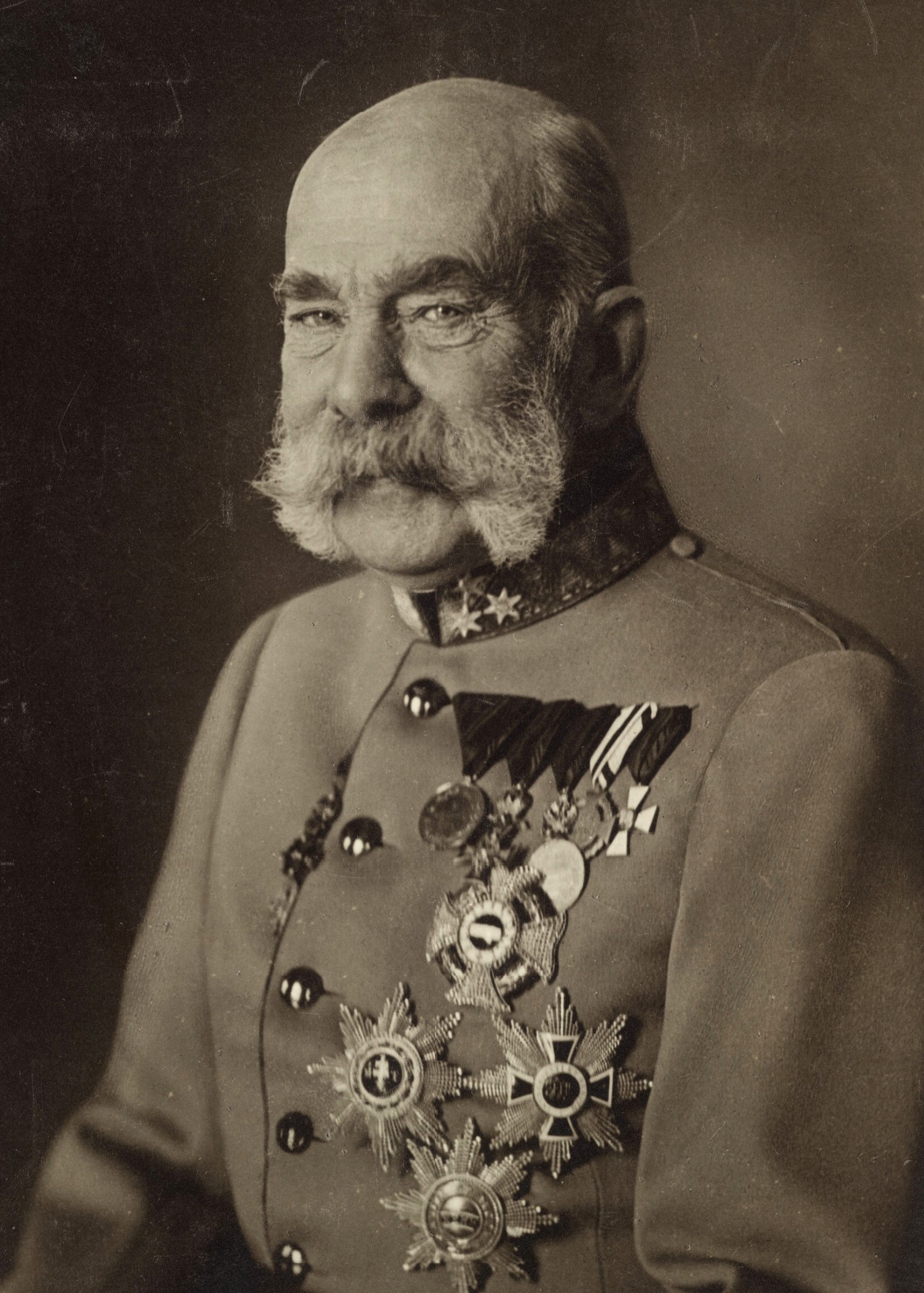
Franz Joseph I
Franz Joseph I.
Emperor of Austria · King of Hungary · King of Bohemia
1830 – 1916
- Born
- 1830
- Died
- 1916
- Reign
- 1848 – 1916
- House
- Austrian Habsburgs
Biography
Sixty-eight years on the throne made Franz Joseph I (1830-1916) the embodiment of the late Habsburg monarchy. He came to power on 2 December 1848, at the age of eighteen, amid the revolutions convulsing the empire: his uncle, the incapable Emperor Ferdinand I, abdicated, his father Archduke Franz Karl renounced his rights, and the young archduke, promoted by his mother Sophie of Bavaria and the minister-president Schwarzenberg, became emperor. The Hungarian revolution was crushed in 1849 with Russian military assistance, and the 1850s were governed as a centralized neo-absolutist state.
Military defeat forced constitutional change. The loss of Lombardy to France and Piedmont in 1859, after the battle of Solferino, and the decisive Prussian victory at Königgrätz in 1866, which expelled Austria from German affairs and cost it Venetia, led to the Compromise (Ausgleich) of 1867 with Hungary. The empire became the dual monarchy of Austria-Hungary, and Franz Joseph was crowned King of Hungary in Budapest, with Empress Elisabeth, who had favored the Hungarian cause, at his side. He had married Elisabeth, his Wittelsbach cousin from Bavaria, in 1854.
The emperor's later reign combined institutional stability with personal calamity. His brother Maximilian, briefly emperor of Mexico, was executed there in 1867; his only son, Crown Prince Rudolf, died with Mary Vetsera at Mayerling in 1889; Elisabeth was assassinated in Geneva in 1898. The succession passed to his nephew Franz Ferdinand, with whom relations were cool. Domestically, Franz Joseph presided over economic growth, the rebuilding of Vienna along the Ringstrasse, and the introduction of universal male suffrage in Austria in 1907, while nationality conflicts among the monarchy's peoples grew steadily harder to manage. The occupation of Bosnia-Herzegovina in 1878 and its annexation in 1908 deepened the rivalry with Serbia and Russia in the Balkans.
When Franz Ferdinand was assassinated at Sarajevo in June 1914, the emperor sanctioned the ultimatum to Serbia that began the First World War. He worked at his desk in Schönbrunn through the war's first two years, dying there on 21 November 1916, aged eighty-six. His grand-nephew Charles succeeded him as the last Habsburg emperor; the monarchy itself dissolved two years later.
Updated June 2026 · How we research
Events
On 28 June 1914 the Archduke Franz Ferdinand, heir presumptive to the Austro-Hungarian throne, and his wife Sophie, Duchess of Hohenberg, were shot dead in Sarajevo by Gavrilo Princip, a nineteen-year-old Bosnian Serb. The archduke was in Bosnia, annexed by Austria-Hungary in 1908, to observe army maneuvers. Princip belonged to a group of young conspirators associated with the Yugoslavist movement in Bosnia, armed and trained with the involvement of officers of the Serbian secret society known as the Black Hand; the degree of the Serbian government's own knowledge has been debated ever since. The first attempt that morning, a thrown bomb, wounded members of the entourage; the fatal shots came when the archduke's car, on a changed route to visit the wounded, stopped and reversed within feet of Princip. For the house of Habsburg the murder compounded a succession already strained. Franz Joseph I, then eighty-three and on the throne since 1848, had lost his only son Rudolf by suicide in 1889; Franz Ferdinand's children were excluded from the succession by his morganatic marriage, so the heirship passed to the emperor's young great-nephew, the Archduke Karl. The diplomatic consequences unfolded over the following month. Vienna's leadership, with an unconditional assurance of German support, resolved to use the crime to settle accounts with Serbia, and on 23 July presented an ultimatum framed to be refused. Serbia's reply accepted most demands; Austria-Hungary judged it insufficient and declared war on 28 July, with Franz Joseph's manifesto "To my peoples" announcing the decision. The mobilization of Russia in Serbia's defense drew in Germany and France within days, and Britain followed upon the invasion of Belgium. Franz Joseph died in 1916, and Karl, the last Habsburg emperor, could not extract the monarchy from the war that the July crisis had begun; it dissolved in 1918.
Also there: Karl I
- Succession
Fall of Austria-Hungary
1918· as long-reigning predecessor whose death freed the dynasty's last hopesThe collapse of the Habsburg monarchy at the end of the First World War. By October 1918 the constituent nationalities of Austria-Hungary were declaring independent states; on 11 November Emperor Karl I issued a proclamation renouncing participation in state affairs, though he never formally abdicated. The empire dissolved into the new Austria, Hungary, Czechoslovakia, Yugoslavia, and parts of Poland, Italy, and Romania — ending six centuries of Habsburg rule.
Also there: Karl I
Connections across houses
Place Franz Joseph I in the wider world of ruling houses.
Recommended Reading
Affiliate disclosure: the links below go to Amazon searches. As an Amazon Associate, Dynastica earns from qualifying purchases.