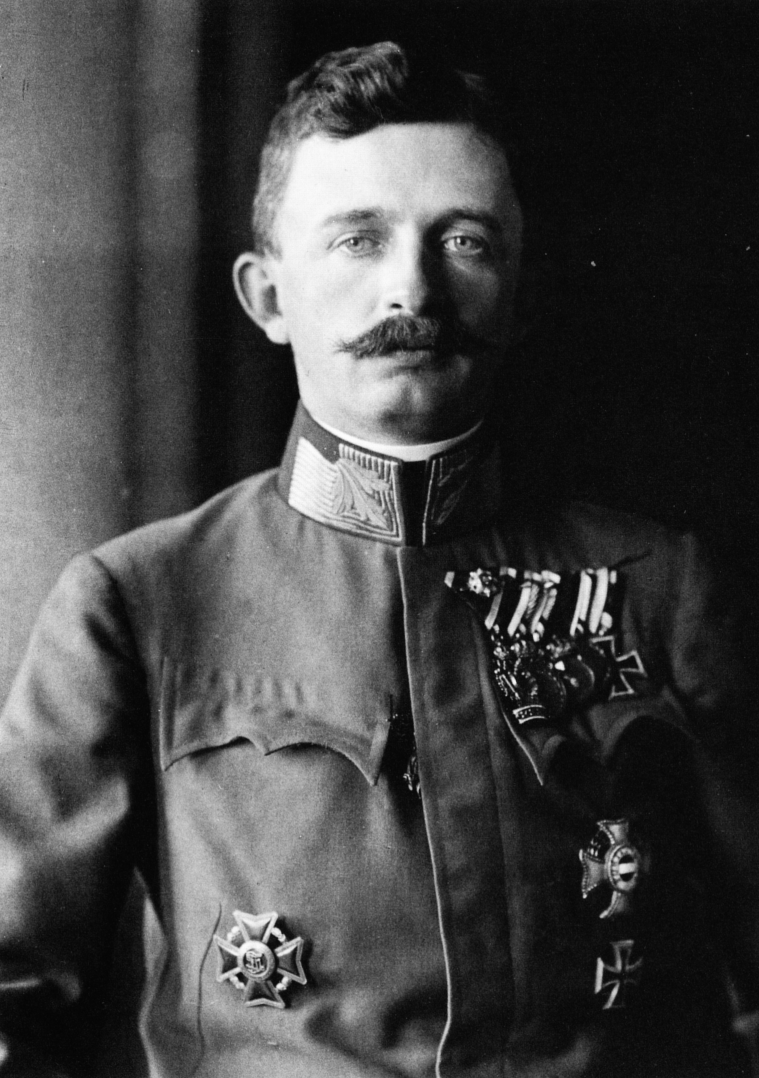
Karl I
Karl I.
Emperor of Austria · King of Hungary · King of Bohemia
1887 – 1922
- Born
- 1887
- Died
- 1922
- Reign
- 1916 – 1918
- House
- Austrian Habsburgs
Biography
The last Habsburg to reign came to the throne in the middle of the First World War and lost it in just over two years. Karl was born in 1887 at Persenbeug in Lower Austria, the son of Archduke Otto and Maria Josepha of Saxony, of the Wettin royal house; he was a grandnephew of the emperor Franz Joseph. His position in the succession was initially remote, but the death of his father in 1906 and the assassination of his uncle Franz Ferdinand at Sarajevo in June 1914 made him heir presumptive. In 1911 he had married Zita of Bourbon-Parma, a princess of the deposed Italian branch of the Bourbons, with whom he had eight children, the eldest being Otto.
Karl succeeded Franz Joseph in November 1916 as Emperor of Austria and, crowned at Budapest in December, as King of Hungary under the name Charles IV. Convinced the war was destroying the monarchy, he pursued a separate peace: in 1917 he used his brothers-in-law, the Bourbon-Parma princes Sixtus and Xavier, then serving in the Belgian army, as secret intermediaries with France. The disclosure of these contacts by the French premier Clemenceau in 1918, the Sixtus Affair, humiliated Karl and bound Austria-Hungary more tightly to Germany. His domestic gestures, including a sweeping amnesty for political prisoners and the October 1918 manifesto proposing federal reorganization of the Austrian lands, came too late to arrest the empire's dissolution.
On 11 November 1918 Karl renounced participation in the affairs of state in Austria, and two days later in Hungary, without formally abdicating either throne. He left for Switzerland in 1919, and in 1921 twice attempted to reclaim the Hungarian crown from the regent Horthy; both attempts failed, and the Allies removed him to the Portuguese island of Madeira. There, in straitened circumstances, he died of pneumonia on 1 April 1922, aged thirty-four.
Zita survived him by sixty-seven years and never remarried. Karl's reputation for personal piety and his wartime peace efforts led to his beatification by Pope John Paul II in 2004. His son Otto von Habsburg became head of the house and a long-serving member of the European Parliament.
Updated June 2026 · How we research
Events
On 28 June 1914 the Archduke Franz Ferdinand, heir presumptive to the Austro-Hungarian throne, and his wife Sophie, Duchess of Hohenberg, were shot dead in Sarajevo by Gavrilo Princip, a nineteen-year-old Bosnian Serb. The archduke was in Bosnia, annexed by Austria-Hungary in 1908, to observe army maneuvers. Princip belonged to a group of young conspirators associated with the Yugoslavist movement in Bosnia, armed and trained with the involvement of officers of the Serbian secret society known as the Black Hand; the degree of the Serbian government's own knowledge has been debated ever since. The first attempt that morning, a thrown bomb, wounded members of the entourage; the fatal shots came when the archduke's car, on a changed route to visit the wounded, stopped and reversed within feet of Princip. For the house of Habsburg the murder compounded a succession already strained. Franz Joseph I, then eighty-three and on the throne since 1848, had lost his only son Rudolf by suicide in 1889; Franz Ferdinand's children were excluded from the succession by his morganatic marriage, so the heirship passed to the emperor's young great-nephew, the Archduke Karl. The diplomatic consequences unfolded over the following month. Vienna's leadership, with an unconditional assurance of German support, resolved to use the crime to settle accounts with Serbia, and on 23 July presented an ultimatum framed to be refused. Serbia's reply accepted most demands; Austria-Hungary judged it insufficient and declared war on 28 July, with Franz Joseph's manifesto "To my peoples" announcing the decision. The mobilization of Russia in Serbia's defense drew in Germany and France within days, and Britain followed upon the invasion of Belgium. Franz Joseph died in 1916, and Karl, the last Habsburg emperor, could not extract the monarchy from the war that the July crisis had begun; it dissolved in 1918.
Also there: Franz Joseph I
The collapse of the Habsburg monarchy at the end of the First World War. By October 1918 the constituent nationalities of Austria-Hungary were declaring independent states; on 11 November Emperor Karl I issued a proclamation renouncing participation in state affairs, though he never formally abdicated. The empire dissolved into the new Austria, Hungary, Czechoslovakia, Yugoslavia, and parts of Poland, Italy, and Romania — ending six centuries of Habsburg rule.
Also there: Franz Joseph I
Connections across houses
Place Karl I in the wider world of ruling houses.
Recommended Reading
Affiliate disclosure: the links below go to Amazon searches. As an Amazon Associate, Dynastica earns from qualifying purchases.