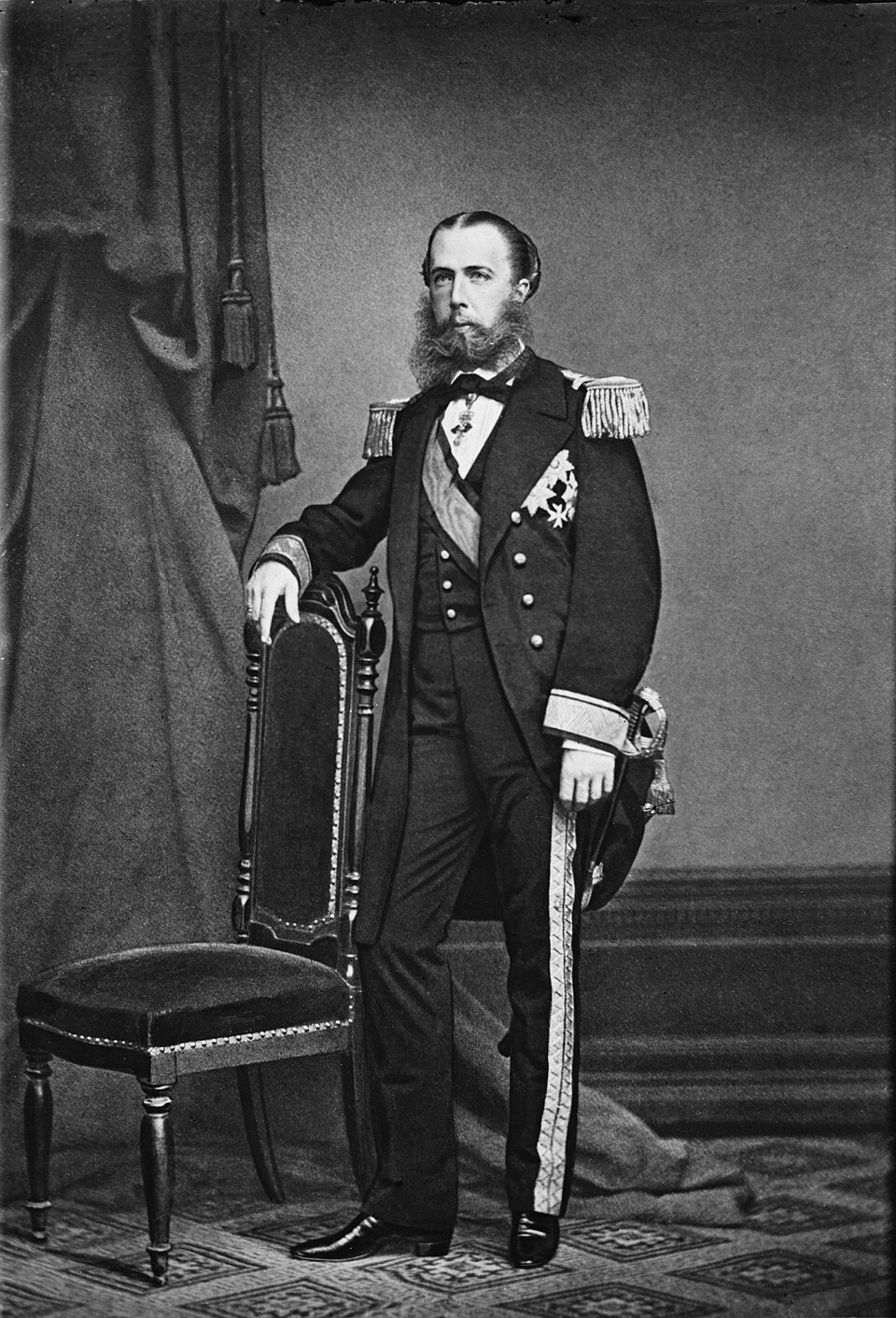
Maximilian I of Mexico
Maximilian I.
Emperor of Mexico (1864–1867) · Archduke of Austria
1832 – 1867
- Born
- 1832
- Died
- 1867
- House
- Austrian Habsburgs
Biography
An Austrian archduke ruled briefly, and fatally, as emperor of Mexico. Maximilian was born at Schönbrunn in 1832, the second son of Archduke Franz Karl and Sophie of Bavaria, a Wittelsbach princess, and the younger brother of Emperor Franz Joseph. He pursued a naval career, serving as commander-in-chief of the Austrian navy, which he modernized and expanded, and from 1857 to 1859 was viceroy of Lombardy-Venetia, where his comparatively liberal administration ended with Austria's defeat in the war of 1859. In 1857 he married Charlotte of Belgium, daughter of King Leopold I of the house of Saxe-Coburg and his Bourbon-Orléans queen, Louise; the couple built the castle of Miramare near Trieste.
The Mexican adventure originated with Napoleon III of France, whose troops had intervened in Mexico during the suspension of foreign debt payments by President Benito Juárez. Mexican conservative exiles, seeking a European monarch, offered the crown to Maximilian, who accepted in 1864 after renouncing his rights of succession in Austria, an act he later contested. He and Charlotte, known in Mexico as Carlota, arrived in 1864, his rule resting on the French expeditionary army.
As emperor Maximilian disappointed his conservative sponsors by upholding many liberal measures, including aspects of the Juárez-era reforms, while never winning over the republicans, who continued the war from the north under Juárez. The end of the American Civil War brought United States pressure against the French presence, and Napoleon III, facing rising costs and European concerns, withdrew his troops in 1866-1867. Carlota traveled to Europe to plead for support and suffered a mental collapse from which she never recovered. Refusing advice to abandon his cause, Maximilian took command of his remaining forces and was besieged at Querétaro, where he was captured in May 1867.
Tried by court-martial under republican law, he was sentenced to death despite appeals for clemency from European governments and prominent liberals. He was executed by firing squad on the Cerro de las Campanas outside Querétaro on 19 June 1867, aged thirty-five. His body was returned to Vienna aboard an Austrian frigate and buried in the Capuchin Crypt; the republic under Juárez was restored in Mexico.
Updated June 2026 · How we research
Connections across houses
Place Maximilian I of Mexico in the wider world of ruling houses.
Recommended Reading
Affiliate disclosure: the links below go to Amazon searches. As an Amazon Associate, Dynastica earns from qualifying purchases.