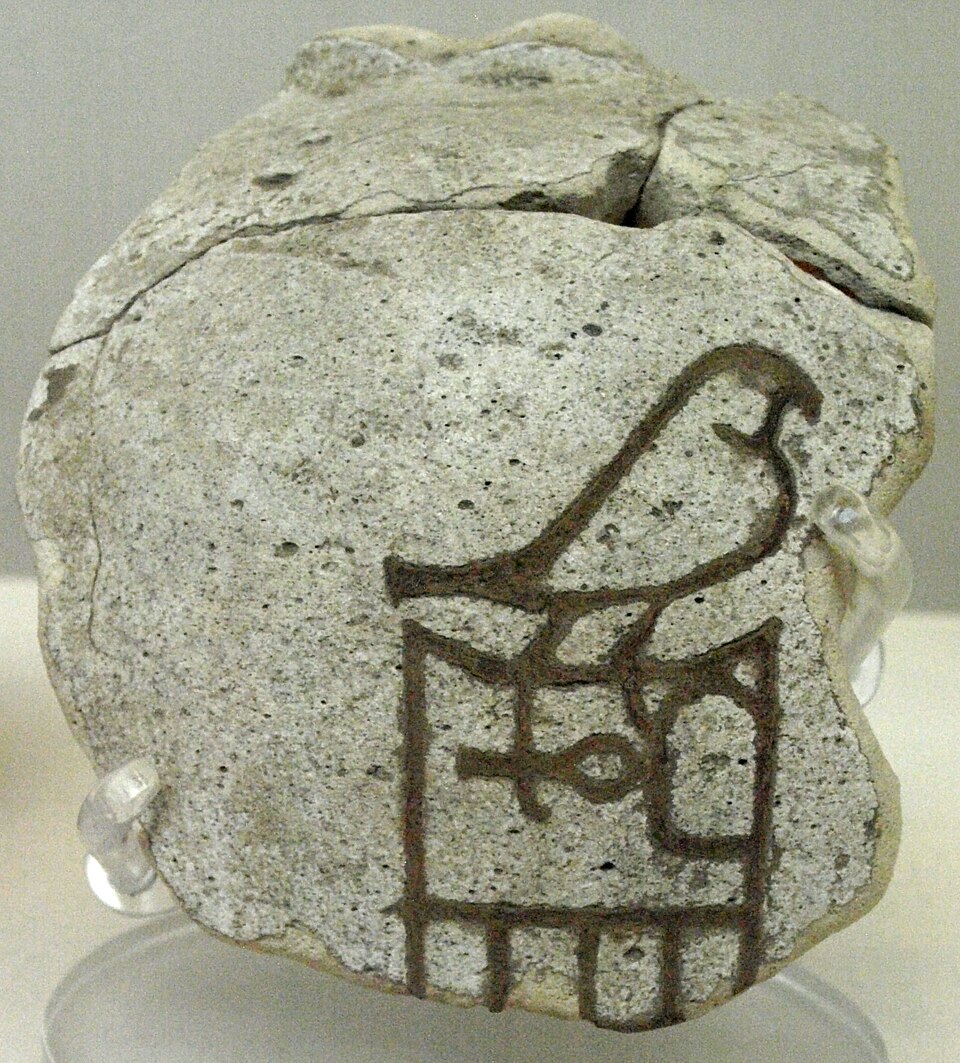
Hor-Aha
- House
- Early Dynastic
Biography
Hor-Aha, "Horus the fighter," was the second king of Egypt's First Dynasty in the reckoning most Egyptologists accept, the successor and probably the son of Narmer, and the ruler under whom the institutions of the newly unified state took visible shape. He is placed around 3100 to 3050 BC; a radiocarbon study of 2013 put the start of his reign between about 3111 and 3045. His personal name appears in later king lists as Teti, and Manetho's Athothis, credited with a long reign, a palace at Memphis, and the authorship of books on anatomy, is generally taken to be him. Because the ancient lists count Menes first and then Teti, and because Narmer and Menes are usually equated, Hor-Aha is treated as the dynasty's second king, though a minority have argued that he himself was Menes. The Naqada mastaba, a mudbrick tomb 54 by 27 meters with palace-facade walls, dates to his reign and bore the names of Narmer, Aha, Neithhotep, and a prince Rekhit; its rich contents point to Neithhotep as its occupant, and on this basis she has usually been regarded as Narmer's queen and Hor-Aha's mother, though some now suggest she was his wife, since she outlived him into the reign of his successor Djer. The earliest mastaba at Saqqara also belongs to his reign. Year labels from his reign record visits to the shrine of Neith at Sais and the sanctuary of Buto in the Delta, ritual feasts, the making of a statue of Anubis, and a "year of smiting Ta-Sety," a campaign against Nubia. Cedar in his tomb is the earliest secure evidence of Egyptian contact with Lebanon, while Egyptian activity in Canaan, so marked under Narmer, fell away sharply. He was buried at Umm el-Qa'ab, Abydos, beside Narmer, in a tomb of three large chambers, B10, B15, and B19, far larger than his father's. Around it lay thirty-six subsidiary graves holding servants and women of the household, dwarfs, dogs, and even lions: the earliest known retainer sacrifices in Egypt, and a measure of the authority the crown now commanded. His consort Benerib was buried beside him; Khenthap, recorded as the mother of Djer, was presumably another wife. Djer succeeded him, and the dynasty Narmer had founded continued through his line.
Updated September 2026 · How we research
Recommended Reading
Affiliate disclosure: the links below go to Amazon searches. As an Amazon Associate, Dynastica earns from qualifying purchases.