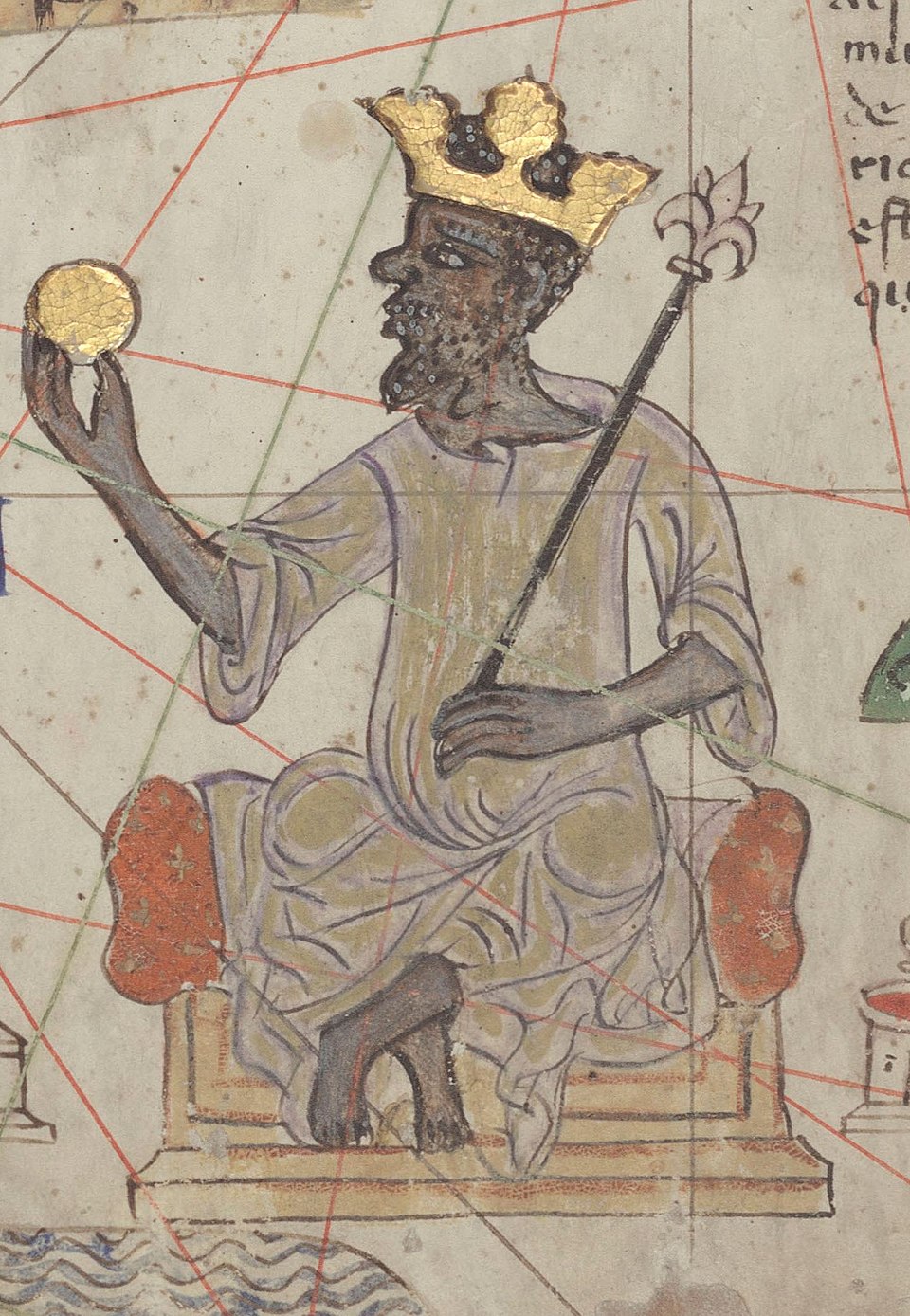
Mansa Musa
Mansa of Mali · Lord of the Mines of Wangara
1280 – 1337
- Born
- 1280
- Died
- 1337
- House
- Keita Dynasty
Biography
Among the rulers of medieval West Africa, Mansa Musa is the best documented, owing largely to the attention his 1324-25 pilgrimage to Mecca attracted from Arabic writers in Cairo and beyond. He was born around 1280 into the Keita dynasty established by Sundiata, and came to the throne of Mali about 1312. According to the account preserved by al-Umari, he succeeded after his predecessor — usually identified as Abu Bakr II — departed on an Atlantic expedition and did not return, though that story rests on a single source.
Musa's reign, lasting until his death about 1337, coincided with the height of Mali's territorial extent and commercial prosperity. The empire controlled the goldfields of Bambuk and Bure and the trans-Saharan routes along which gold moved north in exchange for salt, cloth, and other goods. Arabic geographers describe a state with organized provincial administration and a court of considerable ceremony, though their information was gathered at a distance and often secondhand.
The pilgrimage of 1324-25 made his reputation. Musa traveled to Mecca by way of Cairo with a retinue that contemporary and near-contemporary accounts describe as numbering in the thousands, distributing gold so freely that, according to al-Umari, who visited Cairo some years later, the metal's value in the city remained depressed for years afterward. The figures given for the quantities of gold vary widely between sources and grew in the retelling, but the episode fixed Mali's wealth in the imagination of the Mediterranean world; the empire and its ruler subsequently appeared on European maps, most famously the Catalan Atlas of 1375.
On his return journey Musa is reported to have brought scholars and the Andalusian poet and architect Abu Ishaq al-Sahili to Mali. He extended his authority over Timbuktu and Gao and is credited with patronizing mosque construction, including work associated with the Djinguereber mosque in Timbuktu. Under his rule and that of his successors, Timbuktu developed into a center of Islamic learning and book trade.
Musa was succeeded by his son Mansa Maghan, whose brief reign preceded the accession of Musa's brother Sulayman. The chronology of Musa's death, like much Malian dating, is reconstructed from Arabic sources and is conventionally placed in 1337.
Updated June 2026 · How we research
Connections across houses
Place Mansa Musa in the wider world of ruling houses.
Recommended Reading
Affiliate disclosure: the links below go to Amazon searches. As an Amazon Associate, Dynastica earns from qualifying purchases.