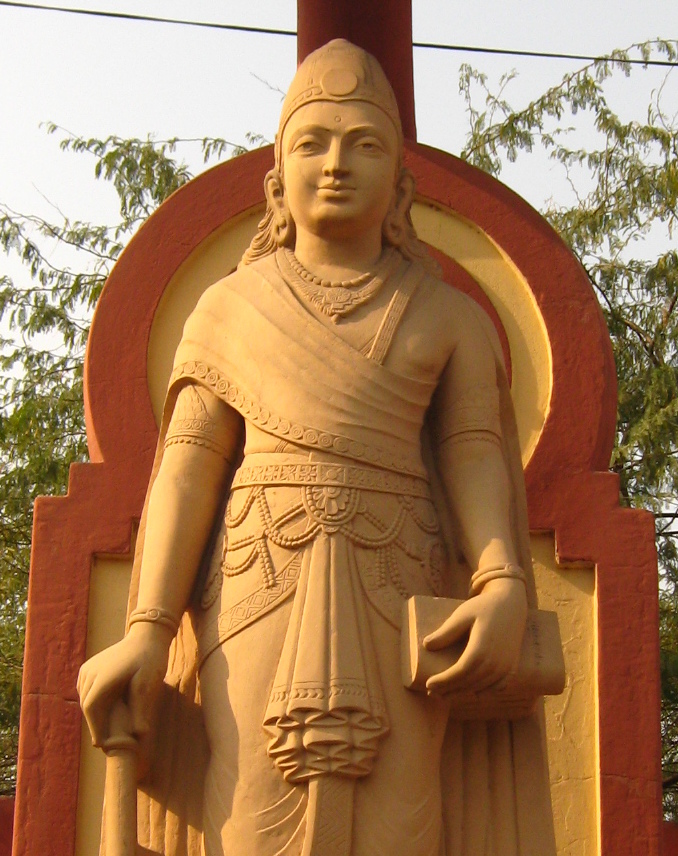
Chandragupta Maurya
340 BC – 297 BC
- Born
- 340 BC
- Died
- 297 BC
- House
- Mauryan Empire
Biography
Chandragupta Maurya established the first empire to unite most of the Indian subcontinent, founding the Mauryan dynasty around 321 BC. The sources for his life are fragmentary and often late: Greek and Roman writers, who call him Sandrokottos, record his dealings with the successors of Alexander the Great; Indian evidence comes from the Puranas, Buddhist chronicles, Jain tradition, and the political treatise Arthashastra attributed to his minister Kautilya. These accounts disagree on basic points, including his family origins, and almost nothing reliable is known of his early life. He is conventionally dated from about 340 to 297 BC.
According to a tradition common to several sources, Chandragupta overthrew the Nanda dynasty of Magadha, in eastern India, with the guidance of the Brahmin adviser Kautilya, also called Chanakya, and took the Nanda capital of Pataliputra as his own. In the northwest he profited from the power vacuum left by Alexander's withdrawal and death, bringing the Punjab and the Indus lands under his control. His empire eventually extended across northern India from Bengal to the borders of Persia, with claims of influence reaching into the Deccan.
The best-attested episode of his reign is his encounter with Seleucus I Nicator, Alexander's former general, who attempted around 305 BC to reassert Greek control over the Indus region. The conflict ended in a treaty under which Seleucus ceded extensive territories in what are now Afghanistan and Baluchistan in exchange for five hundred war elephants, with some form of marriage agreement between the two houses. Seleucus also sent an ambassador, Megasthenes, to the Mauryan court; his account of India, the Indica, survives only in quotations by later authors but shaped Greek knowledge of the subcontinent for centuries.
Jain tradition holds that Chandragupta abdicated late in life, became a disciple of the monk Bhadrabahu, and traveled south to Shravanabelagola in present-day Karnataka, where he ended his life by sallekhana, the Jain practice of ritual fasting unto death. The story cannot be independently verified, but the site retains monuments associated with his memory. He was succeeded by his son Bindusara, who maintained the empire and passed it to Chandragupta's grandson Ashoka, under whom Mauryan power reached its greatest extent.
Updated June 2026 · How we research
Connections across houses
Place Chandragupta Maurya in the wider world of ruling houses.
Recommended Reading
Affiliate disclosure: the links below go to Amazon searches. As an Amazon Associate, Dynastica earns from qualifying purchases.