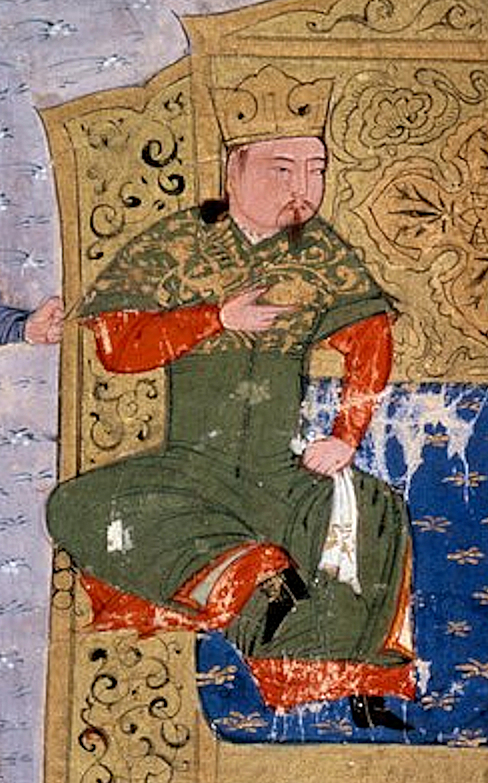
Hulagu Khan
Хүлэгү хаан
Khan of the Ilkhanate · Ilkhan of Persia
1218 – 1265
- Born
- 1218
- Died
- 1265
- House
- Mongol Empire
Biography
Hulagu Khan (1218-1265) founded the Ilkhanate, the Mongol state that governed Persia and much of the Middle East for nearly a century. A son of Tolui and the Kereit princess Sorghaghtani Beki, he belonged to the Toluid branch of Genghis Khan's family, the line that also produced the great khans Möngke and Kublai. When Möngke assumed the imperial throne in 1251, he entrusted Hulagu with the conquest of southwestern Asia, one of two great campaigns the new khan launched alongside Kublai's operations in China.
Hulagu's army moved west in the mid-1250s. In 1256 he reduced the mountain fortresses of the Nizari Ismailis, including Alamut, ending the power of the sect known in the West as the Assassins. Two years later his forces took Baghdad, killed the caliph al-Musta'sim, and brought the Abbasid caliphate to an end, an event long remembered as a turning point in Islamic history. His armies then entered Syria, capturing Aleppo and Damascus, but the advance halted in 1260 when a detachment under his general Kitbuqa was defeated by the Mamluks of Egypt at Ain Jalut. Hulagu himself had already withdrawn most of his troops eastward on receiving news of Möngke's death.
That death fractured the unity of the empire. In the succession struggle between his brothers Kublai and Ariq Böke, Hulagu backed Kublai, and his own realm hardened into a separate state. Relations with his cousin Berke, the Muslim ruler of the Golden Horde, collapsed into open war in 1262 over the Caucasus borderlands and, by some accounts, over the destruction of Baghdad. The conflict marked the first major war between branches of Genghis Khan's line, setting the Jochid rulers of the steppe against the Toluid masters of Persia.
Hulagu maintained a court of considerable religious diversity. His chief wife, Doquz Khatun, was a Nestorian Christian who interceded for Christian populations during the campaigns, while Buddhist and Muslim figures also held influence. He sponsored the scholar Nasir al-Din Tusi and the construction of the observatory at Maragheh. Hulagu died in 1265 and was succeeded by his son Abaqa; his descendants ruled the Ilkhanate until its disintegration in the 1330s, remaining in intermittent rivalry with their Golden Horde cousins and in nominal alliance with the Yuan emperors descended from Kublai.
Updated June 2026 · How we research
Events
After a twelve-day siege, the Mongol army of Hulagu Khan stormed Baghdad on 10 February 1258. They sacked the city for a week, butchering perhaps two hundred thousand inhabitants and throwing the books of the great libraries into the Tigris until, the chronicles say, the river ran black with ink. The last Abbasid caliph, al-Musta'sim, was rolled in a carpet and trampled to death by horses, ending the caliphate that had ruled the Islamic east for half a millennium.
The campaign that ended at Ain Jalut began with the westward offensive of Hulagu Khan, brother of the great khan Möngke, who had been charged with subduing the Islamic lands. In 1258 his army sacked Baghdad and put the last reigning Abbasid caliph, al-Musta'sim, to death, extinguishing a caliphate that had stood for five centuries. In early 1260 the Mongols took Aleppo by storm and received the surrender of Damascus. The Ayyubid ruler of Syria, an-Nasir Yusuf, abandoned his capital without a battle, fled south, and was captured; he was later killed in Mongol custody. Ayyubid Syria had ceased to exist as a power. Hulagu then withdrew the bulk of his army eastward, a movement usually connected to the death of Möngke in 1259 and the succession struggle that followed, though logistical limits on pasturing a large cavalry army in Syria may have weighed as heavily. He left a force of perhaps ten to twenty thousand under the Naiman commander Kitbuqa and sent envoys to Cairo demanding submission. The Mamluk sultan Qutuz executed the envoys and marched into Palestine, joined by the émigré commander Baybars. The armies met on 3 September 1260 at Ain Jalut, the "Spring of Goliath," in the Jezreel Valley of Galilee. The Mamluks, fielding numbers at least equal to the Mongol force, drew Kitbuqa's troops forward with a feigned retreat and enveloped them; Kitbuqa was captured and executed. The defeat was modest in scale but large in consequence: it was the first major battlefield reverse of the Mongol westward expansion not soon avenged, it fixed the Euphrates as the rough frontier between the Mamluk sultanate and Hulagu's Ilkhanate, and it delivered Muslim Syria to the Mamluks. Qutuz was assassinated on the homeward march, and Baybars took the throne.
Also there: An-Nasir Yusuf
Connections across houses
Place Hulagu Khan in the wider world of ruling houses.
Recommended Reading
Affiliate disclosure: the links below go to Amazon searches. As an Amazon Associate, Dynastica earns from qualifying purchases.