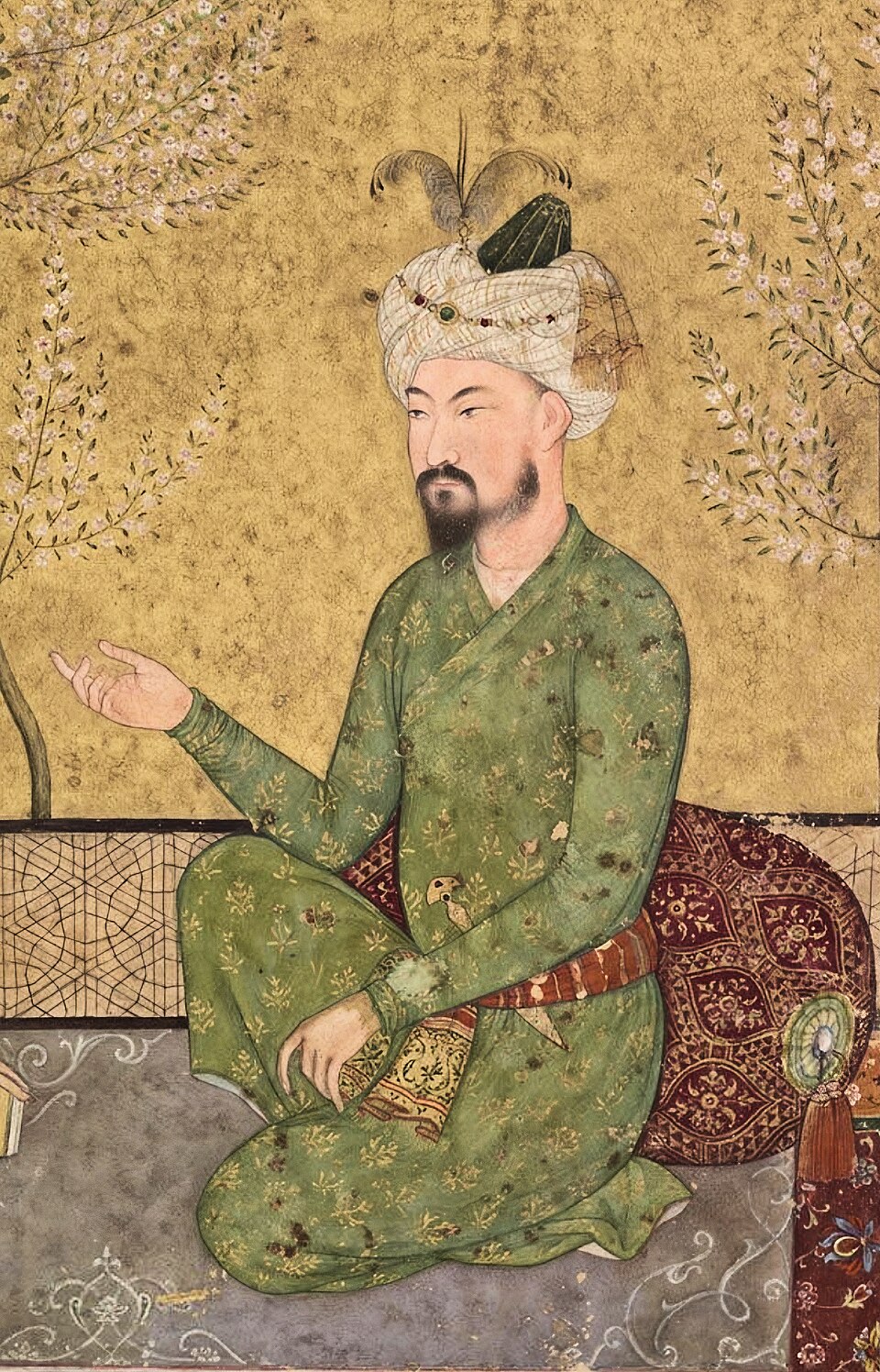
Babur
Padishah
1483 – 1530
- Born
- 1483
- Died
- 1530
- House
- Mughal Empire
Biography
Zahir al-Din Muhammad Babur founded the Mughal Empire, which his descendants ruled in India for more than three centuries. Born in 1483 in the Fergana Valley in Central Asia, he was descended from Timur on his father's side and from Genghis Khan through his mother. He inherited the small principality of Fergana in 1494, at the age of eleven, on the death of his father, Umar Shaikh Mirza, and spent his youth in the unstable politics of post-Timurid Transoxiana. He captured Samarkand, Timur's old capital, more than once, but could not hold it against the rising Uzbek power of Muhammad Shaybani Khan, and by 1504 he had lost his ancestral lands.
In that year Babur seized Kabul, which became his base for the next two decades. From Afghanistan he turned his ambitions toward northern India, then ruled by the Lodi sultans of Delhi. After several preliminary raids, he met Sultan Ibrahim Lodi at Panipat in April 1526. Though heavily outnumbered, Babur's army made effective use of field fortifications, matchlock firearms, and cavalry tactics, and Ibrahim was killed on the field. Babur occupied Delhi and Agra and declared himself emperor.
The victory at Panipat did not by itself secure northern India. In 1527 Babur defeated a large Rajput confederacy under Rana Sanga of Mewar at Khanwa, and subsequent campaigns extended his authority across the Gangetic plain as far as Bengal's borders. He died at Agra in 1530, before the new state had been fully consolidated, and was succeeded by his son Humayun; his remains were later interred in a garden tomb in Kabul, in accordance with his wishes. His grandson Akbar would transform the conquests into a durable empire.
Babur is remembered as a writer as well as a conqueror. His autobiography, the Baburnama, composed in Chagatai Turkish, is a candid and detailed account of his campaigns, his observations of the lands and peoples he encountered, and his personal tastes, from gardens to poetry. It is among the earliest substantial autobiographies in Islamic literature and remains a primary source for the history of Central Asia and India in his era.
Updated June 2026 · How we research
Connections across houses
Place Babur in the wider world of ruling houses.
Recommended Reading
Affiliate disclosure: the links below go to Amazon searches. As an Amazon Associate, Dynastica earns from qualifying purchases.