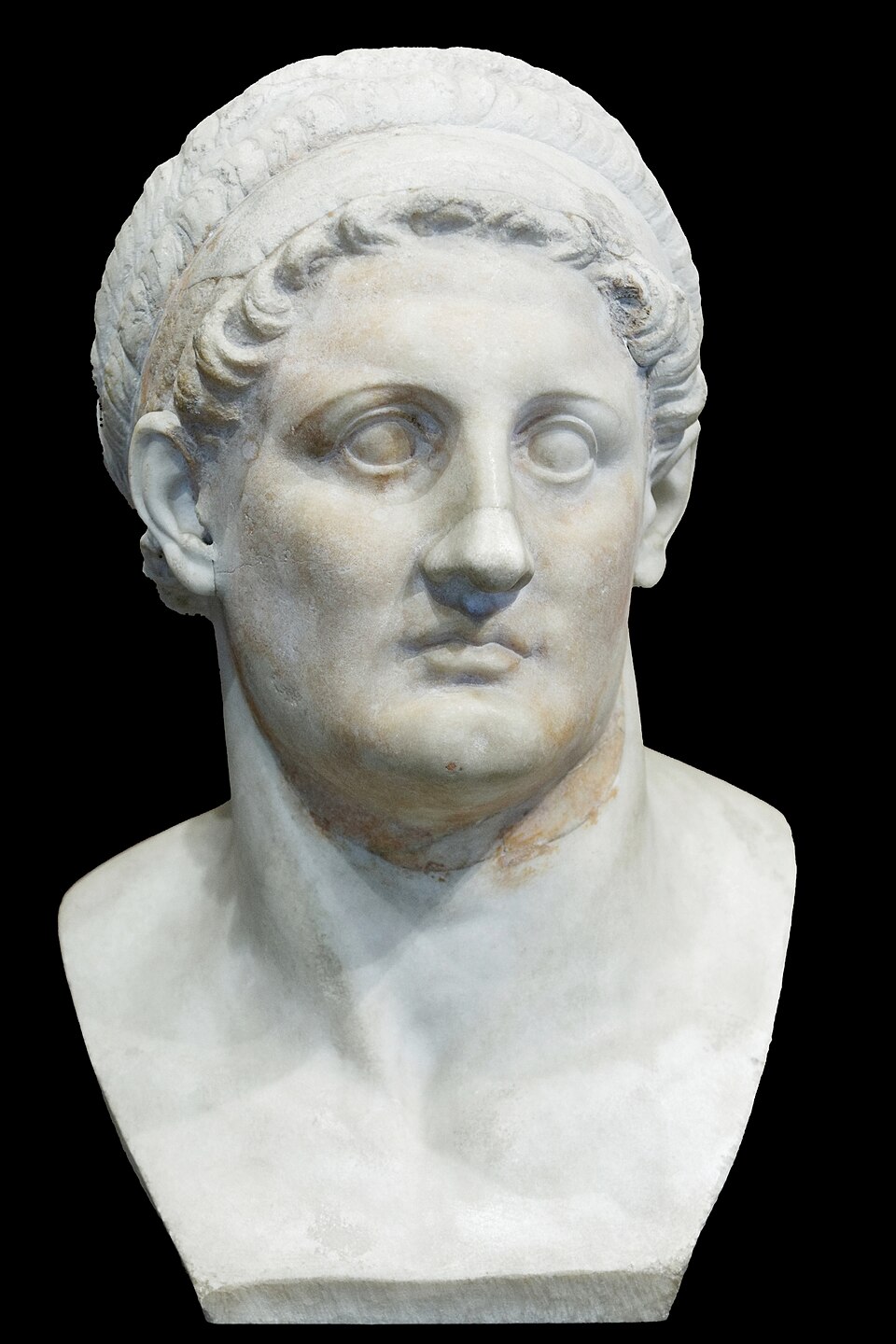
Ptolemy I Soter
Pharaoh of Egypt · Basileus
367 BC – 282 BC
- Born
- 367 BC
- Died
- 282 BC
- House
- Ptolemaic Dynasty
Biography
Among the Macedonian officers who divided Alexander the Great's empire after his death, Ptolemy son of Lagus proved one of the most durable and calculating. Born around 367 BC, he served Alexander throughout the campaigns in Asia, eventually ranking among the king's personal bodyguards, and later wrote a history of the conquests that became a principal source for the historian Arrian.
When Alexander died at Babylon in 323 BC, Ptolemy secured the satrapy of Egypt, a wealthy and easily defended province. He soon demonstrated his independence in dramatic fashion: as Alexander's funeral cortege travelled west, Ptolemy intercepted it and diverted the body to Egypt, where it was installed first at Memphis and later at Alexandria. Possession of the conqueror's remains lent his rule considerable prestige and provoked the regent Perdiccas to invade Egypt in 320 BC, an attack Ptolemy successfully repelled.
Through the long wars of Alexander's successors, Ptolemy held Egypt while contesting Cyprus, Cyrene, and Coele-Syria with his rivals. He suffered a naval defeat off Salamis in Cyprus in 306 BC, but in 305 or 304 BC he followed the other successors in assuming the royal title, formally founding the Ptolemaic dynasty. His aid to Rhodes during its siege by Demetrius earned him the epithet Soter, meaning saviour, by which he is conventionally known.
As king, Ptolemy made Alexandria his capital and laid the foundations of its intellectual life, initiating the scholarly institutions that grew into the Museum and the famous Library, reportedly with the guidance of Demetrius of Phalerum. He also promoted the cult of Serapis, a deity designed to appeal to both Greek and Egyptian subjects. His government combined Macedonian military rule with the existing pharaonic administration, a pattern his successors maintained.
Ptolemy married several times, including Eurydice, daughter of the regent Antipater, and Berenice I, mother of his eventual heir. In 285 BC he associated his son Ptolemy II Philadelphus with him on the throne, securing an orderly succession rare among the successor kingdoms, and died in 282 BC. The dynastic practice of brother-sister marriage that became characteristic of his house began in the next generation, with the union of Ptolemy II and Arsinoe II. His descendants ruled Egypt for nearly three centuries, until the death of Cleopatra VII in 30 BC.
Updated June 2026 · How we research
Connections across houses
Place Ptolemy I Soter in the wider world of ruling houses.
Recommended Reading
Affiliate disclosure: the links below go to Amazon searches. As an Amazon Associate, Dynastica earns from qualifying purchases.