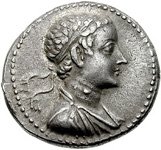
Ptolemy V Epiphanes
Pharaoh of Egypt
210 BC – 180 BC
- Born
- 210 BC
- Died
- 180 BC
- House
- Ptolemaic Dynasty
Biography
The most famous artefact of Hellenistic Egypt, the Rosetta Stone, preserves a priestly decree issued in honour of Ptolemy V Epiphanes, a king whose troubled reign belied the monument's celebratory language. Born around 210 BC to Ptolemy IV Philopator and Arsinoe III, he inherited the throne as a small child around 204 BC after the deaths of both parents, events surrounded by court intrigue. His minority was dominated by a succession of regents and ministers, beginning with the unpopular Agathocles, who was killed by an Alexandrian mob.
The kingdom's weakness invited attack. In the Fifth Syrian War, Antiochus III of the Seleucid empire seized Coele-Syria, the long-contested territory comprising much of the southern Levant, with his victory at Panium around 200 BC proving decisive. The loss ended a century of Ptolemaic control over the region. Peace was sealed by the young king's marriage to Cleopatra I, daughter of Antiochus III, the first of several Seleucid princesses to enter the Ptolemaic house.
At home, the dynasty faced a prolonged native revolt in Upper Egypt, where secessionist pharaohs ruled from Thebes for roughly two decades before the rebellion was finally suppressed in 186 BC. It was against this background of recovery that the priests assembled at Memphis in 196 BC, following the king's coronation there, and issued the decree recording his benefactions to the temples. Inscribed in hieroglyphic, demotic, and Greek, the Memphis decree survives on the Rosetta Stone, which in the nineteenth century supplied the key to deciphering Egyptian hieroglyphs.
Once of age, Ptolemy V ruled in his own name but never recovered the dynasty's lost foreign possessions. He died in 180 BC, aged about thirty, with ancient sources suggesting poisoning by courtiers, though the circumstances remain uncertain. His widow Cleopatra I governed as regent for their young son Ptolemy VI Philometor, and the couple's children continued the dynastic line, including through the sibling marriage of Ptolemy VI and Cleopatra II that had become customary in the family. His reign is generally regarded as the point at which Ptolemaic Egypt ceased to be a great power and began its long dependence on diplomacy, and eventually on Rome, for survival.
Updated June 2026 · How we research
Connections across houses
Place Ptolemy V Epiphanes in the wider world of ruling houses.
Recommended Reading
Affiliate disclosure: the links below go to Amazon searches. As an Amazon Associate, Dynastica earns from qualifying purchases.