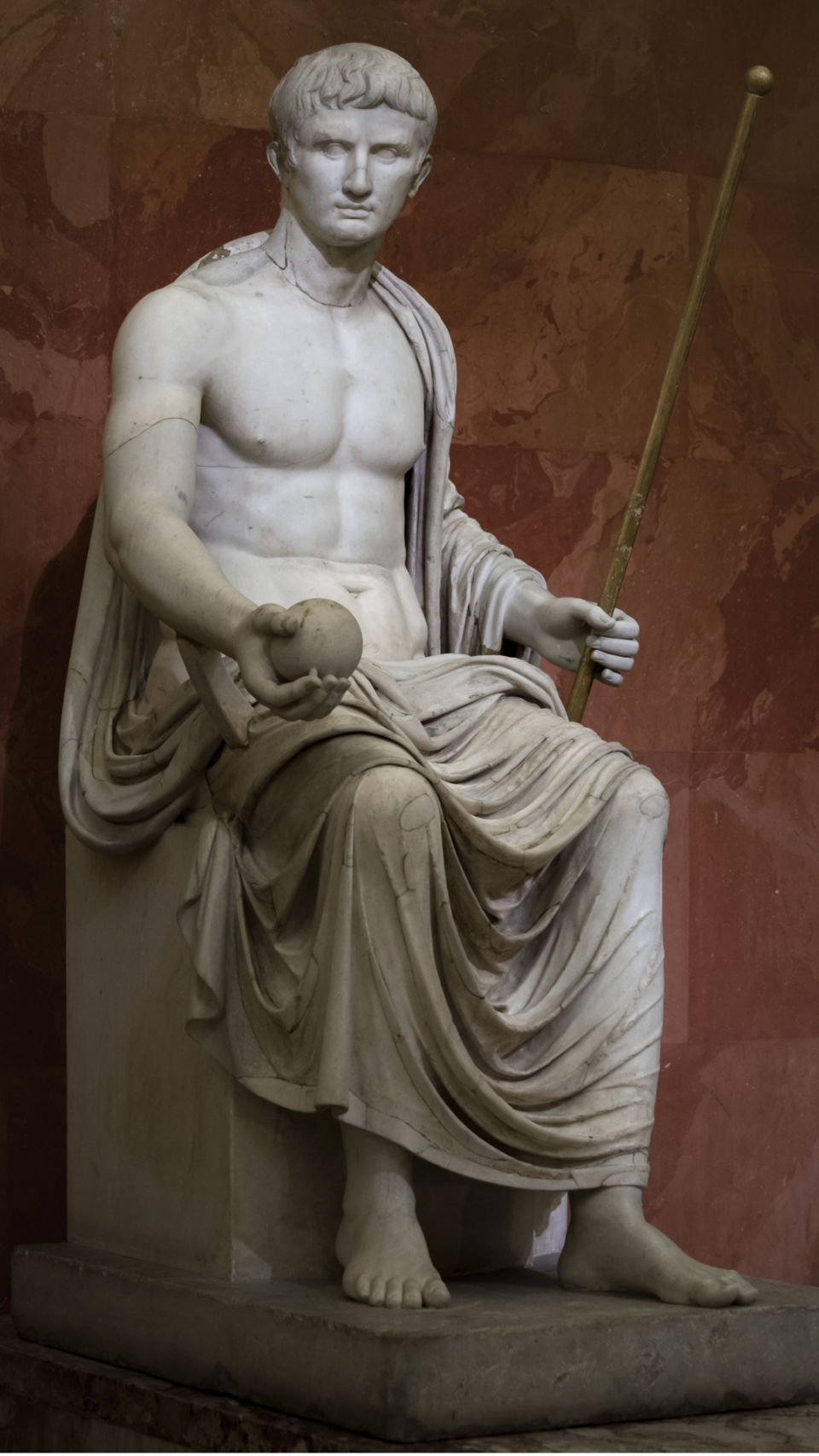
Augustus
Imperator Caesar Divi Filius Augustus
Princeps · Imperator · Pater Patriae · Pontifex Maximus
63 BC – 14
- Born
- 63 BC
- Died
- 14
- Reign
- 27 BC – 14
- House
- Roman Empire
Biography
The first Roman emperor, Augustus was born Gaius Octavius in 63 BC into a wealthy equestrian family of Velitrae. His great-uncle Julius Caesar adopted him posthumously by testament in 44 BC, making the eighteen-year-old, thereafter known as Octavian, heir to Caesar's name and political following. This adoption, the founding link of the Julio-Claudian dynasty, drew the Octavii into the patrician Julii and set the pattern by which the dynasty would repeatedly transmit power through adoption rather than direct descent.
In 43 BC Octavian formed the Second Triumvirate with Mark Antony and Lepidus, and the following year their forces defeated Caesar's assassins Brutus and Cassius at Philippi. The triumviral alliance gradually broke down, and the rivalry with Antony, who had allied himself with Cleopatra VII of Egypt, ended at the naval battle of Actium in 31 BC. Egypt was annexed in 30 BC, leaving Octavian in sole control of the Roman world.
In the settlement of 27 BC he formally returned power to the Senate while retaining command of the key provinces and armies, receiving the honorific Augustus. Behind a facade of restored republican forms he concentrated authority in his own hands, holding tribunician power and supreme command for the rest of his life. His long reign brought administrative reorganization of the provinces, a professional standing army, the creation of the Praetorian Guard, an extensive building program in Rome, and the long internal peace later called the Pax Romana. Poets including Virgil and Horace worked under the patronage of his associate Maecenas.
Augustus married three times, lastly to Livia Drusilla, who remained his wife for over half a century but bore him no children. His only child, Julia, came from his marriage to Scribonia. His search for a successor was repeatedly frustrated by deaths: his nephew Marcellus, his lieutenant and son-in-law Agrippa, and his grandsons Gaius and Lucius Caesar all predeceased him. In AD 4 he adopted Livia's son Tiberius, a Claudian by birth, joining the Julian and Claudian houses in the line that gave the dynasty its name. Augustus died at Nola in AD 14, aged seventy-five, and was deified by the Senate. Tiberius succeeded him without serious opposition, confirming that the monarchical system Augustus had constructed would outlast its founder.
Updated June 2026 · How we research
Events
On 16 January 27 BC the Senate confirmed Octavian's settlement of the previous month, granting him the title Augustus and conferring extraordinary powers while maintaining the formal continuity of the Republic. The arrangement created the role of princeps — first citizen — and gave Rome its first emperor in all but name. The Principate as Augustus designed it lasted three centuries.
Connections across houses
Place Augustus in the wider world of ruling houses.
Recommended Reading
Affiliate disclosure: the links below go to Amazon searches. As an Amazon Associate, Dynastica earns from qualifying purchases.