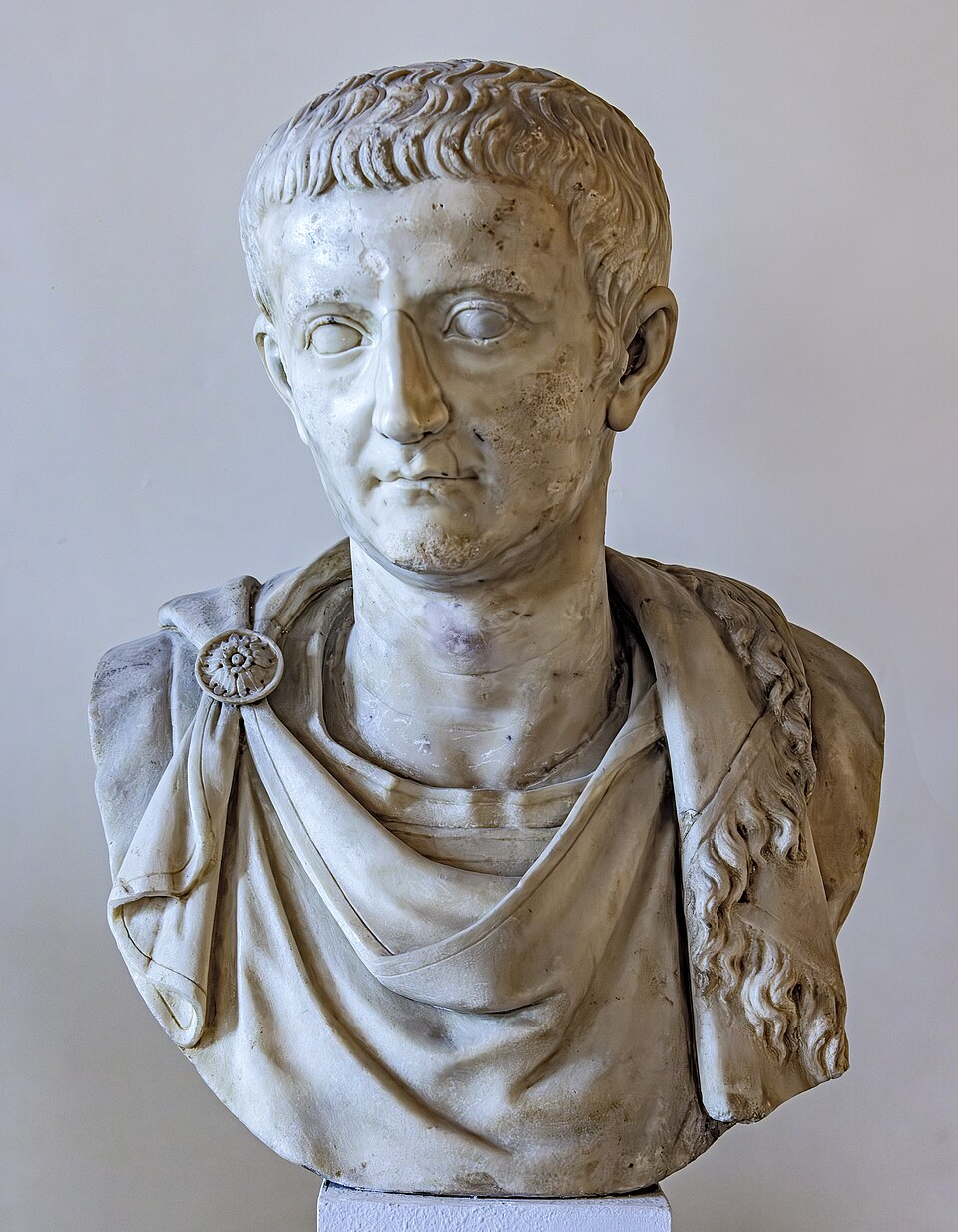
Tiberius
Tiberius Caesar Augustus
Imperator · Princeps
42 BC – 37
- Born
- 42 BC
- Died
- 37
- Reign
- 14 – 37
- House
- Roman Empire
Biography
Tiberius, the second Roman emperor, belonged by birth to the patrician Claudian family and entered the Julian line only through adoption. His father, Tiberius Claudius Nero, had fought against Octavian in the civil wars; his mother, Livia Drusilla, divorced his father and married Octavian in 38 BC, bringing the infant Tiberius into the household of the future Augustus. That marriage was the seam joining the Julian and Claudian houses, and Tiberius's career was shaped by his position within it.
Under Augustus he proved an effective commander, campaigning in Armenia, the Alps, Pannonia and Germany, and later suppressing the great Illyrian revolt of AD 6-9. His personal life was subordinated to dynastic policy: compelled to divorce Vipsania Agrippina, to whom he was attached, he married Augustus's daughter Julia in 11 BC. The marriage failed, and in 6 BC he withdrew to Rhodes for several years. After the deaths of Augustus's grandsons Gaius and Lucius, Augustus adopted Tiberius in AD 4, requiring him in turn to adopt his nephew Germanicus, thereby keeping the bloodline of the Julian house in the succession.
Acceding in AD 14 at the age of fifty-five, Tiberius governed with administrative caution, avoiding new wars of conquest, husbanding the treasury and largely respecting the framework Augustus had built. His reign darkened in its second half. Treason trials under the law of maiestas multiplied, and the praetorian prefect Sejanus accumulated extraordinary power before his sudden fall and execution in 31. From 26 Tiberius lived away from Rome, settling on Capri and governing through correspondence.
The principal narrative sources, Tacitus and Suetonius, wrote under later dynasties and are openly hostile; the scandalous stories they attach to the Capri years cannot be verified and are best treated as polemic rather than record. What is secure is that his absence strained relations with the Senate and left the capital under prefects' control. Tiberius died at Misenum in March AD 37. He was succeeded by Caligula, Germanicus's son and thus his grandson by adoption, continuing the interleaved Julio-Claudian succession that adoption and marriage had created.
Updated June 2026 · How we research
Connections across houses
Place Tiberius in the wider world of ruling houses.
Recommended Reading
Affiliate disclosure: the links below go to Amazon searches. As an Amazon Associate, Dynastica earns from qualifying purchases.