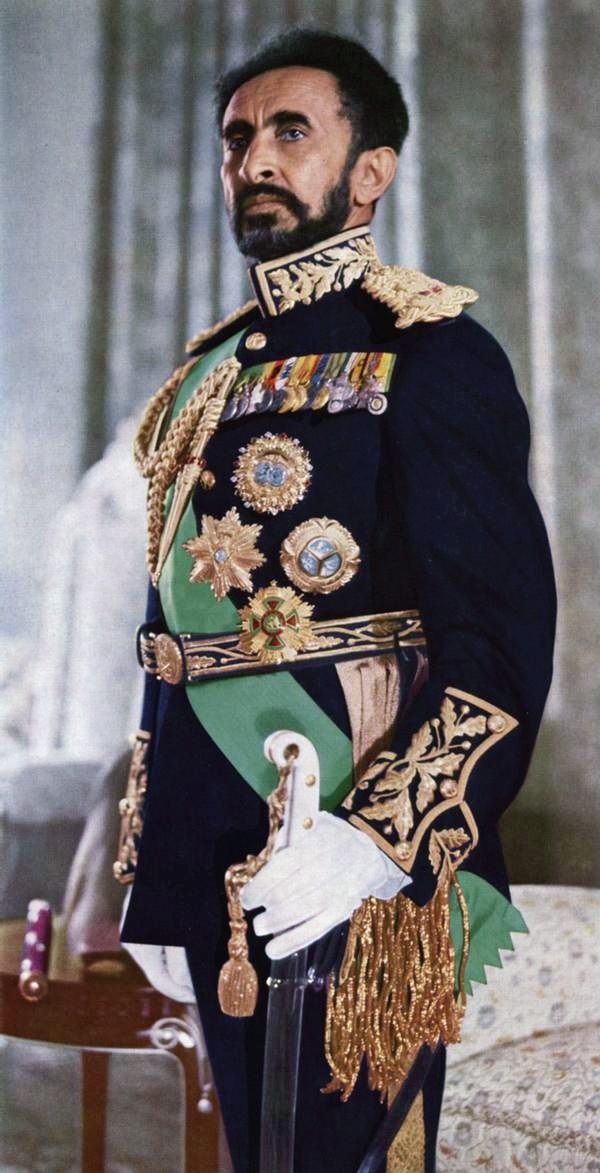
Haile Selassie I
King of Kings · Elect of God
1892 – 1975
- Born
- 1892
- Died
- 1975
- House
- Solomonic Dynasty
Biography
Ras Tafari Makonnen, crowned in 1930 as Haile Selassie I, was the last reigning monarch of Ethiopia's Solomonic dynasty, which traced its legitimacy to Yekuno Amlak's thirteenth-century restoration and, in tradition, to Solomon and Sheba. Born in 1892 near Harar, the son of Ras Makonnen, a cousin and leading general of Emperor Menelik II, he rose through provincial governorships to become regent and heir apparent in 1916 under Empress Zewditu, exercising effective control of foreign policy. He brought Ethiopia into the League of Nations in 1923 and toured Europe the following year, cultivating an image as a modernizer.
On Zewditu's death in 1930 he took the throne and the regnal name Haile Selassie ("Power of the Trinity"). The constitution he promulgated in 1931, Ethiopia's first, concentrated authority in the crown while creating a parliament of limited powers. His early reign was dominated by the Italian invasion launched by Mussolini in October 1935. After the Ethiopian armies were defeated, with extensive Italian use of poison gas, he went into exile and in June 1936 addressed the League of Nations in Geneva, protesting the failure of collective security in a speech that brought him international attention but no effective aid. He spent the occupation years principally in Bath, England, and returned in 1941 when British and Commonwealth forces, alongside Ethiopian patriot fighters, expelled the Italians.
The postwar decades saw cautious reform — a revised constitution in 1955, expansion of education — alongside an essentially autocratic system. Haile Selassie federated and then annexed Eritrea, a decision that fed a long insurgency, and survived an attempted coup by his Imperial Guard in 1960. Abroad his standing was considerable: he championed African decolonization, and Addis Ababa became the seat of the Organisation of African Unity at its founding in 1963. In Jamaica, the Rastafari movement venerated him as divine, an attribution he did not encourage.
Famine in Wollo, inflation, and military discontent eroded his authority in the early 1970s. In September 1974 the Derg, a committee of junior officers, deposed him, abolishing the monarchy the following year. He died in custody in August 1975; the new government announced natural causes, but evidence later pointed to killing, and his remains, found beneath the palace grounds, were reburied in Addis Ababa's Trinity Cathedral in 2000.
Updated June 2026 · How we research
Connections across houses
Place Haile Selassie I in the wider world of ruling houses.
Recommended Reading
Affiliate disclosure: the links below go to Amazon searches. As an Amazon Associate, Dynastica earns from qualifying purchases.