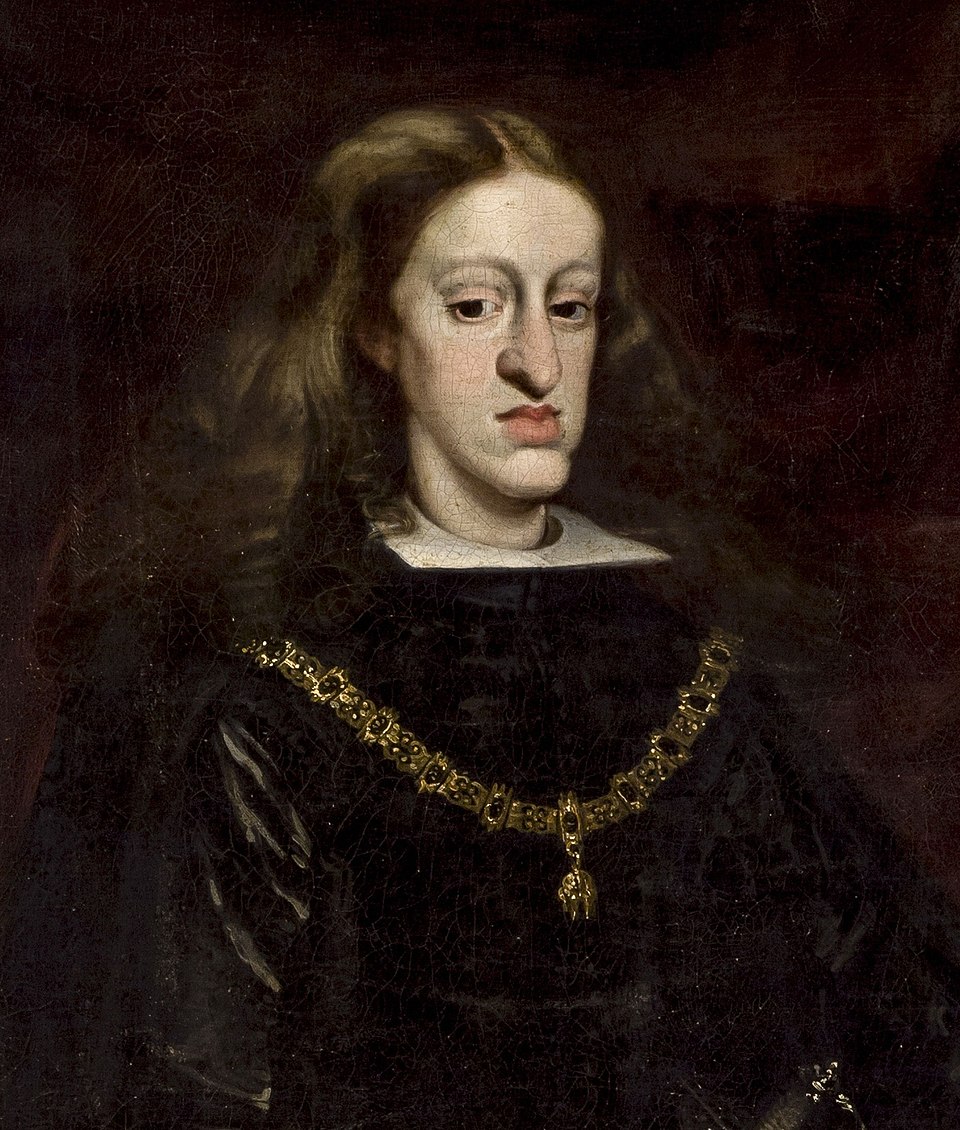
Charles II of Spain
King of Spain
1661 – 1700
- Born
- 1661
- Died
- 1700
- House
- Spanish Habsburgs
Biography
With Charles II (1661-1700) the Spanish Habsburg line ended, and the question of his succession convulsed Europe. He was the only surviving son of Philip IV and Mariana of Austria, a marriage of uncle and niece that capped generations of unions between the Spanish and Austrian branches of the dynasty; his pedigree contained far fewer distinct ancestors than normal, and historians have long connected this accumulated consanguinity with his lifelong ill health. Sickly from birth, slow to walk and speak, and marked by the pronounced Habsburg jaw, he was called El Hechizado, "the Bewitched," by contemporaries who sought supernatural explanations for his condition.
Charles became king at three on his father's death in 1665, under the regency of his mother. Government in his name was contested among court factions: Mariana's confidants, the Jesuit Nithard and then Fernando de Valenzuela, were each overthrown, and in 1677 the king's illegitimate half-brother Don Juan José of Austria seized power until his death in 1679. Abroad, France under Louis XIV stripped territory from the Spanish Netherlands and Franche-Comté in successive wars; the reign's later decades nonetheless saw a measure of monetary stabilization and economic recovery in parts of the peninsula.
The king married twice, first in 1679 Marie Louise d'Orléans, niece of Louis XIV, who died in 1689, and then Maria Anna of Neuburg, sister-in-law of Emperor Leopold I. Both marriages were childless, and the succession became the central problem of European diplomacy. The principal claimants derived their rights from Charles's sisters and aunts: the Bourbon candidates through Maria Theresa, wife of Louis XIV, and the Austrian candidates through Margarita Teresa, wife of Leopold I. The maritime powers negotiated partition treaties over Spanish heads, which Madrid resented as a dismemberment of the monarchy.
Shortly before his death Charles signed a will leaving the entire inheritance to Philip of Anjou, Louis XIV's grandson, in the hope of keeping it intact. He died in Madrid on 1 November 1700, a few days before his thirty-ninth birthday. Philip's accession as Philip V brought the Bourbons to Spain and provoked the War of the Spanish Succession (1701-1714), in which the Austrian Habsburgs, fighting for their own candidate, retained the dynasty's claims but not the Spanish crown.
Updated June 2026 · How we research
Connections across houses
Place Charles II of Spain in the wider world of ruling houses.
Recommended Reading
Affiliate disclosure: the links below go to Amazon searches. As an Amazon Associate, Dynastica earns from qualifying purchases.