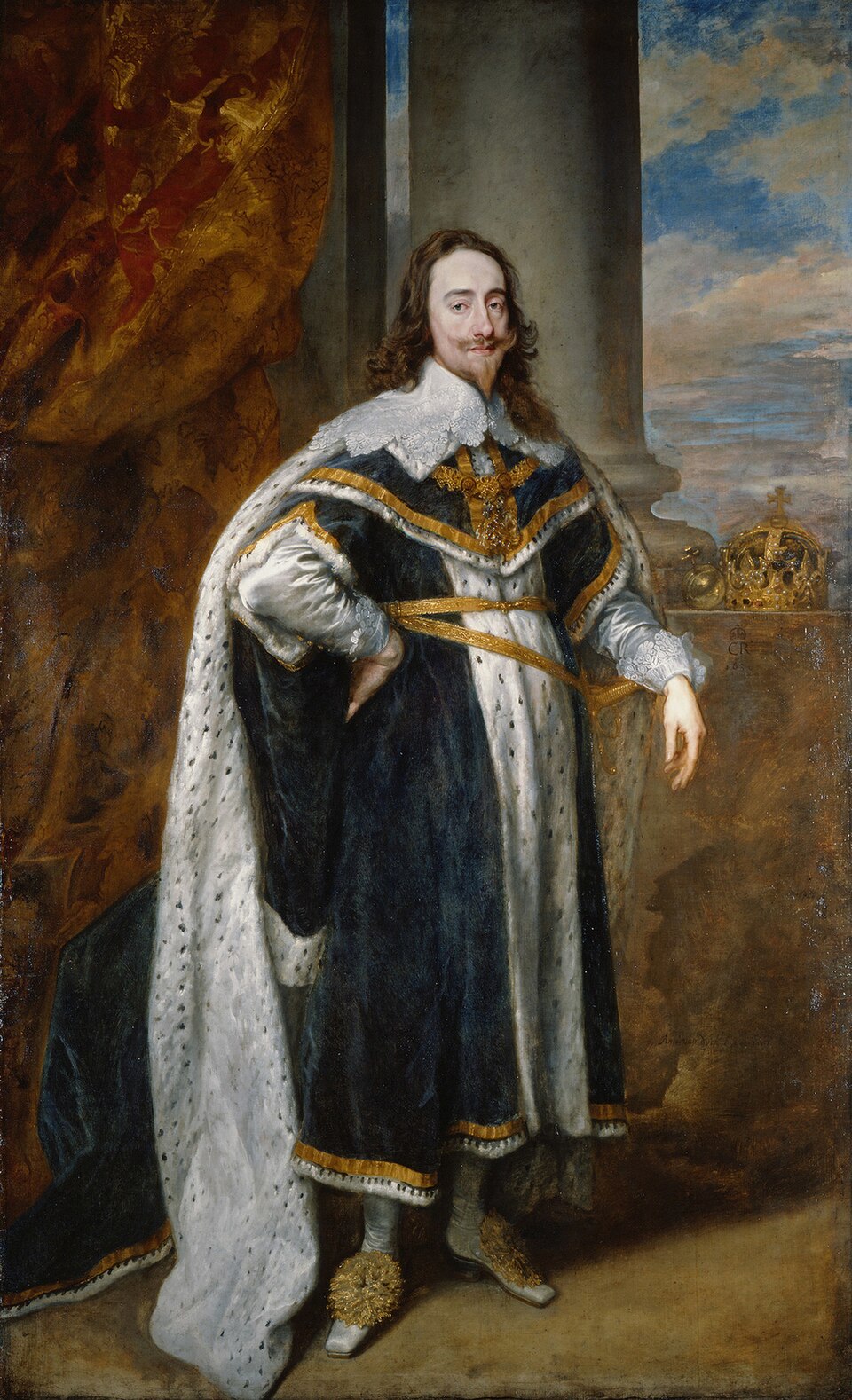
Charles I
Carolus I
King of England · King of Scotland · King of Ireland
1600 – 1649
- Born
- 1600
- Died
- 1649
- Reign
- 1625 – 1649
- House
- Stuart
Biography
Charles I was the second son of James VI of Scotland and Anne of Denmark, born at Dunfermline in November 1600, three years before his father's accession to the English throne. A frail child, he became heir apparent only on the death of his elder brother Henry in 1612. Shortly after his accession in March 1625 he married Henrietta Maria of France, daughter of Henry IV of the House of Bourbon and sister of Louis XIII; her Catholicism was a persistent source of suspicion among his Protestant subjects.
The new king's early parliaments clashed with him over taxation, religion, and the influence of his favourite, the Duke of Buckingham, who was assassinated in 1628. After accepting the Petition of Right, Charles dissolved Parliament in 1629 and governed for eleven years without one, raising revenue through expedients such as ship money. His support for the ceremonial churchmanship of Archbishop William Laud, and the attempt to impose a new prayer book on Scotland, provoked the Bishops' Wars of 1639-40 and forced him to summon Parliament again.
Relations with the Long Parliament collapsed over control of the army and the limits of royal prerogative, and after his failed attempt to arrest five members of the Commons in January 1642, both sides armed. Civil war began that August. Royalist forces were eventually broken at Naseby in 1645, and Charles surrendered to the Scots in 1646. Even in defeat he negotiated with multiple parties at once, and his secret engagement with the Scots triggered a second civil war in 1648.
The army's leaders concluded that no settlement with the king was possible. Tried by a specially constituted High Court of Justice on a charge of treason against his people, Charles refused to recognize its jurisdiction and was beheaded at Whitehall on 30 January 1649. The monarchy was abolished in England until 1660, when his eldest son returned as Charles II. Through his daughter Mary, who married William II of Orange, Charles was also grandfather of the future William III.
Updated June 2026 · How we research
Events
On 30 January 1649, Charles I was beheaded on a scaffold erected outside the Banqueting House in Whitehall — the only English king ever publicly executed by his own subjects. Defeated in two civil wars, refused parliamentary compromise, and convicted of high treason by a tribunal of fifty-nine commissioners (the Rump Parliament had voted away the House of Lords specifically to bring him to trial), he wore two shirts to avoid shivering on the cold morning lest the crowd mistake it for fear.
Connections across houses
Place Charles I in the wider world of ruling houses.
Recommended Reading
Affiliate disclosure: the links below go to Amazon searches. As an Amazon Associate, Dynastica earns from qualifying purchases.