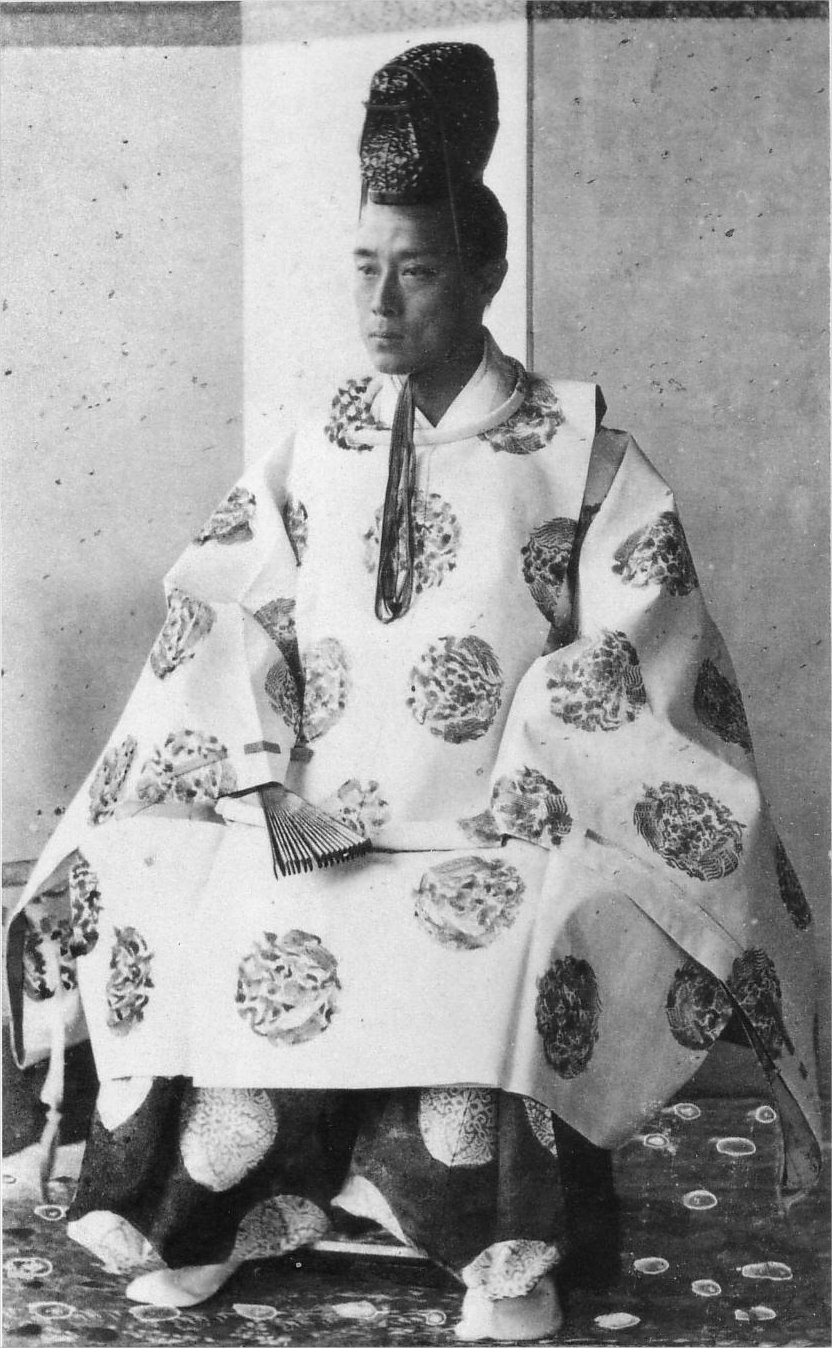
Tokugawa Yoshinobu
1837 – 1913
- Born
- 1837
- Died
- 1913
- House
- Tokugawa Shogunate
Biography
The fifteenth and last of the Tokugawa shoguns, Yoshinobu held the office for barely a year before surrendering it, ending nearly seven centuries of warrior government in Japan. He was born in 1837, a son of Tokugawa Nariaki, lord of the Mito domain, one of the three senior branches of the Tokugawa house. As a young man he was adopted into the Hitotsubashi family, another Tokugawa branch line, and under the name Hitotsubashi Keiki he was put forward as a candidate for shogun in the disputed succession of 1858. His faction lost, and he spent a period in enforced retirement during the purges that followed.
Yoshinobu returned to prominence in the turbulent 1860s, when the shogunate faced foreign pressure following the opening of the treaty ports and rising hostility from the powerful domains of Satsuma and Choshu. He served as guardian to the young shogun Iemochi and as an intermediary between the shogunate and the imperial court in Kyoto. On Iemochi's death he accepted the office of shogun in 1866, reportedly with reluctance, and pursued an energetic program of military and administrative reform with French assistance.
The reforms came too late to restore the shogunate's position. In November 1867, facing the prospect of armed confrontation with a Satsuma-Choshu alliance acting in the emperor's name, Yoshinobu formally returned governing authority to the imperial court, an act known as the Taisei Hokan. He appears to have expected to retain a leading role in a new collegial government, but his opponents engineered a decree stripping him of his lands and offices. Fighting broke out in January 1868 at Toba-Fushimi near Kyoto, opening the Boshin War. After his forces were defeated, Yoshinobu withdrew to Edo and submitted, and the city was surrendered without a major battle.
He lived for another forty-five years in quiet retirement, first in Shizuoka and later in Tokyo, devoting himself to hobbies that included photography, hunting, and cycling. The Meiji government eventually rehabilitated him; he was received by the emperor and in 1902 was granted the rank of prince in the new peerage. Yoshinobu died in 1913, having outlived the world of the shogunate he had relinquished by nearly half a century.
Updated June 2026 · How we research
Connections across houses
Place Tokugawa Yoshinobu in the wider world of ruling houses.
Recommended Reading
Affiliate disclosure: the links below go to Amazon searches. As an Amazon Associate, Dynastica earns from qualifying purchases.