Abd al-Malik
Caliph
646 – 705
- Born
- 646
- Died
- 705
- House
- Umayyad Caliphate
Biography
The Umayyad caliphate that Abd al-Malik ibn Marwan inherited in 685 was close to disintegration; the one he left at his death in 705 was a centralized empire with a common administrative language and its own coinage. Born in Medina in 646 into the Umayyad clan of Quraysh, he was the son of Marwan ibn al-Hakam, who briefly held the caliphate in 684-85 after the Sufyanid line failed during the second civil war (fitna). Abd al-Malik succeeded his father with his authority contested across much of the Islamic world.
His first decade was spent reuniting that world by force. The rival caliph Abdallah ibn al-Zubayr, recognized in the Hijaz, Iraq, and elsewhere, was gradually isolated; Umayyad forces under al-Hajjaj ibn Yusuf besieged Mecca and killed Ibn al-Zubayr in 692, ending the civil war. Kharijite revolts in Iraq and Iran were suppressed in the following years, with al-Hajjaj, appointed governor of Iraq in 694, serving as the caliph's formidable instrument in the east. Warfare with Byzantium resumed after an early truce, and toward the end of the reign Umayyad armies retook Carthage and advanced across North Africa.
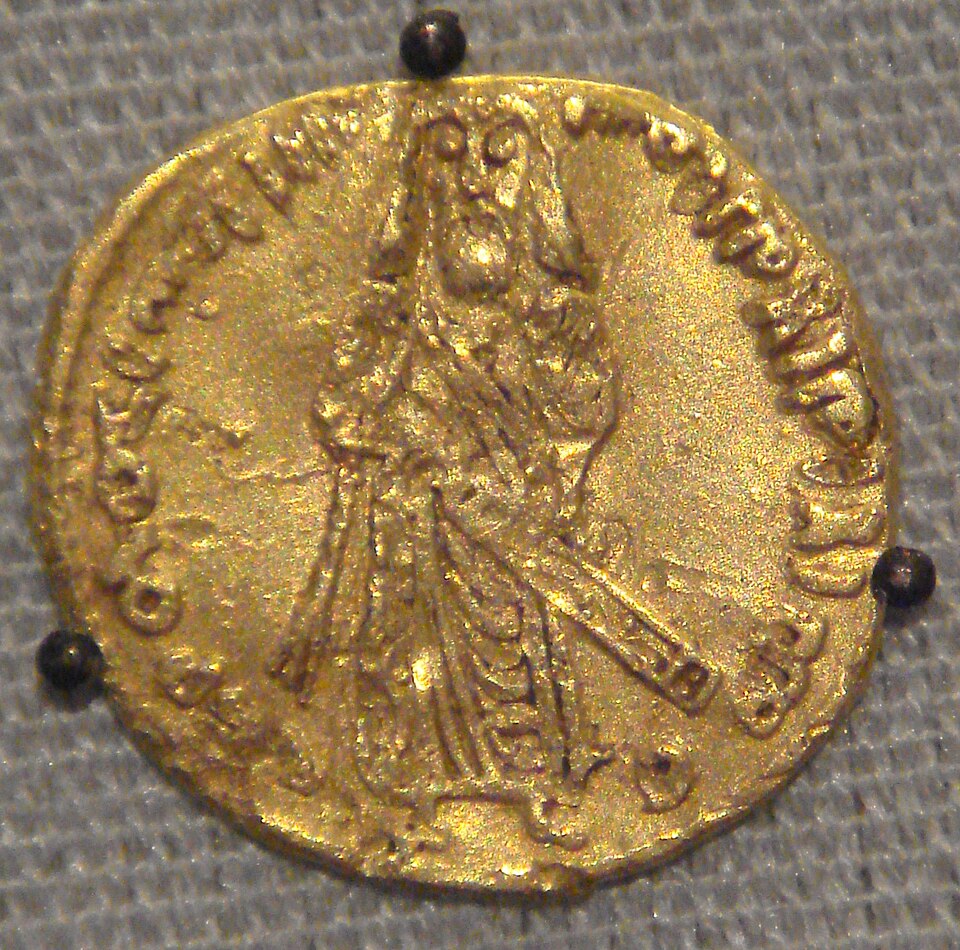
Abd al-Malik's administrative measures had the more lasting effect. He ordered the diwans, the government registers previously kept in Greek in Syria and Persian in Iraq, translated into Arabic, beginning the Arabization of the bureaucracy. From about 696-97 he replaced the adapted Byzantine and Sasanian coins then circulating with a new epigraphic gold dinar and silver dirham bearing Arabic religious inscriptions and no images, a reform that created a stable Islamic currency and announced the polity's distinct identity. A postal relay system and tightened provincial oversight extended the dynasty's reach.
In Jerusalem he built the Dome of the Rock, completed around 691-92 by its inscription, the earliest major monument of Islamic architecture; its mosaics and Quranic texts assert Islam's supersession in a city of Christian monuments, though scholars continue to debate the building's precise original purpose. Abd al-Malik died in 705 and was succeeded peacefully by his son al-Walid I; four of his sons eventually held the caliphate, and the Marwanid line he established ruled until the Abbasid revolution of 750 — after which a grandson of his, Abd al-Rahman, carried the dynasty's fortunes to Spain.
Updated June 2026 · How we research
Connections across houses
Place Abd al-Malik in the wider world of ruling houses.
Recommended Reading
Affiliate disclosure: the links below go to Amazon searches. As an Amazon Associate, Dynastica earns from qualifying purchases.