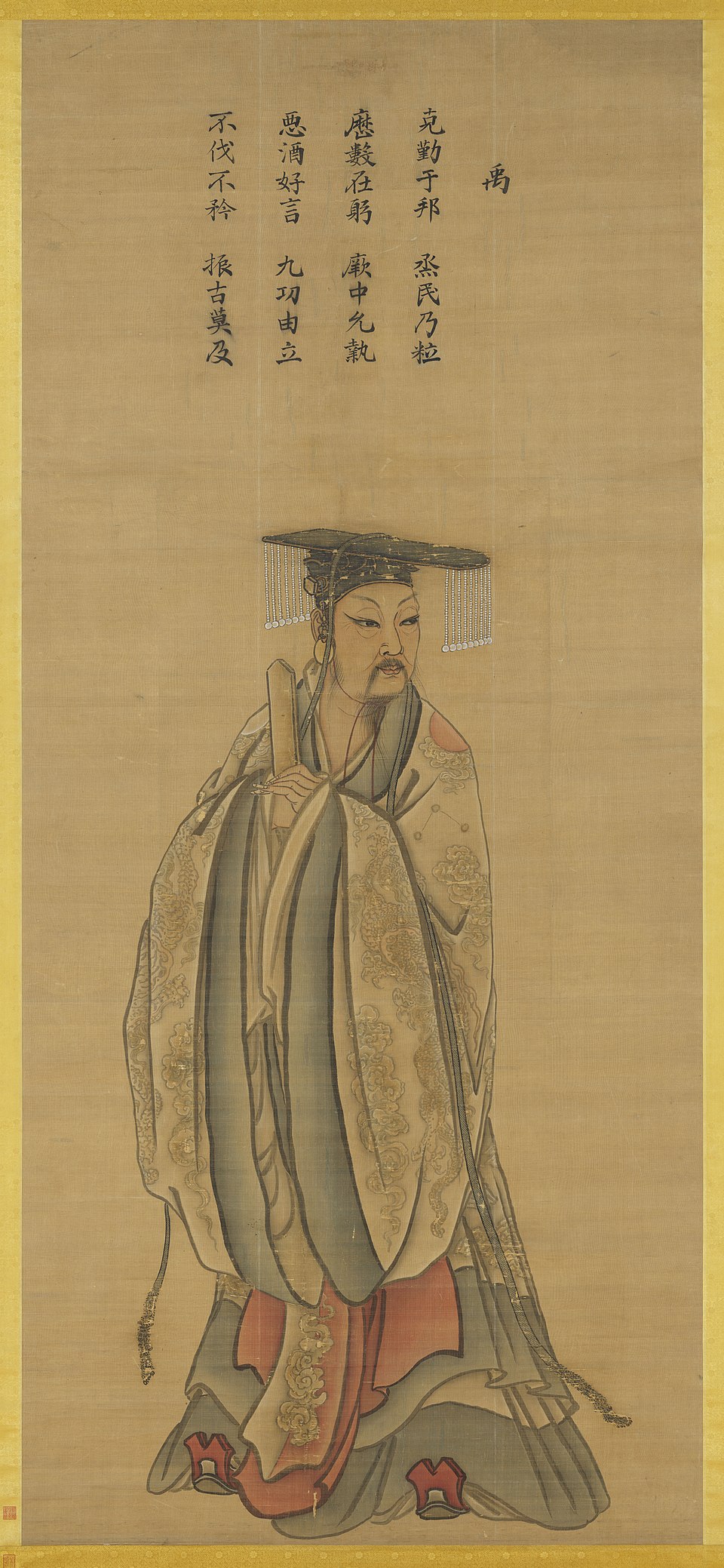
Yu the Great
- House
- Xia
Biography
In Chinese tradition, Yu the Great is the tamer of the primeval floods and the founder of the Xia, the first dynasty in the traditional sequence. Like Romulus in Roman tradition, he is a figure of legend whose deeds are recounted in texts written many centuries after the era to which they are assigned — conventionally the late third millennium BC — and his historicity cannot be verified. The earliest references to him appear in Western Zhou sources, including bronze inscriptions and the Book of Documents, which already treat him as an ancient culture hero; the developed narrative belongs to Eastern Zhou and Han texts such as Sima Qian's Records of the Grand Historian.
The tradition makes Yu the son of Gun, who had been charged by the sage-king Yao with controlling the great inundation and failed after nine years of building dikes. Appointed in his father's place under the sage-king Shun, Yu adopted the opposite method, dredging and channeling the waters to the sea. The accounts emphasize his self-sacrificing diligence: for thirteen years he labored across the land, three times passing the door of his own house without entering, until the floods were mastered and the land divided into the Nine Provinces. The geographical chapter "Tribute of Yu" in the Book of Documents, which describes this ordering of the realm, became a foundational text of Chinese geography.
As reward, the tradition continues, Shun set aside his own sons and abdicated the throne to Yu, the last act in the idealized sequence of merit-based succession. Yu is said to have reigned virtuously, cast the nine ritual cauldrons symbolizing the provinces, and intended to pass power to a minister; but after his death the lords turned instead to his son Qi, whose accession made the throne hereditary and founded the Xia line.
Whether any historical reality underlies the Xia remains disputed. Many Chinese archaeologists associate the dynasty with the Erlitou culture of the early second millennium BC in the middle Yellow River valley, while other scholars hold that no excavated evidence can yet be linked to the Xia of the texts, since no contemporary writing survives. Yu himself is best understood as Chinese civilization's exemplary flood-conqueror and founder figure, whatever lies behind the legend.
Updated June 2026 · How we research
Recommended Reading
Affiliate disclosure: the links below go to Amazon searches. As an Amazon Associate, Dynastica earns from qualifying purchases.