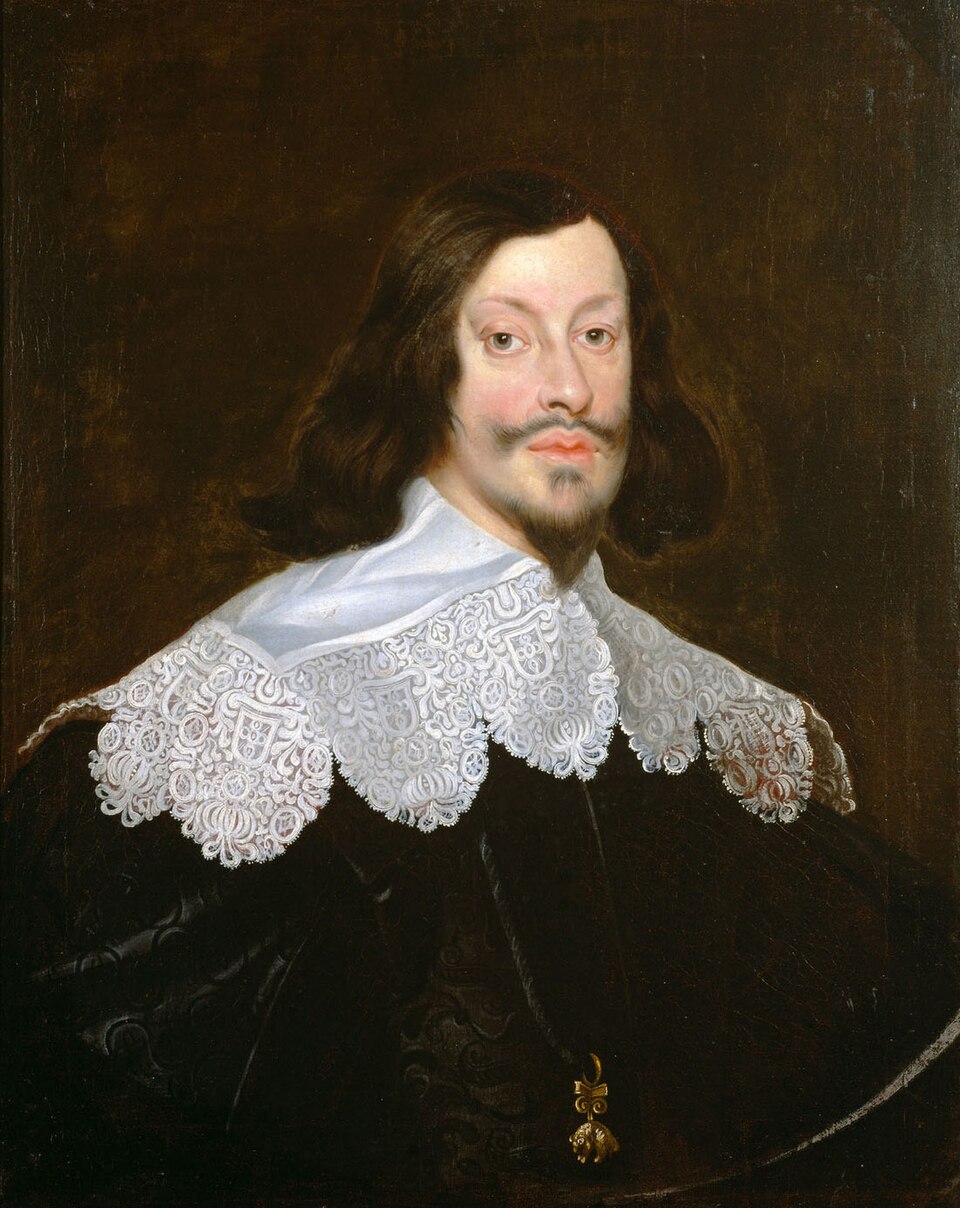
Ferdinand III
Ferdinand III.
Holy Roman Emperor · King of Bohemia · King of Hungary · Archduke of Austria
1608 – 1657
- Born
- 1608
- Died
- 1657
- Reign
- 1637 – 1657
- House
- Austrian Habsburgs
Biography
The emperor who signed the Peace of Westphalia, Ferdinand III, presided over the Habsburg monarchy's transition from the ambitions of the Thirty Years' War to the compromises that ended it. He was born in Graz on 13 July 1608, the son of Ferdinand II and Maria Anna of Bavaria, and was raised in the firmly Catholic atmosphere of his father's court. He was crowned King of Hungary in 1625 and King of Bohemia in 1627.
Ferdinand sought a military role during his father's reign and received supreme command of the imperial armies after the assassination of Wallenstein in 1634. In September of that year, forces under his nominal command, joined with Spanish troops led by his cousin the Cardinal-Infante Ferdinand, won a major victory over the Swedes at Nördlingen. The success contributed to the Peace of Prague in 1635, which reconciled most of the German Protestant princes with the emperor. In 1631 he had married the Spanish infanta Maria Anna, daughter of Philip III, continuing the long pattern of marriages between the Austrian and Spanish branches of the dynasty; their sons included Ferdinand IV, who died young in 1654, and the future emperor Leopold I.
He succeeded his father as emperor in 1637, inheriting a war that had turned against the Habsburgs. French and Swedish advances through the 1640s, including defeats at the second battle of Breitenfeld in 1642 and at Jankau in 1645, gradually narrowed his options. Negotiations at Münster and Osnabrück culminated in the Peace of Westphalia in October 1648. Ferdinand accepted terms that confirmed the religious settlement in the Empire and strengthened the constitutional position of the princes, while preserving Habsburg authority within the Austrian and Bohemian lands themselves, where re-Catholicization continued.
Ferdinand III was also a serious musician, the first emperor whose own compositions survive. He wrote sacred and secular works, including the allegorical Drama musicum, and maintained a court chapel of high quality, sustaining a tradition of musical patronage and practice that later Habsburgs, notably Leopold I, continued. His final years were occupied with postwar reconstruction and with securing the succession, complicated by the early death of Ferdinand IV. He died in Vienna on 2 April 1657 and was succeeded by Leopold I.
Updated June 2026 · How we research
Events
The series of treaties signed at Münster and Osnabrück in October 1648 ended the Thirty Years' War in the Empire and the Eighty Years' War between Spain and the Dutch Republic. The settlement recognized the sovereignty of the German princes, granted formal independence to the Dutch and the Swiss, and established the principle of cuius regio, eius religio (whose realm, his religion) on a durable basis. Conventionally cited as the foundation of the modern European state system.
Connections across houses
Place Ferdinand III in the wider world of ruling houses.
Recommended Reading
Affiliate disclosure: the links below go to Amazon searches. As an Amazon Associate, Dynastica earns from qualifying purchases.