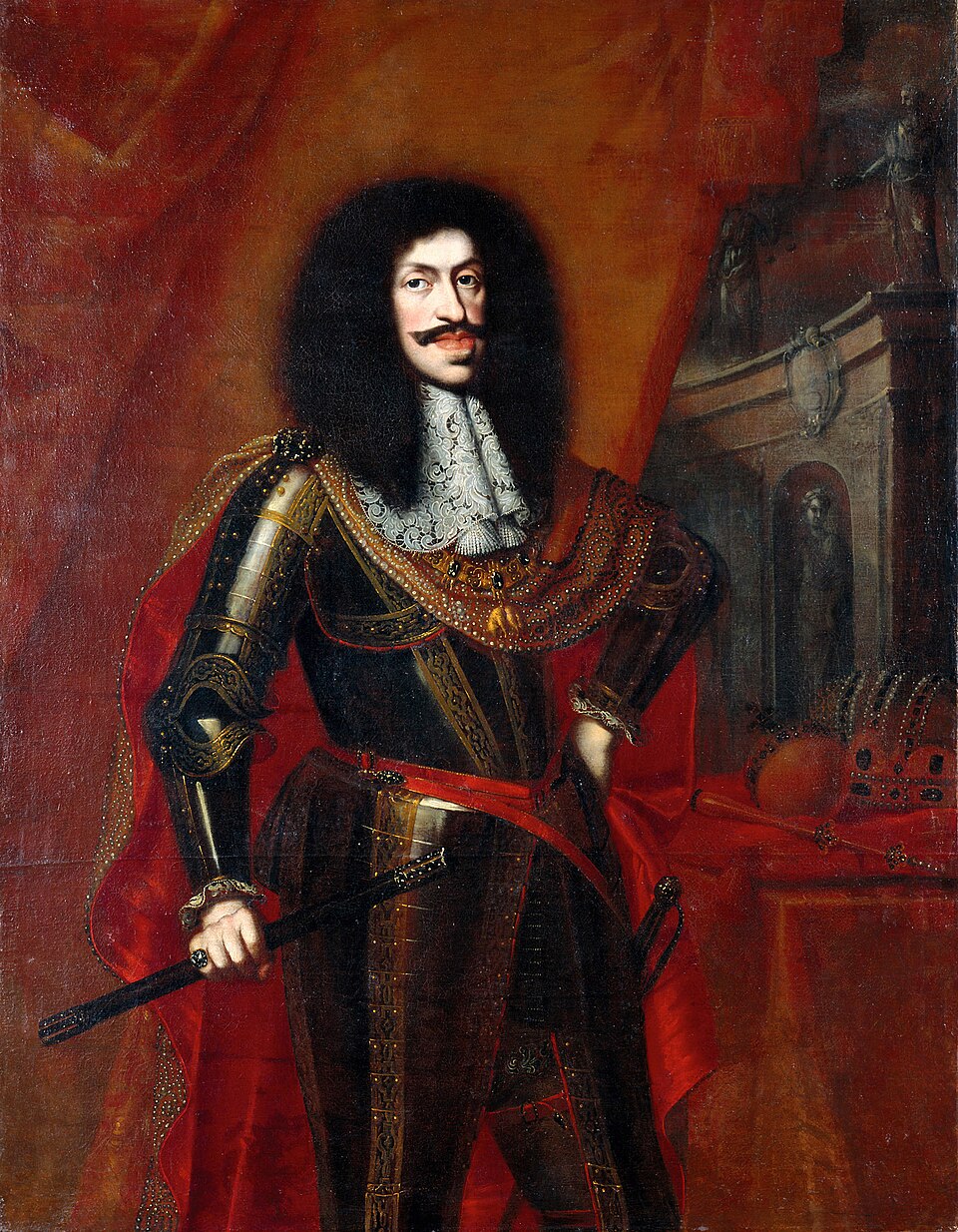
Leopold I
Leopold I.
Holy Roman Emperor · King of Bohemia · King of Hungary · Archduke of Austria
1640 – 1705
- Born
- 1640
- Died
- 1705
- Reign
- 1658 – 1705
- House
- Austrian Habsburgs
Biography
A second son originally destined for the church, Leopold I became one of the longest-reigning Habsburg emperors and presided over the monarchy's rise to great-power status in the late seventeenth century. He was born in Vienna in 1640 to Emperor Ferdinand III and Maria Anna of Spain, and became heir only when his elder brother Ferdinand IV died in 1654. Elected King of Hungary and of Bohemia in the 1650s, he was chosen Holy Roman Emperor in 1658 after a contested election in which French diplomacy worked against him.
His reign was defined by war on two fronts. In the east, the Ottoman Empire mounted its last great offensive into Central Europe, besieging Vienna in 1683; the city was relieved by a combined imperial and Polish army under King John III Sobieski. The counteroffensive that followed, led by commanders including Charles of Lorraine and Prince Eugene of Savoy, recaptured Buda in 1686 and culminated in the victory at Zenta in 1697. By the Treaty of Karlowitz in 1699 the Ottomans ceded almost all of Hungary and Transylvania, transforming the Habsburg monarchy into a major territorial power. In the west, Leopold fought repeated coalitions against Louis XIV of France, and at the end of his life entered the War of the Spanish Succession to press his family's claim to the inheritance of the childless Charles II of Spain.
Leopold's marriages illustrate the dynasty's interlocking alliances. His first wife, Margaret Theresa of Spain, the infanta painted by Velázquez in Las Meninas, was both his niece and his first cousin; their daughter married into the Wittelsbach electoral house of Bavaria. His second wife, Claudia Felicitas, came from the Tyrolean Habsburg line, and his third, Eleonore Magdalene of Palatinate-Neuburg, bore his successors Joseph I and Charles VI. A man of pronounced piety and a serious musician, Leopold composed sacred and theatrical works and made Vienna a center of the Italian opera.
He died in Vienna in 1705, in the middle of the Spanish succession war, and was buried in the Capuchin Crypt. His reign, which began with the monarchy on the defensive, ended with Habsburg armies fighting for supremacy in both Germany and Spain.
Updated June 2026 · How we research
Connections across houses
Place Leopold I in the wider world of ruling houses.
Recommended Reading
Affiliate disclosure: the links below go to Amazon searches. As an Amazon Associate, Dynastica earns from qualifying purchases.