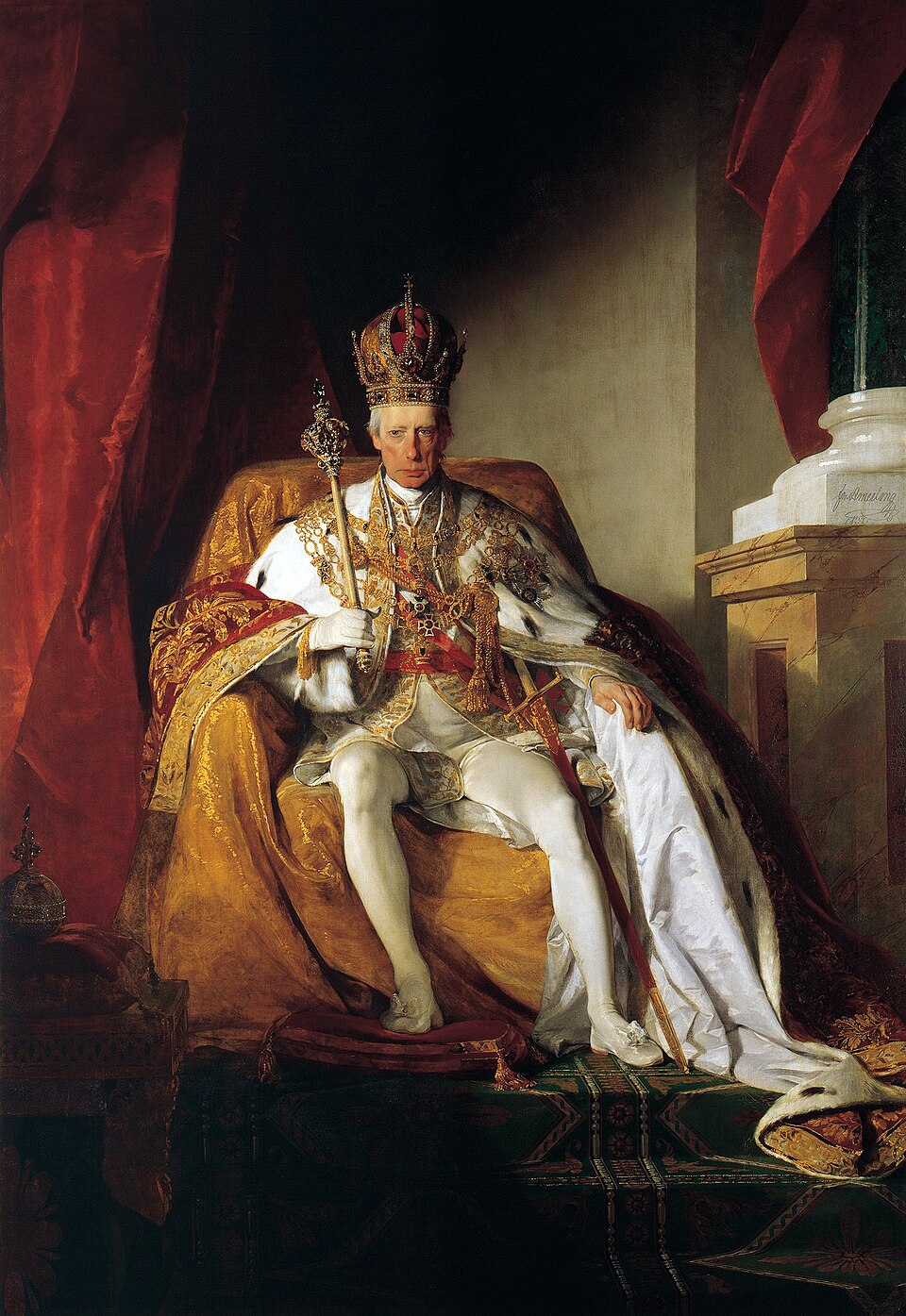
Francis II
Franz II.
Holy Roman Emperor (1792–1806) · Emperor of Austria (as Francis I, 1804–1835) · King of Bohemia · King of Hungary
1768 – 1835
- Born
- 1768
- Died
- 1835
- Reign
- 1792 – 1835
- House
- Austrian Habsburgs
Biography
Two imperial titles, one of them of his own creation, define the reign of Francis II. Born in Florence in 1768, the eldest son of the future Leopold II and the Bourbon princess Maria Luisa of Spain, he was brought to Vienna for grooming under his uncle Joseph II and succeeded his father in 1792, weeks before revolutionary France declared war on Austria. He was the last ruler ever elected Holy Roman Emperor.
His first two decades were consumed by war with France. Austria suffered repeated defeats in the campaigns of the 1790s and at Austerlitz in 1805, losing the Austrian Netherlands, Lombardy, and other territories in successive treaties. Anticipating Napoleon's assumption of an imperial title, Francis proclaimed himself hereditary Emperor of Austria in 1804, and in August 1806, after the formation of the Confederation of the Rhine stripped the old empire of substance, he abdicated the Roman imperial crown and declared the Holy Roman Empire dissolved, ending a polity of a thousand years. As Emperor Francis I of Austria he fought on; after the defeat of 1809 he accepted, at the urging of his minister Metternich, the marriage of his daughter Marie Louise to Napoleon in 1810, a Habsburg-Bonaparte union that produced Napoleon's only legitimate son. In 1813 Austria joined the final coalition, and Vienna hosted the congress of 1814-1815 that reordered Europe.
Francis married four times. His second wife, Maria Theresa of Naples and Sicily, a Bourbon and his double first cousin, was the mother of his children, including his successor Ferdinand and the archduchess Marie Louise; his third wife came from the Habsburg-Este line, and his fourth, Caroline Augusta, was a Wittelsbach princess of Bavaria. The pattern reflected the dynasty's continued reliance on its traditional Bourbon and Bavarian connections.
His later reign, conducted in close partnership with Metternich, was marked by conservatism, censorship, and policing, the system associated with the era between 1815 and 1848. A man of methodical, bureaucratic habits, Francis remained personally popular in Vienna. He died there in March 1835 and was buried in the Capuchin Crypt, leaving the throne, against some advisers' doubts, to his epileptic eldest son Ferdinand I, with government effectively entrusted to a regency council around Metternich.
Updated June 2026 · How we research
Connections across houses
Place Francis II in the wider world of ruling houses.
Recommended Reading
Affiliate disclosure: the links below go to Amazon searches. As an Amazon Associate, Dynastica earns from qualifying purchases.