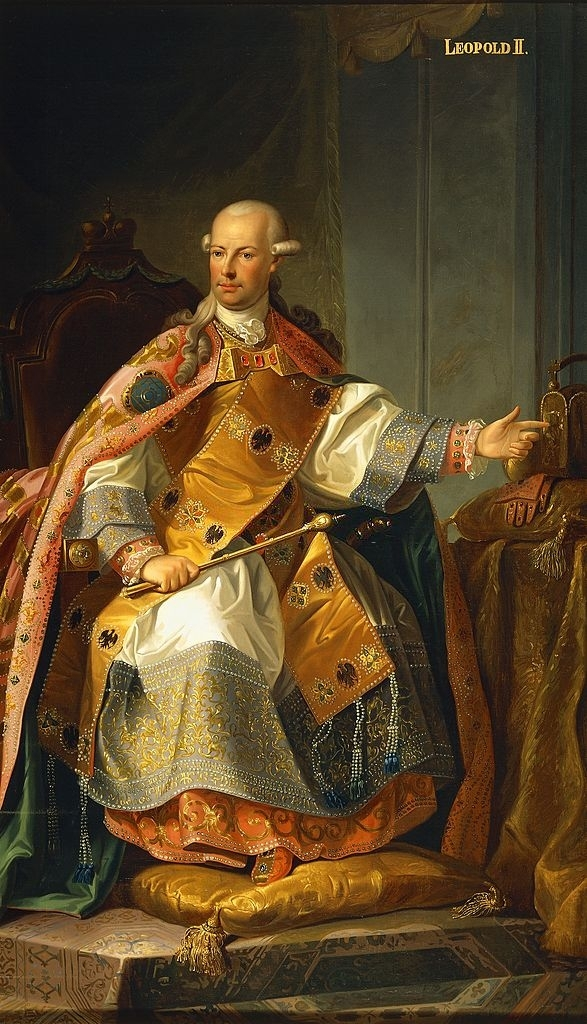
Leopold II
Leopold II.
Holy Roman Emperor · King of Bohemia · King of Hungary · Archduke of Austria · Grand Duke of Tuscany
1747 – 1792
- Born
- 1747
- Died
- 1792
- Reign
- 1790 – 1792
- House
- Austrian Habsburgs
Biography
Before he was emperor, Leopold II spent a quarter century as one of Europe's most systematic reforming princes. Born in Vienna in 1747, the third son of Emperor Francis I Stephen and Maria Theresa, he became Grand Duke of Tuscany in 1765 on his father's death. In Florence he pursued cautious, methodical reform of administration, economy, and law; the Tuscan criminal code of 1786 abolished the death penalty and torture, making the grand duchy the first European state to do so. His marriage in 1765 to Maria Luisa of Spain, daughter of the Bourbon king Charles III, linked the new house of Habsburg-Lorraine to the Spanish Bourbons and produced sixteen children.
The death of his childless elder brother Joseph II in February 1790 called Leopold to Vienna at a moment of crisis. Joseph's headlong reforms had provoked open revolt in the Austrian Netherlands and near-rebellion in Hungary, while the monarchy remained at war with the Ottoman Empire. Leopold moved quickly and pragmatically: he withdrew or moderated the most contested measures, conciliated the Hungarian estates and was crowned King of Hungary at Pressburg, restored Habsburg authority in the Netherlands, and ended the Turkish war. He was elected Holy Roman Emperor and crowned at Frankfurt in October 1790.
The French Revolution overshadowed his short reign. His sister Marie Antoinette was queen of France, and her deteriorating position drew him into reluctant engagement. In August 1791 he joined King Frederick William II of Prussia in the Declaration of Pillnitz, expressing conditional readiness to intervene in France, a statement intended as restrained but read in Paris as a threat. In February 1792 he concluded a formal defensive alliance with Prussia.
Leopold died unexpectedly in Vienna on 1 March 1792, after less than two years on the throne; war between France and Austria broke out weeks later under his son and successor Francis II. Historians have generally judged him among the most capable of the later Habsburgs, a ruler who combined his mother's pragmatism with his brother's reforming instincts but was granted little time to apply either. Through his many sons he became the ancestor of the dynasty's principal nineteenth-century lines.
Updated June 2026 · How we research
Connections across houses
Place Leopold II in the wider world of ruling houses.
Recommended Reading
Affiliate disclosure: the links below go to Amazon searches. As an Amazon Associate, Dynastica earns from qualifying purchases.