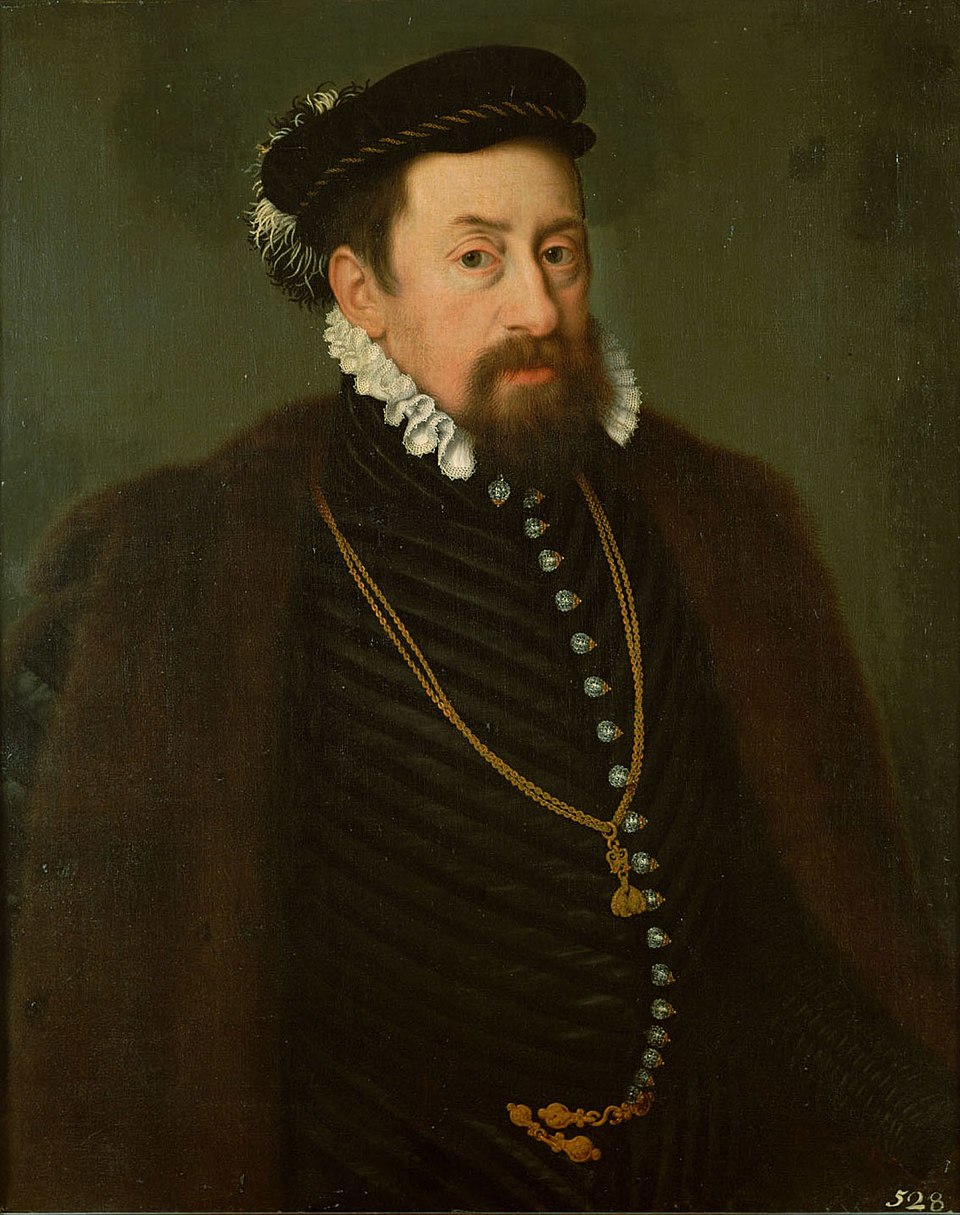
Maximilian II
Maximilian II.
Holy Roman Emperor · King of Bohemia · King of Hungary · Archduke of Austria
1527 – 1576
- Born
- 1527
- Died
- 1576
- Reign
- 1564 – 1576
- House
- Austrian Habsburgs
Biography
Maximilian II, Holy Roman Emperor from 1564 to 1576, occupied an unusual position among the Austrian Habsburgs of his century: a Catholic monarch widely suspected of Lutheran sympathies, who governed during the confessional divisions that followed the Peace of Augsburg. Born in Vienna on 31 July 1527, he was the eldest son of Ferdinand I and Anna of Bohemia and Hungary, and a nephew of Emperor Charles V.
His upbringing brought him into early contact with Protestant ideas, and his evident interest in reformed preaching caused alarm within the family. Charles V and Ferdinand I pressed him to give assurances of his Catholic loyalty, which he eventually provided, though he declined throughout his life to commit himself to militant confessional politics. In 1548 he married his cousin Maria of Spain, daughter of Charles V, a union that reinforced the bond between the Austrian and Spanish branches of the dynasty and produced a large family, including the future emperors Rudolf II and Matthias.
Maximilian was crowned King of Bohemia in 1562 and King of Hungary in 1563, succeeding his father as emperor in 1564. His rule was marked by accommodation rather than enforcement. In 1568 and 1571 he granted the nobility of Lower Austria the right to Lutheran worship on their estates, a concession that distinguished his government from the stricter policies of his Spanish relatives and of his own successors. He avoided involvement in the Dutch revolt against Philip II and resisted pressure to align imperial policy with Spanish interests.
On the eastern frontier he inherited the long conflict with the Ottoman Empire. A campaign in Hungary in 1566, during which Suleiman the Magnificent died at the siege of Szigetvár, ended without decisive result, and the Peace of Adrianople in 1568 confirmed the territorial division of Hungary in exchange for an annual payment to the sultan. In 1575 a faction of the Polish-Lithuanian nobility elected Maximilian to the vacant Polish throne, but Stephen Báthory secured the crown before the emperor could act.
Maximilian died at Regensburg on 12 October 1576, declining the final sacraments of the Catholic Church, a gesture consistent with the ambiguity he had maintained throughout his life. His son Rudolf II succeeded him. Historians have generally judged his reign a period of relative confessional calm in the Habsburg lands, achieved through deliberate restraint rather than resolution of the underlying disputes.
Updated June 2026 · How we research
Connections across houses
Place Maximilian II in the wider world of ruling houses.
Recommended Reading
Affiliate disclosure: the links below go to Amazon searches. As an Amazon Associate, Dynastica earns from qualifying purchases.