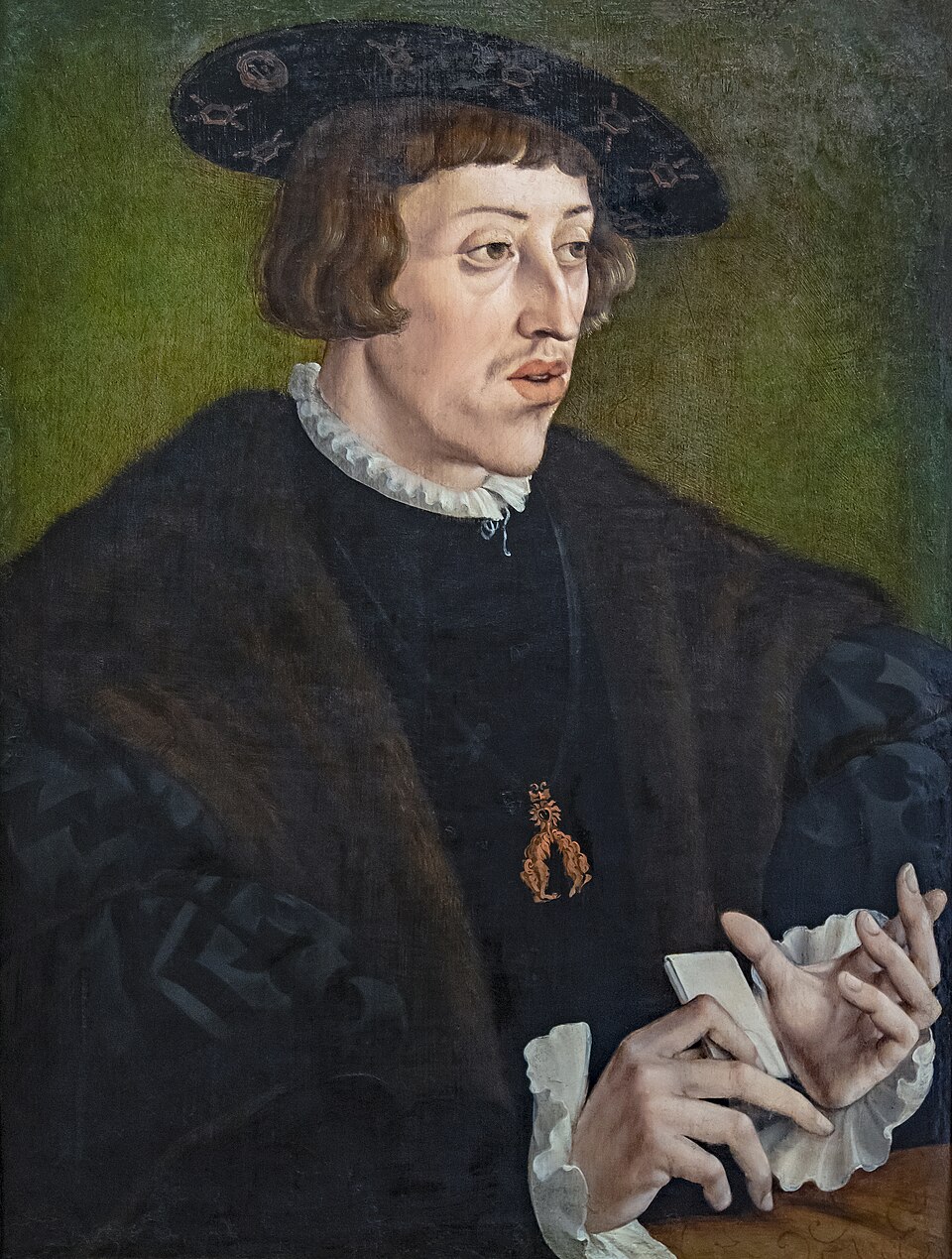
Ferdinand I
Ferdinand I.
Holy Roman Emperor · King of Bohemia · King of Hungary · Archduke of Austria
1503 – 1564
- Born
- 1503
- Died
- 1564
- Reign
- 1556 – 1564
- House
- Austrian Habsburgs
Biography
Unlike most Habsburg rulers of his era, Ferdinand I was a Spaniard by birth and upbringing. He was born at Alcalá de Henares in 1503, the second son of Philip the Handsome of Habsburg and Joanna of Castile, and was raised in Spain at the court of his maternal grandfather, Ferdinand of Aragon. When his elder brother Charles V inherited the vast Spanish-Burgundian-Austrian conglomerate, the brothers divided responsibilities: by the compacts of 1521-1522 Ferdinand received the Austrian hereditary lands and acted as his brother's deputy in the empire.
His marriage proved the making of Habsburg Central Europe. Under the double betrothal arranged at the Congress of Vienna in 1515 between Emperor Maximilian I and the Jagiellon rulers of Bohemia, Hungary, and Poland, Ferdinand married Anna Jagiellonica, sister of King Louis II, while Louis married Ferdinand's sister Mary. When Louis died without children at the Battle of Mohács against the Ottomans in 1526, Ferdinand claimed both crowns. The Bohemian estates elected him king, while in Hungary he faced a rival, John Zápolya, and decades of contest with the Ottoman Empire, which besieged Vienna itself in 1529 and held the central part of the Hungarian kingdom.
Ferdinand was elected King of the Romans in 1531 and increasingly carried the burden of imperial government as Charles V withdrew. He took a leading part in negotiating the Peace of Augsburg of 1555, which stabilized relations between Catholic and Lutheran estates in the empire. After Charles abdicated in 1556, Ferdinand assumed the imperial office, and the electors formally recognized the transfer in 1558. The division of 1521 and the succession of 1556 together created the lasting split between the Spanish and Austrian branches of the dynasty.
With Anna Jagiellonica he had fifteen children, whom he married into the Wittelsbach, Jagiellon, Gonzaga, Medici, and other houses, reinforcing the network of alliances on which Habsburg policy rested. An able administrator, he created central institutions in Vienna that governed the Austrian lands for generations. Ferdinand died in Vienna in 1564 and was buried in Prague; his son Maximilian II succeeded him in the empire, Bohemia, and Habsburg Hungary.
Updated June 2026 · How we research
Events
On 29 August 1526 the Ottoman army under Süleyman I destroyed the army of the Kingdom of Hungary on the plain of Mohács, near the Danube in the country's south. Süleyman had opened the road in 1521 by taking Belgrade, the key fortress of Hungary's southern defenses, and marched north in 1526 with a large, artillery-rich force. The young king Louis II, who ruled both Hungary and Bohemia, met him with an army of roughly 25,000, assembled hastily and without the substantial contingents of Transylvania under John Zápolya and of Croatia, which had not arrived. The battle lasted only a few hours. Hungarian heavy cavalry charges achieved initial momentum but broke against the Ottoman center, where chained guns and janissary volleys shattered the attack, and the army disintegrated. Most of the Hungarian high command, including both archbishops and a large part of the episcopate and baronage, died on the field or in the rout. Louis II drowned in a swollen stream during the flight, leaving no legitimate heir. Süleyman occupied and burned Buda but withdrew that autumn without garrisoning central Hungary. The succession crisis proved as consequential as the battle. By treaties of 1515 between the Habsburgs and the Jagiellonians, and through his marriage to Louis's sister Anna, Ferdinand I of Habsburg, brother of the emperor Charles V, claimed the vacant crowns. He was elected king of Bohemia in October 1526, while in Hungary rival diets elected both Ferdinand and John Zápolya, beginning a civil war that ended with the country partitioned among Habsburg "Royal Hungary," the Ottoman-held center after 1541, and an Ottoman-vassal principality in Transylvania. The Habsburg acquisition of the Bohemian and Hungarian crowns in 1526 assembled the Danubian composite monarchy that the dynasty would rule until 1918.
Also there: Süleyman the Magnificent
Between 1554 and 1556 Charles V, exhausted by four decades of universal war, partitioned the empire he had inherited intact. His son Philip received Spain, the Indies, the Italian possessions, and the Low Countries; his brother Ferdinand received Austria, Bohemia, Hungary, and ultimately the imperial title. The split divided the Habsburgs into Spanish and Austrian branches that would remain cousin powers for the next century and a half. Charles retired to a monastery in Yuste and died there in 1558.
Also there: Charles V, Philip II of Spain
Connections across houses
Place Ferdinand I in the wider world of ruling houses.
Recommended Reading
Affiliate disclosure: the links below go to Amazon searches. As an Amazon Associate, Dynastica earns from qualifying purchases.