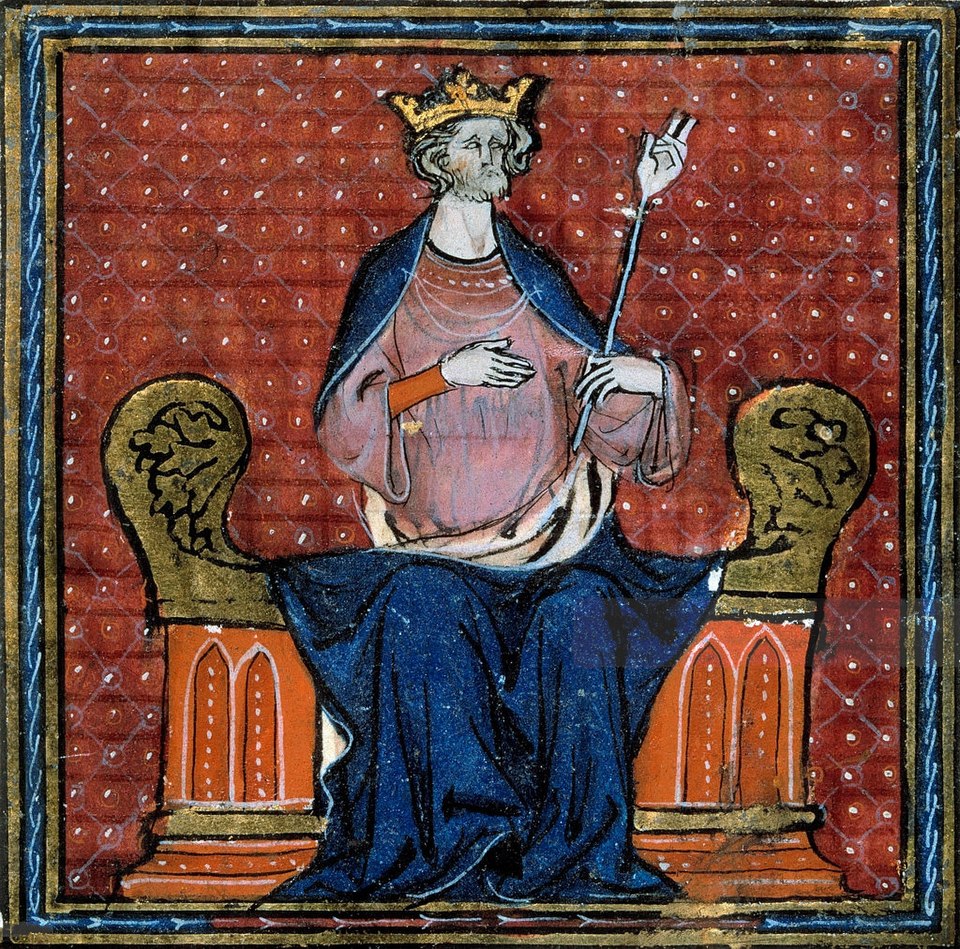
Hugh Capet
Hugues Capet
King of the Franks · Duke of the Franks · Count of Paris
940 – 996
- Born
- 940
- Died
- 996
- Reign
- 987 – 996
- House
- Capetian
Biography
When the Frankish magnates assembled in 987 to choose a successor to the childless Louis V, they passed over the last Carolingian claimant and elected Hugh Capet, setting a new family on the West Frankish throne. Hugh was the son of Hugh the Great, duke of the Franks and the most powerful magnate of his generation, and of Hedwig of Saxony, a sister of the emperor Otto I; through his mother he was closely connected to the Ottonian dynasty that ruled East Francia and the empire. Two of his Robertian forebears, Odo and Robert I, had briefly held the West Frankish crown in earlier decades, so the family's elevation in 987 was not without precedent.
Hugh succeeded to his father's duchy in 956, while still a minor, and spent the following decades consolidating his position in the lands between Paris and Orléans. Under the last Carolingian kings, Lothair and Louis V, he acted as the leading lay magnate of the realm, alternately cooperating with and obstructing the crown. He married Adelaide of Aquitaine, daughter of William Towhead, count of Poitou and duke of Aquitaine, a union that linked him to the principal princely house of southwestern France.
His election in 987 owed much to Adalbero, archbishop of Reims, who argued before the assembled magnates against the claims of Charles of Lorraine, the late king's uncle and the surviving Carolingian male. Crowned in July 987, Hugh moved within months to have his son Robert crowned as co-king, beginning the Capetian practice of associating the heir in the kingship during the father's lifetime, a custom that long protected the dynasty from succession disputes. Charles of Lorraine pressed his claim by force and seized Laon, but he was betrayed and captured in 991, ending the Carolingian challenge.
Hugh's effective authority scarcely extended beyond the royal domain around Paris and Orléans, and the great territorial princes obeyed him only intermittently. He died in 996 and was succeeded without dispute by Robert II. The dynasty he founded held the French throne in the direct male line until 1328, and through its Valois and Bourbon branches for centuries more.
Updated June 2026 · How we research
Connections across houses
Place Hugh Capet in the wider world of ruling houses.
Recommended Reading
Affiliate disclosure: the links below go to Amazon searches. As an Amazon Associate, Dynastica earns from qualifying purchases.