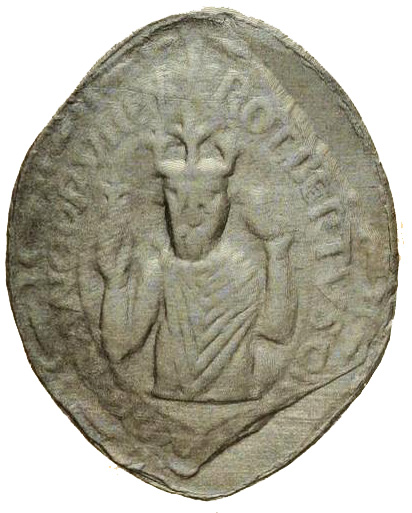
Robert II
Robert II le Pieux
King of the Franks · King of France
972 – 1031
- Born
- 972
- Died
- 1031
- Reign
- 996 – 1031
- House
- Capetian
Biography
The second king of the Capetian dynasty, Robert II succeeded his father Hugh Capet in 996, having already been crowned as co-king in 987 to secure the new royal line. Educated at Reims under Gerbert of Aurillac, the future Pope Sylvester II, he acquired a reputation for learning and devotion that earned him the epithet "the Pious." Throughout his reign he worked to consolidate the fragile authority his father had established over a kingdom in which great territorial princes often held more practical power than the crown.
Robert's marriages proved turbulent. His first union, with Rozala of Italy, widow of Count Arnulf II of Flanders, was repudiated. He then married Bertha of Burgundy, but the match fell within the prohibited degrees of kinship and drew papal condemnation; under sustained ecclesiastical pressure the marriage was dissolved. His third wife, Constance of Arles, came from the house of the counts of Provence, extending Capetian connections toward the Midi. The marriage was famously discordant, and Constance's rivalry with her sons clouded the king's later years.
The central territorial achievement of the reign was the acquisition of the Duchy of Burgundy. When Robert's uncle, Duke Henry of Burgundy, died in 1002, the king pressed his claim against local opposition in a long struggle that ended with the duchy's submission by 1016. Burgundy was later granted to his younger son Robert, founding the Capetian ducal house of Burgundy, which would hold the duchy for three centuries and intermarry repeatedly with the royal line.
Following Capetian practice, Robert had his eldest son Hugh crowned co-king, but Hugh died in 1025. The succession then passed to the next son, Henry, whose coronation Constance opposed in favor of a younger brother. The dispute provoked open revolt within the royal family during Robert's final years. He died at Melun in 1031 and was buried at Saint-Denis, leaving the throne to Henry I and a precedent of dynastic continuity that proved more durable than the conflicts surrounding it.
Updated June 2026 · How we research
Connections across houses
Place Robert II in the wider world of ruling houses.
Recommended Reading
Affiliate disclosure: the links below go to Amazon searches. As an Amazon Associate, Dynastica earns from qualifying purchases.