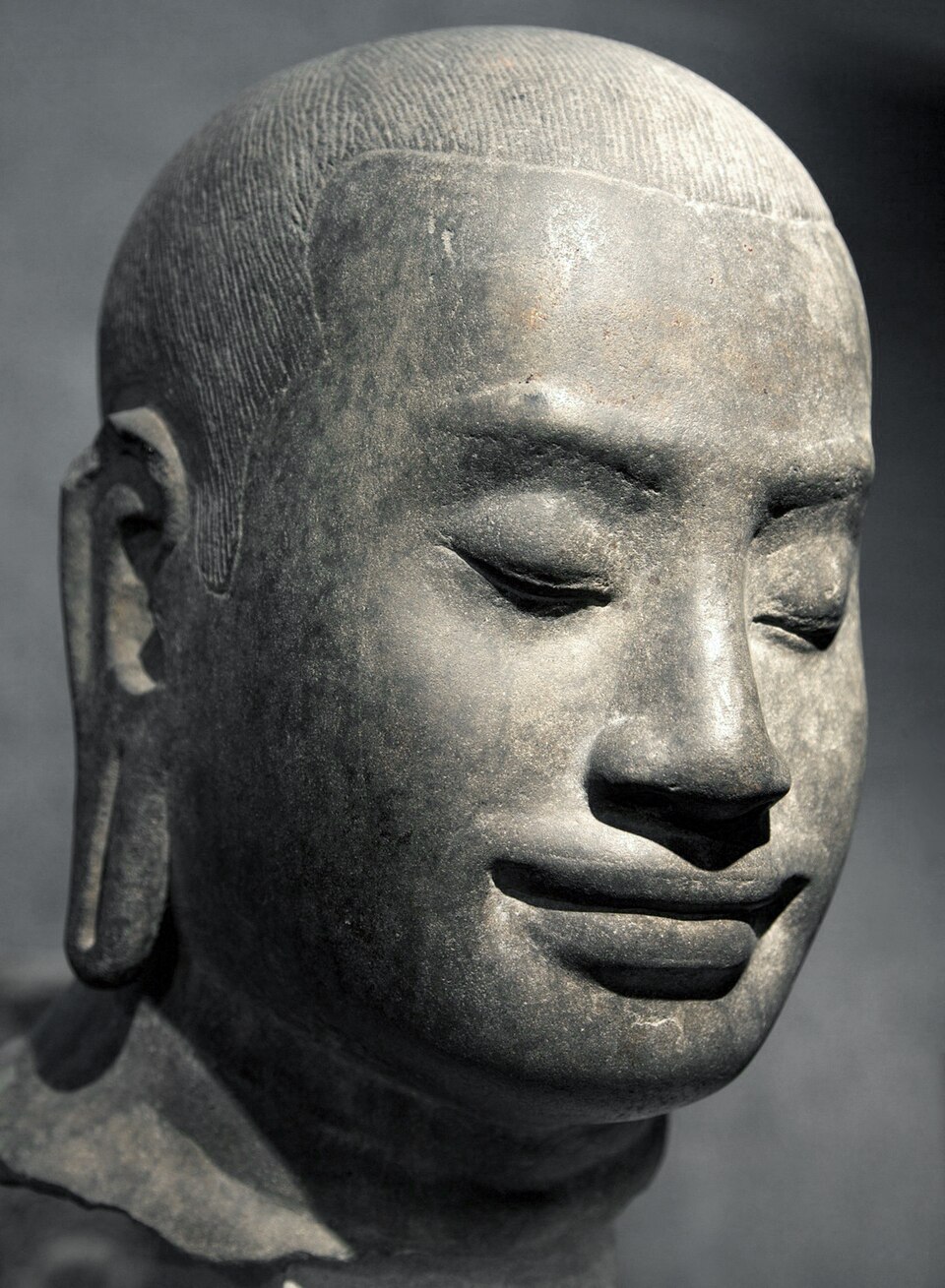
Jayavarman VII
King of the Khmer Empire
d. 1218
- Died
- 1218
- Reign
- 1181 – 1218
- House
- Khmer Empire
Biography
Jayavarman VII transformed Angkor more thoroughly than any king before him, and did so after coming to power past the age of fifty. A son of King Dharanindravarman II, born probably in the 1120s, he spent years away from the center of power — including, by some accounts, time in Champa — while the throne passed through other hands. When Cham forces sacked Angkor in 1177, reportedly arriving by water across the Tonle Sap, he led the resistance; reliefs at the Bayon depict the naval battles of this war. By 1181 he had driven out the invaders and was consecrated king.
He was a Mahayana Buddhist, the first Khmer king to make Buddhism unambiguously the religion of state, and his building program expressed it on an unprecedented scale. He rebuilt the capital as Angkor Thom, a walled and moated city three kilometers on a side, centered on the Bayon, whose towers bear the famous serene stone faces — variously interpreted as the bodhisattva Lokeshvara, the king himself, or both. He dedicated Ta Prohm in 1186 to his mother in the image of the Perfection of Wisdom, and Preah Khan in 1191 to his father in the image of Lokeshvara; the foundation steles of these temples inventory thousands of attached villages and personnel, providing exceptional evidence for the Angkorian economy.
His public works went beyond temples. Inscriptions credit him with 102 hospitals distributed across the kingdom and with rest houses along a network of raised roads radiating from the capital toward outlying provinces — infrastructure that inscriptional rhetoric frames as royal compassion. Militarily, he reversed the verdict of 1177, invading Champa and reducing it to a Khmer province for roughly two decades from 1203.
Two learned sisters successively became his chief queens: Jayarajadevi, and after her death Indradevi, who composed the Sanskrit inscription recounting both women's lives. Jayavarman VII died around 1218 — the date is approximate — with the posthumous name Mahaparamasaugata. The sandstone portrait heads believed to represent him in meditation are among the most recognized works of Khmer art, and his reign marks both the territorial peak of the empire and, in the strain of his vast projects, perhaps the beginning of its overextension.
Updated June 2026 · How we research
Connections across houses
Place Jayavarman VII in the wider world of ruling houses.
Recommended Reading
Affiliate disclosure: the links below go to Amazon searches. As an Amazon Associate, Dynastica earns from qualifying purchases.