Suryavarman II
King of the Khmer Empire
d. 1150
- Died
- 1150
- Reign
- 1113 – 1150
- House
- Khmer Empire
Biography
Suryavarman II built Angkor Wat. A prince from a collateral branch of the royal family in the northeast of the kingdom, he seized the throne around 1113 while still young, defeating a rival described in an inscription as his great-uncle — probably the aged king Dharanindravarman I — in a battle the text compares to Garuda destroying a serpent. The influential priest Divakarapandita, who had served several previous kings, performed his consecration, lending the usurpation the sanction of the religious establishment.
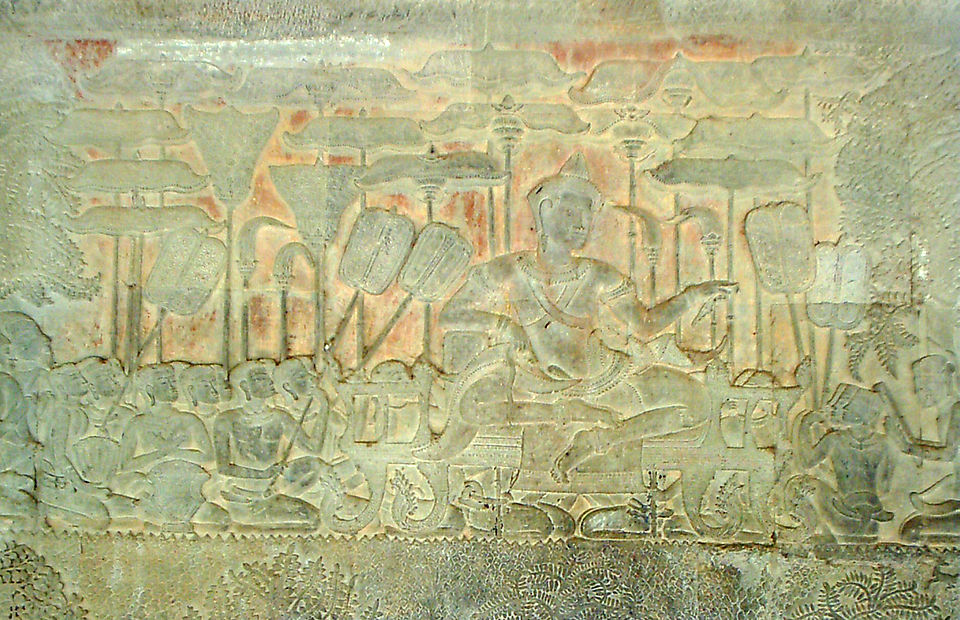
His state temple broke with two centuries of precedent. Angkor Wat was dedicated not to Shiva but to Vishnu, faces west rather than east, and surpasses every earlier Khmer monument in scale, with an outer enclosure of about 1.5 by 1.3 kilometers ringed by a moat nearly 200 meters wide. Its bas-reliefs, running for hundreds of meters, depict Hindu epic and cosmological scenes alongside a portrait gallery of Suryavarman himself enthroned and on the march with his army — among the most detailed images of an Angkorian court in existence. The temple was almost certainly intended also as his funerary monument; his posthumous name was Paramavishnuloka, 'he who has entered the supreme world of Vishnu.'
Abroad, Suryavarman was relentlessly aggressive. He restored diplomatic relations with Song China, sending embassies recorded in 1116 and 1120, and Chinese sources acknowledged the Khmer state as a great power of the southern seas. But his repeated campaigns against Dai Viet in the north, sometimes with Cham allies and sometimes against Champa itself, achieved little lasting result; Khmer forces took the Cham capital Vijaya in 1145, only for control to collapse within a few years.
The end of his reign is poorly documented. He is last securely attested around 1145-1150, and a tradition that he died on campaign against Champa cannot be confirmed; the date of 1150 is conventional. The decades after his death brought dynastic instability and, in 1177, the Cham sack of Angkor — a catastrophe from which the kingdom was rescued by the future Jayavarman VII.
Updated June 2026 · How we research
Connections across houses
Place Suryavarman II in the wider world of ruling houses.
Recommended Reading
Affiliate disclosure: the links below go to Amazon searches. As an Amazon Associate, Dynastica earns from qualifying purchases.