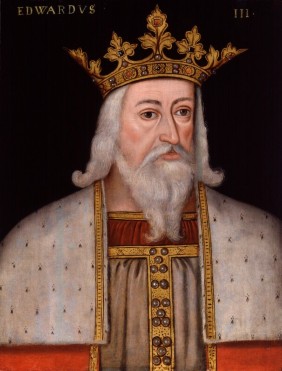
Edward III
Edwardus III
King of England · Lord of Ireland · King of France (claimed)
1312 – 1377
- Born
- 1312
- Died
- 1377
- Reign
- 1327 – 1377
- House
- Plantagenet
Biography
Edward III reigned for fifty years, one of the longest tenures of any medieval English king. The son of Edward II and Isabella of France, daughter of Philip IV, he was placed on the throne in 1327 at the age of fourteen after his father's deposition by Isabella and her ally Roger Mortimer. In 1330 the young king seized control of his own government in a coup at Nottingham Castle, executing Mortimer and retiring his mother from public life. In 1328 he had married Philippa of Hainault, who bore him a large family, including five sons who survived to adulthood.
Through his mother, Edward had a claim to the French throne, which passed in 1328 to Philip VI of the house of Valois. Disputes over Gascony and Philip's support for Scotland led Edward to assert that claim, and in 1337 began the conflict later known as the Hundred Years' War. English arms won notable successes: the naval battle of Sluys in 1340, the victory at Crécy in 1346, the capture of Calais in 1347, and the battle of Poitiers in 1356, where his eldest son Edward, the Black Prince, took King John II of France prisoner. The Treaty of Brétigny in 1360 granted Edward an enlarged Aquitaine in full sovereignty in exchange for renouncing the French crown, though war resumed in 1369 and most of the gains were lost.
At home the reign saw the foundation of the Order of the Garter around 1348, the growing role of the Commons in parliament, and statutes regulating wages and papal jurisdiction. The Black Death of 1348-49 killed a large proportion of the population and transformed economic life. Edward's children linked the dynasty outward and inward alike: his son Lionel married into the Visconti of Milan, and John of Gaunt's later marriage gave the family a claim in Castile.
Edward's final decade was marked by military reverses and declining health. The Good Parliament of 1376 attacked his ministers and his mistress Alice Perrers, and the death of the Black Prince that year left a child as heir. When Edward died in June 1377, the crown passed to his ten-year-old grandson Richard II.
Updated June 2026 · How we research
Events
On 26 August 1346, Edward III's English army of roughly twelve thousand destroyed a French force perhaps three times its size at Crécy in Ponthieu. The Welsh and English longbowmen broke wave after wave of French knightly charges; the sixteen-year-old Black Prince commanded the vanguard. The battle announced English military supremacy of the early Hundred Years' War and dethroned the heavily armored knight as Europe's dominant battlefield weapon.
Also there: Edward the Black Prince
Connections across houses
Where Edward III's family tree leaves the Plantagenet and enters other ruling houses.
Recommended Reading
Affiliate disclosure: the links below go to Amazon searches. As an Amazon Associate, Dynastica earns from qualifying purchases.