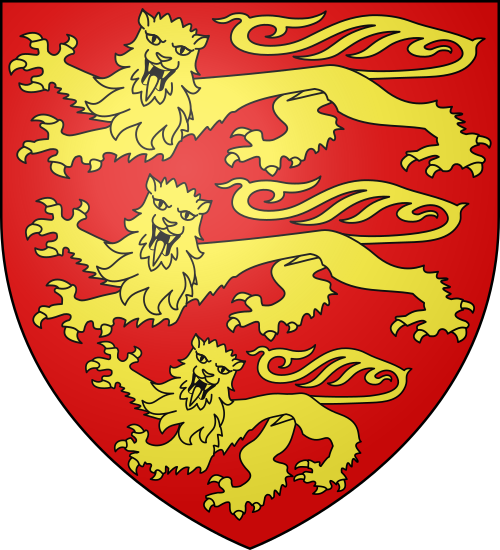
Plantagenet
England · 1154 – 1485
Overview
The Plantagenets ruled England from 1154 to 1485 — three hundred and thirty-one years, longer than any other dynasty in English history. Their founder Henry II inherited the largest dynastic patrimony in twelfth-century Europe: through his father Geoffrey of Anjou he was Count of Anjou, Maine, and Touraine; through his mother Empress Matilda he was heir to the English throne; through his wife Eleanor of Aquitaine he became Duke of the largest French province. By his coronation in 1154 the Angevin Empire stretched from the Scottish border to the Pyrenees.
The dynasty's fortunes inverted over the next century. John lost Normandy, Anjou, and Maine to Philip II of France in 1204, was forced to seal Magna Carta in 1215, and died in civil war. His son Henry III recovered slowly; Edward I conquered Wales and tried to conquer Scotland. The Hundred Years' War began under Edward III on a claim to the French throne through his mother Isabella of France — a claim that bound English foreign policy to French dynastic politics for a century and a quarter.
The Plantagenet line ended in civil war between its own cadet branches. The Lancastrian (descended from John of Gaunt, Edward III's third surviving son) and Yorkist (descended from Edmund of Langley, the fourth) branches fought intermittently between 1455 and 1487 — the Wars of the Roses. Richard III, the last Plantagenet king, died at Bosworth Field in 1485, defeated by Henry Tudor whose marriage to Elizabeth of York fused the warring branches.
The Plantagenet genealogical legacy is unusually dense: through Edward III's many sons and grandsons the dynasty seeded most of the later English noble houses, the entire Tudor line, the Stuart line via Margaret Tudor, and through Eleanor of Aquitaine connections to both the Capetian house of France and the medieval Castilian and Norman aristocracies. The cross-dynasty bridges Dynastica maps from the Plantagenet pages reach further than the dynasty's three centuries on the throne would suggest.
Updated May 2026 · How we research
Succession of rulers
- 1.Henry IIr. 1154 – 1189
- 2.Richard Ir. 1189 – 1199
- 3.Johnr. 1199 – 1216
- 4.Henry IIIr. 1216 – 1272
- 5.Edward Ir. 1272 – 1307
- 6.Edward IIr. 1307 – 1327
- 7.Edward IIIr. 1327 – 1377
- 8.Richard IIr. 1377 – 1399
- 9.Henry IVr. 1399 – 1413
- 10.Henry Vr. 1413 – 1422
- 11.Henry VIr. 1422 – 1461
- 12.Edward IVr. 1461 – 1483
- 13.Edward Vr. 1483 – 1483
- 14.Richard IIIr. 1483 – 1485
Rulers of the Plantagenet in order of accession.
Lineage
19 figures- Eleanor of Aquitaine1122 – 1204
- Henry II1133 – 1189
- Richard I1157 – 1199
- John1166 – 1216
- Henry III1207 – 1272
- Edward I1239 – 1307
- Edward II1284 – 1327
- Edward III1312 – 1377
- Edward the Black Prince1330 – 1376
- Richard II1367 – 1400
- John of Gaunt1340 – 1399
- Margaret of Anjou1430 – 1482
- Edward IV1442 – 1483
- Edward V1470 – 1483
- Elizabeth of York1466 – 1503
- Richard III1452 – 1485
All figures
- Eleanor of Aquitaine1122 – 1204
- Henry II1133 – 1189
- Richard I1157 – 1199
- John1166 – 1216
- Henry III1207 – 1272
- Edward I1239 – 1307
- Edward II1284 – 1327
- Edward III1312 – 1377
- Edward the Black Prince1330 – 1376
- John of Gaunt1340 – 1399
- Henry IV1367 – 1413
- Richard II1367 – 1400
- Henry V1386 – 1422
- Henry VI1421 – 1471
- Margaret of Anjou1430 – 1482
- Edward IV1442 – 1483
- Richard III1452 – 1485
- Elizabeth of York1466 – 1503
- Edward V1470 – 1483
Related events
Two months after Eleanor's annulment from Louis VII of France, she married Henry, Duke of Normandy and Count of Anjou, in Poitiers on 18 May 1152. The match brought her vast duchy under Henry's control and, when he became king of England two years later, created the Angevin Empire — a French king's vassal who now controlled more of France than the king himself.
Also involved: Capetian (Eleanor's first husband's house)
The destruction of the Latin army at Hattin and the surrender of Jerusalem in 1187 prompted the largest Western military response since the First Crusade. The papal call was answered by the three leading monarchs of Latin Europe: the emperor Frederick Barbarossa, who drowned crossing a river in Anatolia in June 1190, leaving his great army to disintegrate; Philip II of France; and Richard I of England, who had taken the cross as count of Poitou and inherited the Plantagenet dominions in 1189. Richard's journey east included the conquest of Cyprus from its Byzantine ruler in 1191, an acquisition that anchored Latin power in the eastern Mediterranean for centuries. The two kings joined the long siege of Acre, which had been invested by Guy of Lusignan since 1189 while Saladin's army in turn surrounded the besiegers. The city fell in July 1191. Philip, ill and at odds with Richard, returned to France soon afterward, where his maneuvering against Plantagenet lands shaped the rest of the war. Richard marched south along the coast, defeating Saladin's attack at Arsuf in September 1191 and refortifying Jaffa and Ascalon, but twice advanced toward Jerusalem and twice withdrew, judging that the city could not be held even if taken while Saladin's field army survived. Negotiations ran alongside the fighting, conducted largely through Saladin's brother al-Adil, and included proposals, never realized, for a marriage settlement involving Richard's sister. After Richard's relief of Jaffa in August 1192, both exhausted sides concluded the Treaty of Jaffa in September: a three-year truce confirming Latin control of the coast from Tyre to Jaffa, with Ascalon demolished, and guaranteeing Christian pilgrims access to Jerusalem, which remained under Ayyubid rule. Richard sailed for home and was captured in Austria; Saladin died in Damascus in March 1193.
Also involved: Capetian (Joint leadership until Philip II's early departure), Ayyubid Dynasty (Held Jerusalem and contested the coast)
The decisive battle of medieval France. On 27 July 1214 Philip II Augustus crushed a coalition of the Holy Roman Emperor Otto IV, Count Ferdinand of Flanders, and the English under John, ending the Plantagenet attempt to recover the continental holdings John had lost a decade earlier. Bouvines confirmed France as the dominant power of Latin Europe and broke John's standing at home — the Magna Carta crisis followed within a year.
Also involved: Capetian (victor)
On 15 June 1215, in a meadow at Runnymede, John of England sealed the Great Charter under duress from an alliance of rebellious barons. The document compelled the king to respect certain feudal rights, established that no free man could be imprisoned without the lawful judgment of his peers, and bound the crown to the rule of law. John repudiated it within weeks and Pope Innocent III voided it; later kings reissued it, and it became the foundational text of English constitutional liberty.
On 26 August 1346, Edward III's English army of roughly twelve thousand destroyed a French force perhaps three times its size at Crécy in Ponthieu. The Welsh and English longbowmen broke wave after wave of French knightly charges; the sixteen-year-old Black Prince commanded the vanguard. The battle announced English military supremacy of the early Hundred Years' War and dethroned the heavily armored knight as Europe's dominant battlefield weapon.
Also involved: Capetian (defeated (under Valois cadet branch))
On 25 October 1415, Henry V's exhausted and outnumbered English army won the most lopsided victory of the Hundred Years' War. Trapped between the woods of Agincourt and the marshy Tramecourt valley, the heavily armored French knights bogged in mud while English longbow arrows fell among them at a thousand-volley-per-minute rate. Casualty estimates vary wildly but the French lost much of their nobility; the English lost perhaps a hundred dead.
Also involved: Capetian (defeated (under Valois))
Thirty-two years of intermittent civil war between the Lancastrian and Yorkist branches of the Plantagenet dynasty, triggered by the recurring incapacity of Henry VI and the rival claim of Richard, Duke of York. The conflict produced six battles in the 1450s–1460s, the murderous reign of Edward IV, the disappearance of his sons in the Tower, and the final defeat of Richard III at Bosworth in 1485. Resolved by the marriage of Henry VII and Elizabeth of York the following year.
Also involved: Tudor (ultimate beneficiary)
On 22 August 1485, Henry Tudor's army of perhaps five thousand met Richard III's larger royal force on Ambion Hill in Leicestershire. The crucial defection of the Stanleys mid-battle, and Richard's reckless personal charge in an attempt to kill Henry himself, decided the outcome. Richard III became the last English king to die in battle; Henry VII was crowned on the field. The Plantagenet dynasty ended on the same hour the Tudor dynasty began.
Also involved: Tudor (founded)
On 18 January 1486 Henry Tudor married Elizabeth of York, eldest surviving daughter of Edward IV, in Westminster Abbey. The match fused the warring Lancastrian and Yorkist branches of the Plantagenet house, ending the Wars of the Roses by dynastic union rather than continued bloodshed. Their grandson Henry VIII would be the result; through their granddaughter Margaret, the union also transmitted the English crown to the Stuart line a century later.
Also involved: Tudor
See also
Same region
- Khosroid
Iberia (Caucasus) · 580 – 786
- Khazar
Caspian Steppe / Eurasia · 650 – 969
- Umayyad Caliphate
Syria / Damascus / Spain · 661 – 750
- Carolingian
Frankish Empire / Holy Roman Empire · 751 – 987
 Rurikid
Russia / Eastern Europe · 862 – 1610
- Argyros
Byzantium / Anatolia · 870 – 1056
Same era
 Abbasid Caliphate
Middle East / Mesopotamia · 750 – 1258
 Bagrationi
Georgia (Caucasus) · 780 – 1810
- Abkhazia
Georgia / Caucasus · 786 – 1008
- Ossetia
North Caucasus · 800 – 1239
- Khmer Empire
Southeast Asia / Cambodia · 802 – 1431
- Arcruni
Armenia / Caucasus · 830 – 1021