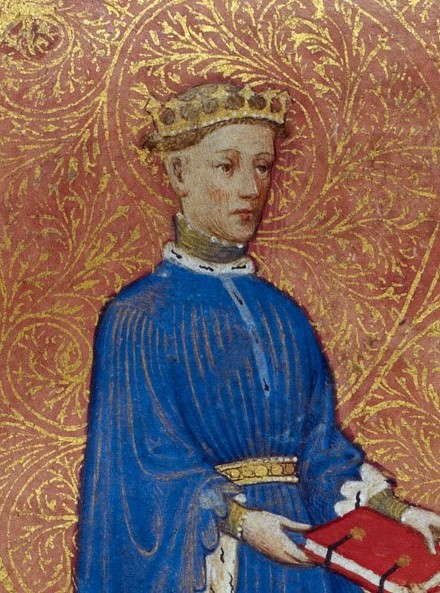
Henry V
Henricus V
King of England · Lord of Ireland · Heir of France (1420)
1386 – 1422
- Born
- 1386
- Died
- 1422
- Reign
- 1413 – 1422
- House
- Plantagenet
Biography
The eldest son of Henry IV and Mary de Bohun, Henry V was born at Monmouth in 1386, before his father's usurpation of the crown made him heir to England. As Prince of Wales he gained long military experience in the campaigns against the Welsh revolt of Owain Glyndwr and was badly wounded by an arrow at the battle of Shrewsbury in 1403. He served prominently on the royal council during his father's later illness and succeeded peacefully in 1413.
Henry moved quickly to consolidate the Lancastrian dynasty, reburying Richard II at Westminster and suppressing the Lollard rising associated with Sir John Oldcastle. In 1415 he revived the English claim to the French throne inherited from Edward III and prepared an invasion, surviving on the eve of departure the Southampton Plot, a conspiracy among nobles to replace him. His first campaign took the port of Harfleur and ended on 25 October 1415 at Agincourt, where his outnumbered and exhausted army inflicted a crushing defeat on the French nobility.
A second invasion from 1417 was a methodical war of conquest. Henry took Caen and then Rouen, which fell in 1419 after a long siege, bringing all Normandy under English rule for the first time since 1204. France, divided by the feud between the Burgundian and Armagnac factions and ruled by the intermittently insane Charles VI, proved unable to mount effective resistance, and the murder of Duke John of Burgundy in 1419 drove his heir into alliance with England.
The Treaty of Troyes in 1420 made Henry regent of France and heir to Charles VI, disinheriting the Dauphin, and he married the king's daughter Catherine of Valois, joining the houses of Lancaster and Valois. He died of illness at Vincennes in August 1422, aged about thirty-five, weeks before Charles VI, and so never wore the French crown he had been promised. His infant son succeeded as Henry VI of England and, under the treaty, as king of France. Through his widow's later union with the Welsh courtier Owen Tudor, Catherine became grandmother of Henry VII, founder of the Tudor dynasty.
Updated June 2026 · How we research
Events
On 25 October 1415, Henry V's exhausted and outnumbered English army won the most lopsided victory of the Hundred Years' War. Trapped between the woods of Agincourt and the marshy Tramecourt valley, the heavily armored French knights bogged in mud while English longbow arrows fell among them at a thousand-volley-per-minute rate. Casualty estimates vary wildly but the French lost much of their nobility; the English lost perhaps a hundred dead.
Connections across houses
Place Henry V in the wider world of ruling houses.
Recommended Reading
Affiliate disclosure: the links below go to Amazon searches. As an Amazon Associate, Dynastica earns from qualifying purchases.