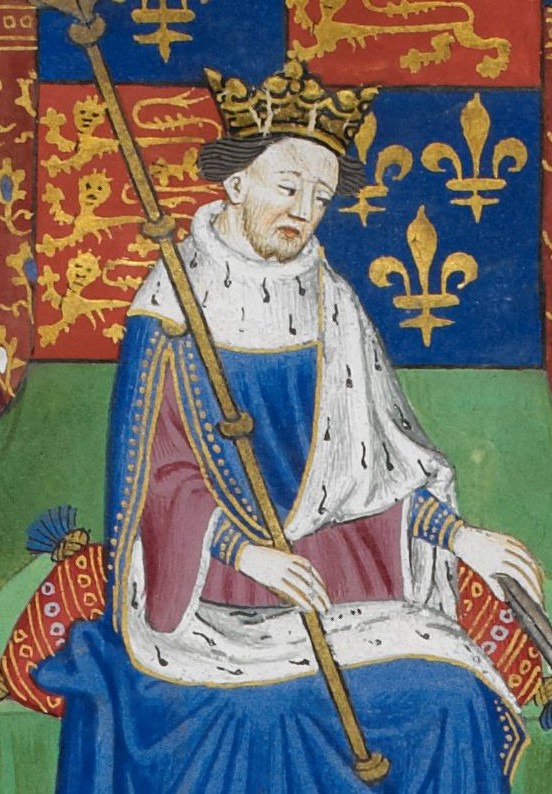
Henry VI
Henricus VI
King of England · King of France (1422–1453) · Lord of Ireland
1421 – 1471
- Born
- 1421
- Died
- 1471
- Reign
- 1422 – 1461
- House
- Plantagenet
Biography
No English monarch has come to the throne younger than Henry VI, who succeeded his father Henry V on 1 September 1422 at the age of nine months. Weeks later the death of his grandfather Charles VI of France made him, under the Treaty of Troyes, titular king of France as well; his mother was Catherine of Valois, Charles's daughter. He was crowned at Westminster in 1429 and at Paris in 1431, the only English king crowned in France, while his uncle John, duke of Bedford, defended the dual monarchy against the Valois revival inspired by Joan of Arc.
Henry assumed personal rule in 1437 but proved pious, unwarlike, and easily led. Inclined to peace, he married Margaret of Anjou in 1445 under the Truce of Tours; she was the daughter of Rene, duke of Anjou and titular king of Naples, and niece by marriage of Charles VII of France. The secret promise to surrender Maine that accompanied the match proved deeply unpopular. The king's most enduring acts were his foundations of Eton College in 1440 and King's College, Cambridge, in 1441. Abroad, the position collapsed: Normandy was lost by 1450, the year of Jack Cade's rebellion, and the defeat at Castillon in 1453 ended English Gascony, leaving only Calais.
In August 1453 Henry suffered a complete mental collapse, shortly before the birth of his only child, Edward of Westminster. Richard, duke of York, governed as protector during his incapacity, and the rivalry between York and the queen's party hardened into the dynastic conflict later called the Wars of the Roses, opening at St Albans in 1455. After York's son won the decisive battle of Towton in March 1461, Henry was deposed in favour of Edward IV.
Captured in 1465 after years as a fugitive, Henry was held in the Tower of London until the earl of Warwick's revolt briefly restored him in October 1470, a nominal "readeption" in which he was little more than a figurehead. Edward IV's victories at Barnet and Tewkesbury in the spring of 1471 destroyed the Lancastrian cause; Henry's son was killed at Tewkesbury, and Henry himself died in the Tower on the night of 21 May 1471, almost certainly killed on Edward's orders.
Updated June 2026 · How we research
Events
Thirty-two years of intermittent civil war between the Lancastrian and Yorkist branches of the Plantagenet dynasty, triggered by the recurring incapacity of Henry VI and the rival claim of Richard, Duke of York. The conflict produced six battles in the 1450s–1460s, the murderous reign of Edward IV, the disappearance of his sons in the Tower, and the final defeat of Richard III at Bosworth in 1485. Resolved by the marriage of Henry VII and Elizabeth of York the following year.
Also there: Margaret of Anjou, Edward IV, Richard III, Henry VII
Connections across houses
Place Henry VI in the wider world of ruling houses.
Recommended Reading
Affiliate disclosure: the links below go to Amazon searches. As an Amazon Associate, Dynastica earns from qualifying purchases.