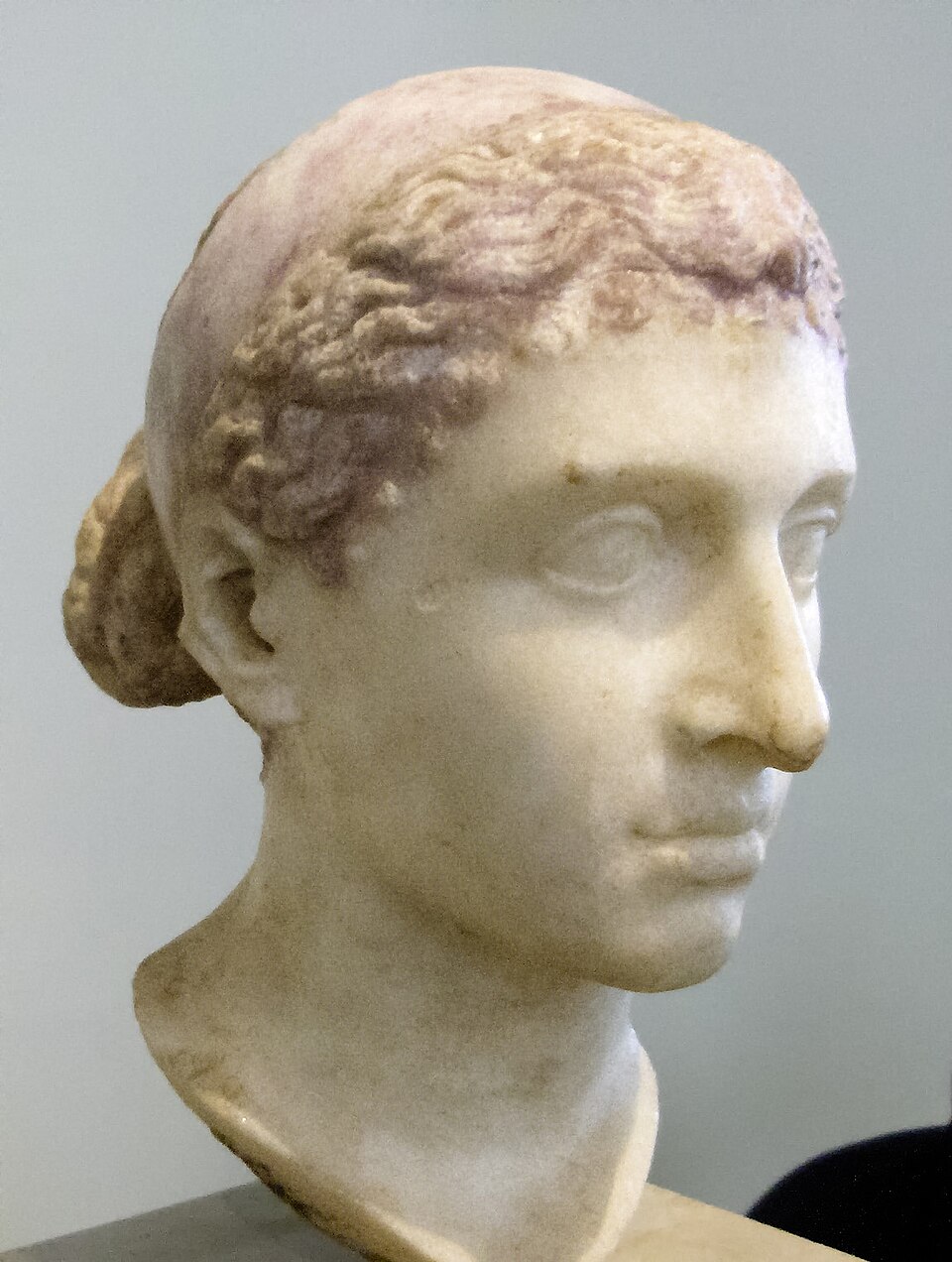
Cleopatra VII Philopator
Queen of Egypt · Pharaoh
69 BC – 30 BC
- Born
- 69 BC
- Died
- 30 BC
- House
- Ptolemaic Dynasty
Biography
The last active ruler of the Ptolemaic dynasty, Cleopatra VII Philopator governed Egypt for over two decades and became one of the most recognised figures of the ancient world. Born in 69 BC, a daughter of Ptolemy XII Auletes, she inherited the throne in 51 BC jointly with her younger brother Ptolemy XIII, in keeping with the dynasty's practice of sibling co-rule. Unlike many of her predecessors, she is said by Plutarch to have learned the Egyptian language, the first of her Macedonian house reported to do so.
Rivalry with her brother's faction drove her from power, but the arrival of Julius Caesar in Alexandria in 48 BC, in pursuit of his defeated rival Pompey, transformed her position. Caesar took her side in the dynastic quarrel; Ptolemy XIII died during the ensuing Alexandrian War, and Cleopatra was restored, ruling first with another brother, Ptolemy XIV, and later with Ptolemy XV Caesarion, her son, whose father she declared to be Caesar. She visited Rome and was there when Caesar was assassinated in 44 BC.
In the new order that followed, she aligned with Marcus Antonius, whom she met at Tarsus in 41 BC. Their political and personal alliance produced three children and bound Egypt's resources to Antony's ambitions in the East. At the Donations of Alexandria in 34 BC, Antony distributed eastern territories among Cleopatra and her children, a ceremony that Octavian exploited in the propaganda war preceding the final conflict. Rome declared war on Cleopatra, and at Actium in 31 BC the fleet of Antony and Cleopatra was defeated.
Octavian entered Egypt in 30 BC. Antony took his own life, and Cleopatra, after failed negotiations, followed; the tradition that she died from the bite of an asp, an Egyptian cobra, circulated soon after her death, though the exact means was already uncertain in antiquity. She was thirty-nine. With her death and the killing of Caesarion, the dynasty founded by Ptolemy I came to an end after nearly three centuries, and Egypt became a province of the Roman empire. Ancient hostile sources and later literature have shaped her image heavily, but contemporary evidence shows a capable administrator who kept her kingdom independent longer than its circumstances made likely.
Updated June 2026 · How we research
Connections across houses
Place Cleopatra VII Philopator in the wider world of ruling houses.
Recommended Reading
Affiliate disclosure: the links below go to Amazon searches. As an Amazon Associate, Dynastica earns from qualifying purchases.