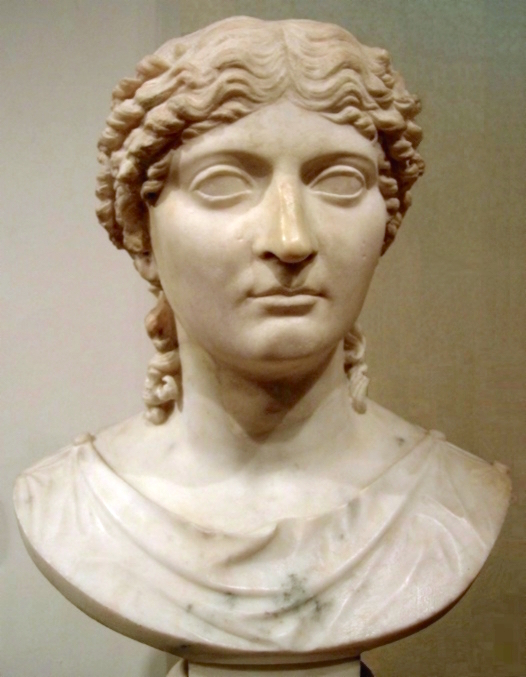
Agrippina the Younger
Iulia Agrippina Augusta
Augusta · Empress consort
15 – 59
- Born
- 15
- Died
- 59
- House
- Roman Empire
Biography
Few members of the imperial family concentrated as many strands of the Julio-Claudian dynasty as Agrippina the Younger: daughter of Germanicus, great-granddaughter of Augustus, sister of Caligula, wife of Claudius and mother of Nero. She was born in AD 15 at a Roman base on the Rhine, on the site of the later Colonia Agrippinensis, modern Cologne, founded in her honor in 50.
Her first marriage, to Gnaeus Domitius Ahenobarbus, produced her only child, the future Nero, in 37. Under her brother Caligula she was implicated in an alleged conspiracy in 39 and exiled; her uncle Claudius recalled her on his accession in 41. After the fall of Claudius's wife Messalina in 48, Agrippina married the emperor himself in 49, a union between uncle and niece that required the Senate to amend the law on permissible marriage. The match rejoined the bloodline of Augustus, which she carried, to the Claudian branch then holding the throne, and it was completed in 50 when Claudius adopted her son as Nero Claudius Caesar, placing him ahead of his own younger son Britannicus in the succession. In the same year she received the title Augusta, unprecedented for the living wife of a reigning emperor.
Claudius died in October 54. Tacitus, Suetonius and Cassius Dio allege that Agrippina poisoned him with mushrooms; the claim was current almost immediately but cannot be confirmed, and some modern historians regard a natural death as equally possible. Nero, aged sixteen, succeeded smoothly, and in the first months Agrippina exercised open influence, appearing with her son on coinage in a manner without precedent.
Her ascendancy was brief. Nero progressively excluded her from power, and in March 59 he had her killed at her villa near Baiae after, in the detailed account of Tacitus, a collapsing ship intended to drown her had failed. She left memoirs of her family's fortunes, now lost, which Tacitus and the elder Pliny cite, making her one of the few Roman imperial women known to have written an account of her own house.
Updated June 2026 · How we research
Connections across houses
Place Agrippina the Younger in the wider world of ruling houses.
Recommended Reading
Affiliate disclosure: the links below go to Amazon searches. As an Amazon Associate, Dynastica earns from qualifying purchases.