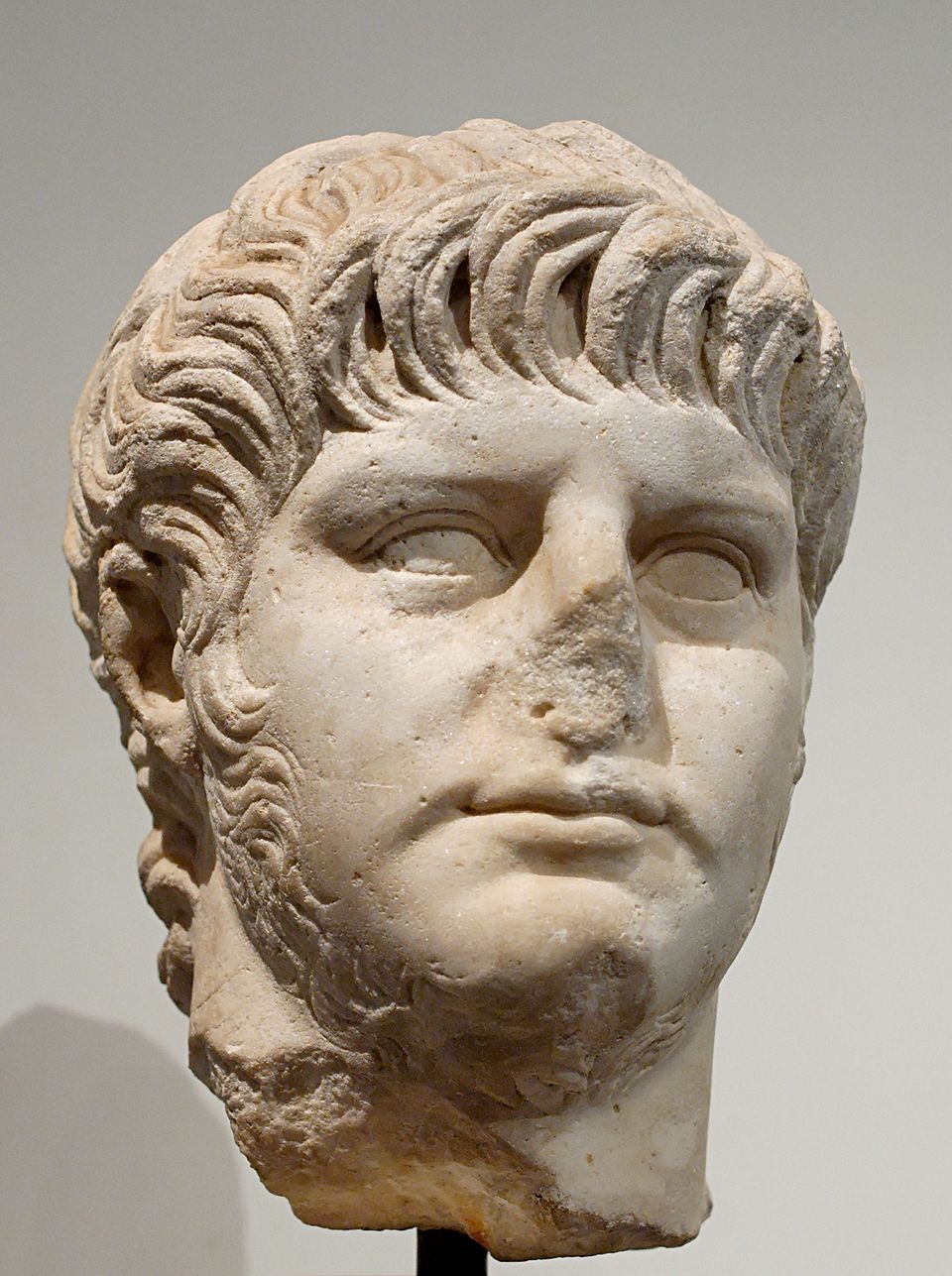
Nero
Nero Claudius Caesar Augustus Germanicus
Imperator · Princeps
37 – 68
- Born
- 37
- Died
- 68
- Reign
- 54 – 68
- House
- Roman Empire
Biography
Nero, the last emperor of the Julio-Claudian dynasty, ruled from AD 54 to 68. Born Lucius Domitius Ahenobarbus at Antium in 37, he was the son of Gnaeus Domitius Ahenobarbus and Agrippina the Younger, a sister of Caligula and great-granddaughter of Augustus. After Agrippina married the emperor Claudius, her uncle, Claudius adopted the boy in 50, and the adoption — characteristic of the way the dynasty joined its Julian and Claudian lines — placed him ahead of Claudius's own son Britannicus in the succession. He married Claudius's daughter Octavia in 53 and became emperor at sixteen on Claudius's death the following year.
The early reign was steered by his tutor Seneca and the praetorian prefect Burrus and was later remembered as a period of competent government. Tensions with his mother grew as Nero asserted independence, and in 59 he had Agrippina killed. Octavia was divorced and put to death in 62, after which he married Poppaea Sabina. Abroad, his generals fought a long war with Parthia over Armenia, settled by compromise in 63, and suppressed the revolt of Boudica in Britain in 60-61.
In July 64 a fire destroyed much of Rome. Nero organized relief and rebuilt the city on a more regular plan, but rumors that he had started the blaze persisted, and he directed blame onto the Christians of Rome, who were executed in numbers. On ground cleared by the fire he built the Domus Aurea, a vast palace complex whose expense deepened hostility toward him. He performed publicly as a singer and charioteer, conduct traditionalists considered disgraceful in a Roman aristocrat, and toured the festivals of Greece in 66-67.
The Pisonian conspiracy of 65 was detected and harshly punished; Seneca and the poet Lucan were among those forced to die. In 68 the governor Vindex rose in Gaul and Galba was proclaimed in Spain. Deserted by the Praetorian Guard and declared a public enemy by the Senate, Nero killed himself in June 68, aged thirty. With him the line descended from Augustus ended, and the empire passed into the civil wars of the Year of the Four Emperors.
Updated June 2026 · How we research
Events
A fire that began in the merchant district around the Circus Maximus burned for six days and destroyed two-thirds of the city. The emperor Nero, despite later legend, was at Antium when it broke out and returned to organize relief; he then made the city's Christians a scapegoat for the disaster, crucifying members of the community in his gardens. The persecution gave Christianity its first Roman martyrs.
Connections across houses
Place Nero in the wider world of ruling houses.
Recommended Reading
Affiliate disclosure: the links below go to Amazon searches. As an Amazon Associate, Dynastica earns from qualifying purchases.