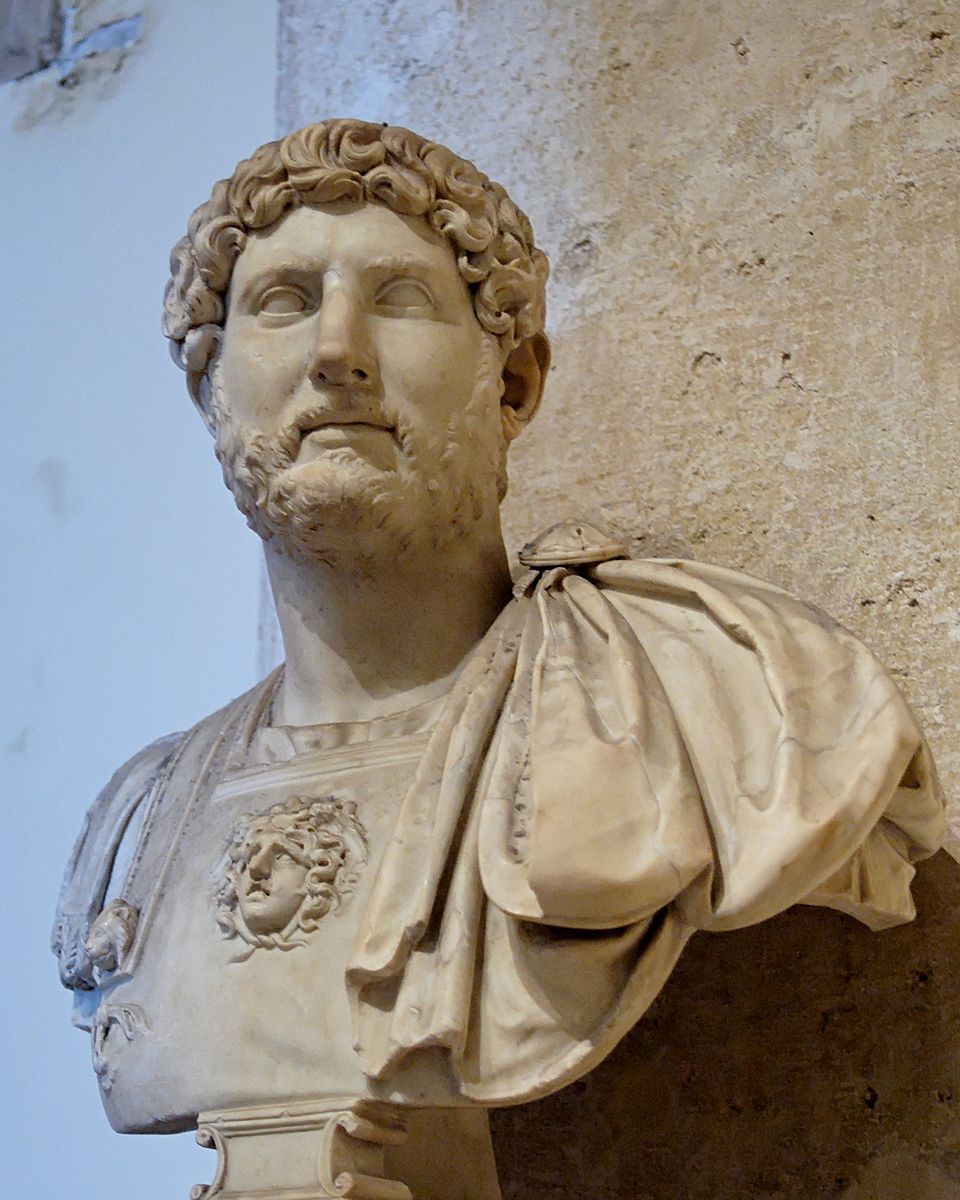
Hadrian
Imperator Caesar Traianus Hadrianus Augustus
Imperator · Princeps
76 – 138
- Born
- 76
- Died
- 138
- Reign
- 117 – 138
- House
- Roman Empire
Biography
Hadrian succeeded Trajan in AD 117 and redirected the empire from expansion toward consolidation. Born in 76 into a senatorial family from Italica in Spain, the same town as Trajan, he lost his father young and came under the guardianship of Trajan, his father's cousin. His position in the dynasty was secured by marriage as much as blood: around 100 he married Vibia Sabina, Trajan's grandniece. He served in the Dacian Wars and held a series of commands, and when Trajan died in Cilicia in 117 Hadrian, then governor of Syria, was announced as his adopted son and heir, an adoption some contemporaries suspected had been arranged by the empress Plotina.
His first major decision was to abandon Trajan's conquests in Mesopotamia and Armenia, judging them indefensible. Thereafter he gave the empire fixed, fortified frontiers, of which the stone wall across northern Britain begun in 122 and bearing his name is the most famous. Hadrian spent more than half his reign traveling the provinces, inspecting armies, founding cities, and patronizing building from Britain to Egypt. A committed admirer of Greek culture, he completed the temple of Olympian Zeus at Athens and organized the Panhellenion, a league of Greek cities. In Rome he rebuilt the Pantheon in the domed form that survives, and outside the city he laid out the vast villa at Tivoli.
His philhellenism extended to his companion Antinous, a young Bithynian who drowned in the Nile in 130 and whom Hadrian deified, founding the city of Antinoopolis in his memory. The gravest crisis of the reign was the Bar Kokhba revolt in Judaea (132-136), suppressed at great cost in lives; Jerusalem was refounded as the colony Aelia Capitolina.
Childless and in failing health, Hadrian arranged the succession for two generations. After the death of his first choice, Aelius Caesar, he adopted Antoninus Pius in 138 on condition that Antoninus in turn adopt the young Marcus Aurelius and Lucius Verus, extending the chain of adoptive succession that had governed the empire since Nerva. Hadrian died at Baiae in July 138 and was buried in the mausoleum he had built on the Tiber, now the Castel Sant'Angelo.
Updated June 2026 · How we research
Connections across houses
Place Hadrian in the wider world of ruling houses.
Recommended Reading
Affiliate disclosure: the links below go to Amazon searches. As an Amazon Associate, Dynastica earns from qualifying purchases.