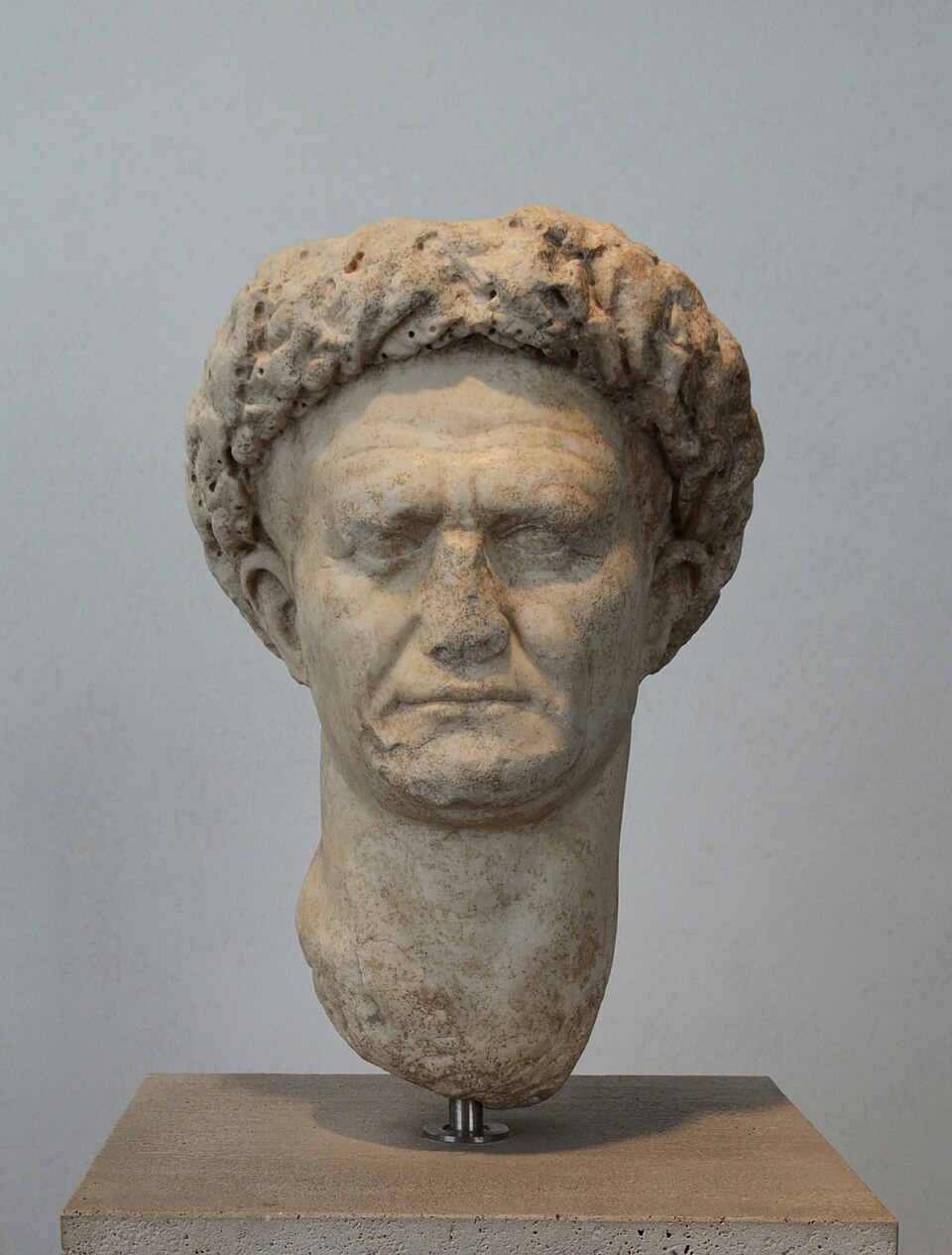
Vespasian
Imperator Caesar Vespasianus Augustus
Imperator · Princeps · Founder of the Flavian dynasty
9 – 79
- Born
- 9
- Died
- 79
- Reign
- 69 – 79
- House
- Roman Empire
Biography
Unlike his Julio-Claudian predecessors, Vespasian came from an undistinguished equestrian family of the Sabine country, born near Reate in AD 9. His rise illustrates how the imperial system created careers outside the old aristocracy. As legate of the Second Legion he served with distinction in Claudius's invasion of Britain in 43, owing his early advancement partly to favor at the Claudian court, where his son Titus was brought up alongside Claudius's son Britannicus — a personal link between the dynasty Vespasian served and the one he later founded.
After a consulship in 51 and the proconsulship of Africa, Nero appointed him in 67 to suppress the great revolt in Judaea. He was conducting that war when Nero's death in 68 ended the Julio-Claudian line and opened the civil wars of the Year of the Four Emperors. In July 69 the legions of Egypt, Judaea and Syria proclaimed Vespasian; his partisans defeated Vitellius's forces in northern Italy, and Rome fell to them in December 69. The Senate formally conferred his powers, and a surviving fragment of the law recording the grant, the lex de imperio Vespasiani, remains a key document of the principate.
His decade in power was devoted to consolidation. He restored state finances depleted by Nero's expenditure and the civil wars, imposing new taxes with unapologetic pragmatism. He held the censorship with Titus, recruited new men from Italy and the provinces into the Senate, and extended Latin rights widely in Spain. In Rome he built the Temple of Peace and began the Flavian Amphitheatre, the Colosseum, on the drained lake of Nero's Golden House — a deliberate return of dynastic land to public use.
Vespasian openly grounded his legitimacy in his sons. Titus, who completed the Judaean war, was groomed as partner in power, and the succession passed to him peacefully when Vespasian died of illness in June 79, the first emperor succeeded directly by a natural son. Through Titus and then Domitian, the Flavian dynasty he founded ruled until 96.
Updated June 2026 · How we research
Connections across houses
Place Vespasian in the wider world of ruling houses.
Recommended Reading
Affiliate disclosure: the links below go to Amazon searches. As an Amazon Associate, Dynastica earns from qualifying purchases.