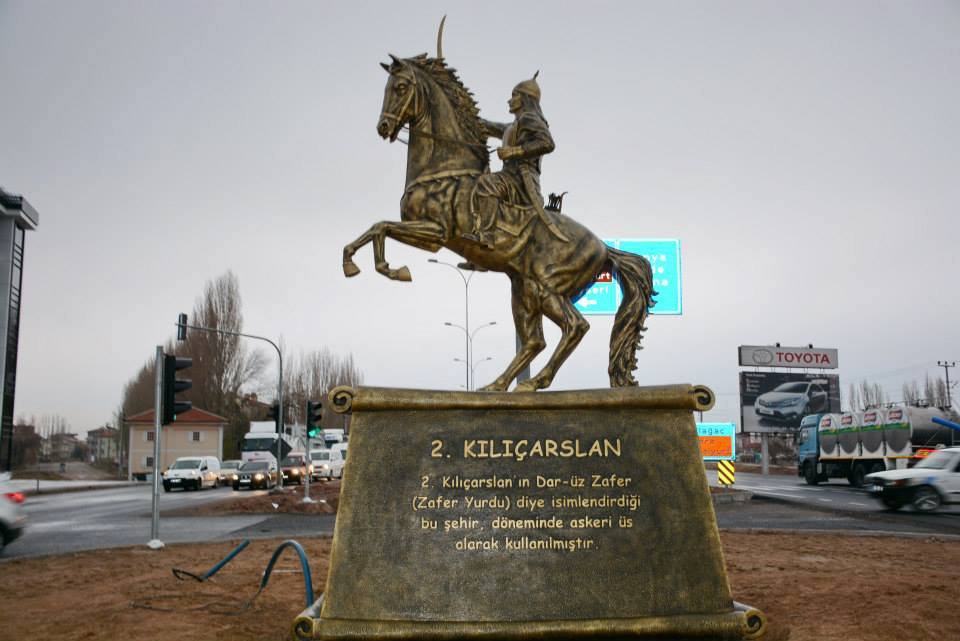
Kilij Arslan I
Sultan of Rum
1079 – 1107
- Born
- 1079
- Died
- 1107
- Reign
- 1092 – 1107
- House
- Seljuk Dynasty
Biography
Kilij Arslan I was the first Muslim ruler to face a crusade, and his career fixed the Sultanate of Rum as a permanent fact of Anatolian history. He belonged to the dynasty's rival branch: his great-grandfather Qutalmish had died contesting the throne against Alp Arslan, and his father Suleiman ibn Qutalmish had carved out a sultanate in Byzantine Anatolia, taking Nicaea, before dying in 1086 in a war against fellow Seljuks in Syria. The boy was held at Malik-Shah's court as a hostage, and only the great sultan's death in 1092 freed him to return west, where he reclaimed Nicaea and his father's title.
His first encounter with the crusading movement was deceptively easy. In October 1096 his forces annihilated the People's Crusade, the undisciplined mass that had followed Peter the Hermit across the Bosporus, at Civetot near Nicaea. Judging the Franks a nuisance rather than a threat, he was away campaigning against the Danishmendids for Melitene when the armies of the First Crusade — a different instrument altogether — invested Nicaea in May 1097. He failed to break the siege, and the city surrendered to the Byzantines in June; his wife and children, captured inside, were returned by the emperor without ransom. At Dorylaeum on 1 July 1097 he ambushed the crusader vanguard with Danishmendid allies and was driven off when the main body came up. Thereafter he resorted to scorched earth across the plateau, harassing rather than confronting the Franks on their march to Syria.
The defeats were not final. Kilij Arslan moved his capital inland to Konya, and in 1101 he led the coalition that destroyed three successive crusading armies near Mersivan and in the south — victories that restored Turkish control of central Anatolia and ended the notion that crusaders crossed the peninsula at will. Confident in his recovered strength, he pushed east, taking Malatya in 1106 and even Mosul in 1107, inserting himself into the politics of the Seljuk east. There he overreached. Confronting Jawali, the sultan Muhammad Tapar's emir, near the Khabur river in June 1107, his army broke, and Kilij Arslan drowned in the river during the rout, in his late twenties. His sons continued the line at Konya, which would outlast the Great Seljuks by more than a century and seed the Turkification of Anatolia.
Updated June 2026 · How we research
Events
Nicaea, a walled city on the shore of Lake Ascanius in northwestern Anatolia, served as the capital of Kilij Arslan I, sultan of the Seljuk Sultanate of Rum. In May 1097 the armies of the First Crusade, ferried across the Bosporus with Byzantine assistance, invested the city. It was the crusade's first major operation, undertaken in cooperation with the emperor Alexios I Komnenos, to whom the crusade's leaders had sworn oaths regarding former imperial territory. Kilij Arslan was absent when the siege began, campaigning in eastern Anatolia against the Danishmend Turks over the city of Melitene; his treasury and family remained inside Nicaea. Having underestimated the size and seriousness of the crusader host, he returned by forced marches and attacked the besiegers' southern positions on 21 May. The relief attempt failed against superior numbers, and the sultan withdrew into the interior, leaving the garrison to its own devices. The city's western wall fronted the lake, which kept it supplied and uncaptured until Alexios had boats hauled overland and launched on the water, closing the last route in mid-June. Cut off, the garrison negotiated with Byzantine representatives rather than with the crusader princes, and on 19 June 1097 the city surrendered directly to imperial officers. Crusaders were admitted only in small escorted groups, and the city was spared a sack, an arrangement that protected the inhabitants but fed lasting resentment between the Latin leadership and the emperor. A week later the crusade marched east; Kilij Arslan attacked the leading column at Dorylaeum on 1 July and was again defeated. He abandoned the western plateau, moving his capital inland to Konya, and the Byzantines recovered Nicaea and the Aegean coastlands after sixteen years of Seljuk rule.
Connections across houses
Place Kilij Arslan I in the wider world of ruling houses.
Recommended Reading
Affiliate disclosure: the links below go to Amazon searches. As an Amazon Associate, Dynastica earns from qualifying purchases.