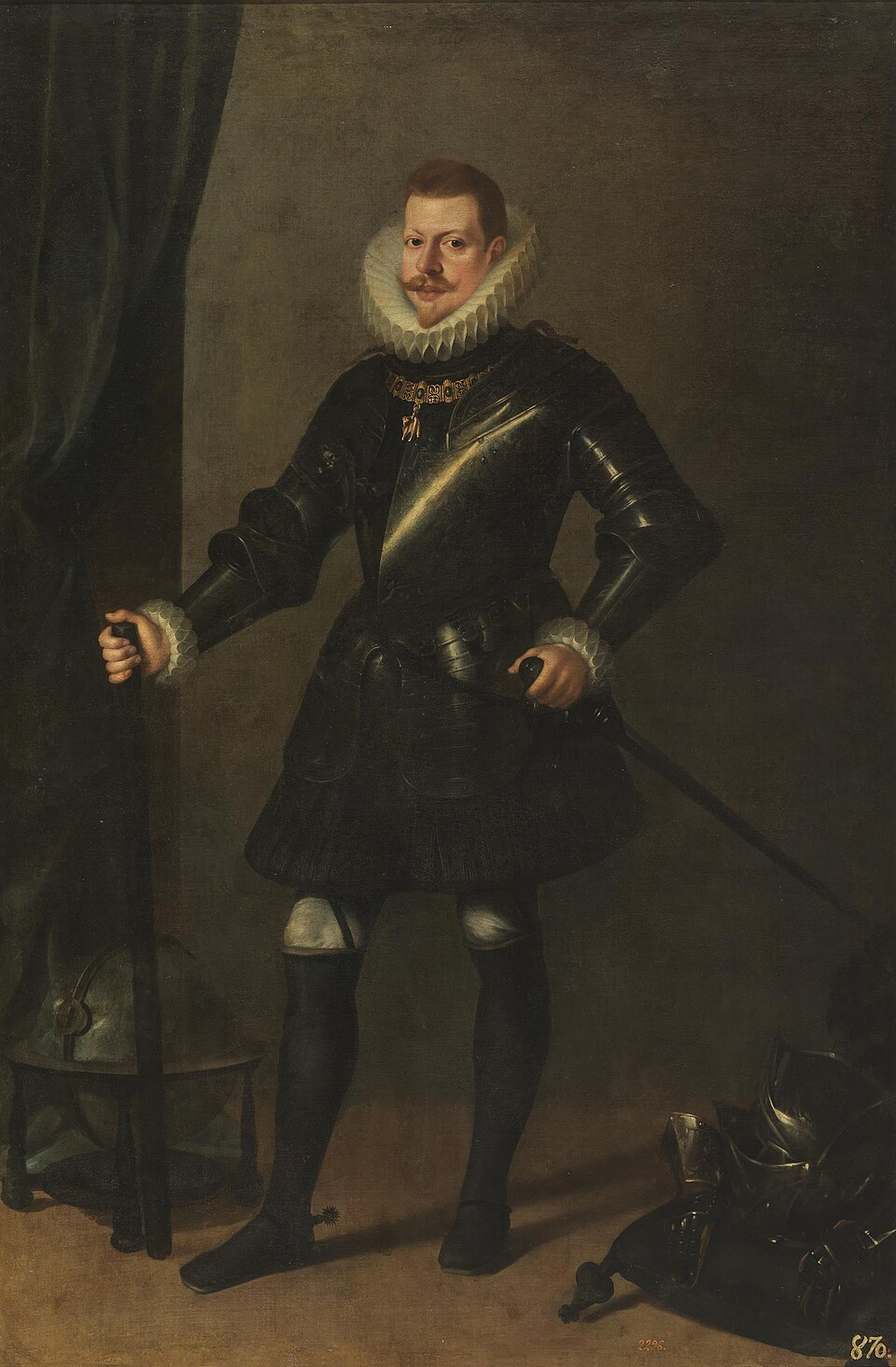
Philip III of Spain
King of Spain · King of Portugal
1578 – 1621
- Born
- 1578
- Died
- 1621
- House
- Spanish Habsburgs
Biography
The reign of Philip III (1578-1621) introduced into Spanish government the rule of the valido, the royal favorite who governed in the king's name. He was the son of Philip II by his fourth wife, Anna of Austria, herself a Habsburg of the imperial line — one of the recurrent marriages by which the Spanish and Austrian branches of the dynasty reinforced their alliance. None of his elder half-brothers or brothers survived, and he succeeded his father in September 1598, aged twenty.
Pious and retiring, Philip entrusted affairs almost entirely to Francisco Gómez de Sandoval y Rojas, Duke of Lerma, who accumulated offices and wealth on an unprecedented scale and presided over a court marked by patronage and corruption until his fall in 1618, when he was replaced by his own son, the Duke of Uceda. In 1599 Philip married Margaret of Austria, of the Styrian branch of the Austrian Habsburgs; she died in 1611. Their children carried the dynastic network onward: Philip IV succeeded in Spain; Anne of Austria married Louis XIII of France and became the mother of Louis XIV; Maria Anna married the future Emperor Ferdinand III.
The reign brought a pause in Spain's wars, sometimes called the Pax Hispanica. Peace was concluded with England in 1604, and in 1609 the Twelve Years' Truce suspended the long war with the Dutch rebels, a tacit acknowledgment of the Republic's de facto independence. The same year the crown ordered the expulsion of the Moriscos, the descendants of converted Muslims; some 300,000 people were deported by 1614, with damaging economic effects in Valencia and Aragon. Castile's underlying difficulties — fiscal exhaustion, debased coinage, plague losses from the late 1590s — went largely unaddressed, prompting the analyses of contemporary reform writers known as arbitristas.
In his final years Spain was drawn back toward general war. When the Bohemian revolt of 1618 opened the Thirty Years' War, Philip supported his Austrian cousins with money and troops, including the army that helped win the White Mountain in 1620. He died in Madrid on 31 March 1621, shortly before the truce with the Dutch expired, leaving his sixteen-year-old son Philip IV a monarchy about to resume war on multiple fronts.
Updated June 2026 · How we research
Connections across houses
Place Philip III of Spain in the wider world of ruling houses.
Recommended Reading
Affiliate disclosure: the links below go to Amazon searches. As an Amazon Associate, Dynastica earns from qualifying purchases.