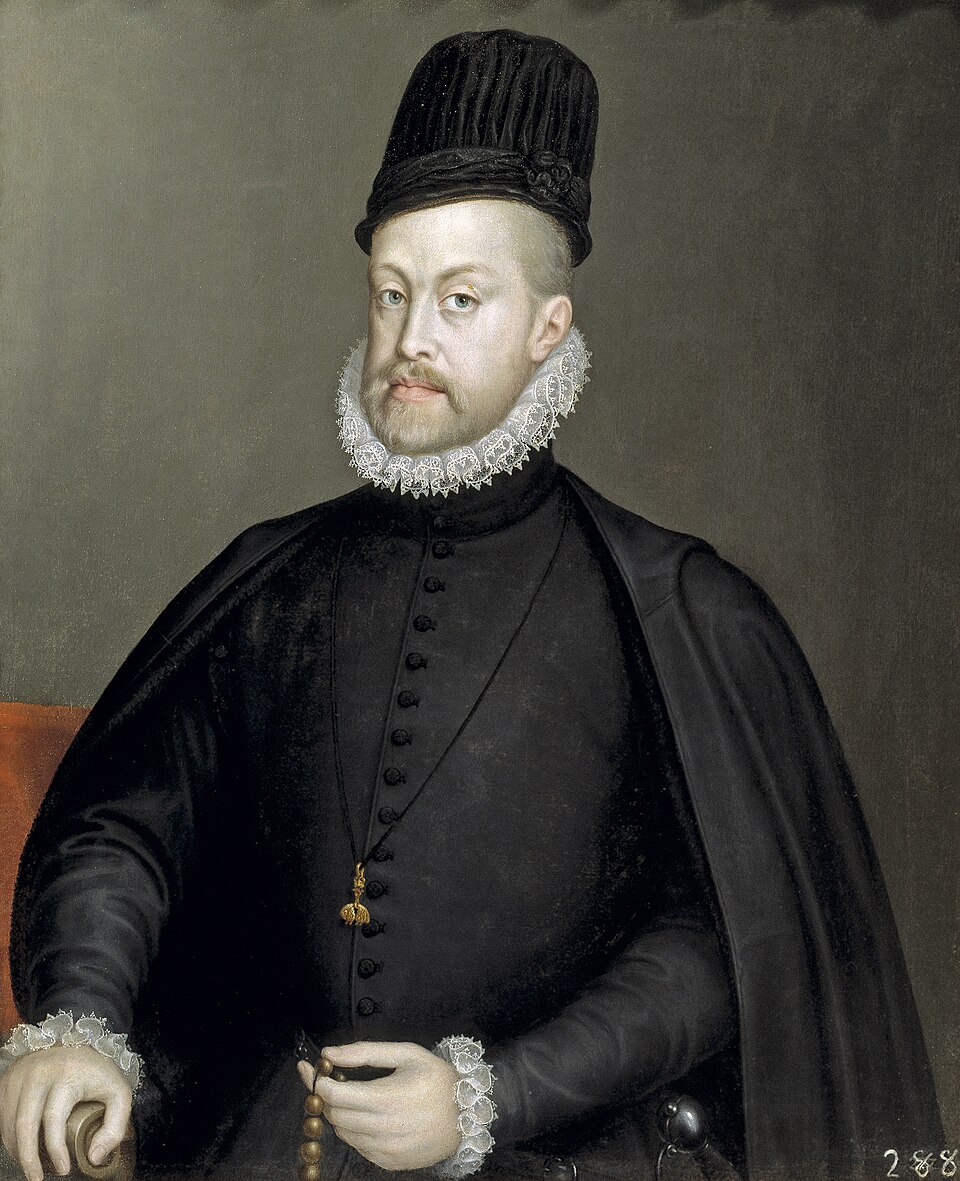
Philip II of Spain
King of Spain · King of Portugal · King of Naples and Sicily
1527 – 1598
- Born
- 1527
- Died
- 1598
- House
- Spanish Habsburgs
Biography
Under Philip II (1527-1598) the Spanish monarchy reached its greatest territorial extent and assumed the burdens that came with it. The only legitimate son of Charles V and Isabella of Portugal, he was born at Valladolid and educated in Castile, unlike his itinerant, Netherlands-born father. Charles's abdications of 1555-1556 gave Philip Spain, the Netherlands, Franche-Comté, and the Italian possessions, while the imperial title passed to his uncle Ferdinand I, completing the separation of the Spanish and Austrian branches of the house; the two lines remained allies and continued to intermarry.
Philip married four times: Maria Manuela of Portugal, mother of the unstable Don Carlos, who died in confinement in 1568; Mary I of England, whose death in 1558 ended his association with the English crown; Elisabeth of Valois, sealing the Peace of Cateau-Cambrésis with France in 1559; and his niece Anna of Austria, daughter of Emperor Maximilian II, mother of his heir Philip III. In 1580, after the extinction of the Aviz male line, he enforced his claim to Portugal through his mother, uniting the entire Iberian peninsula and the Portuguese overseas empire under one ruler.
He governed this assemblage from Castile as a bureaucrat-king, working through paper rather than presence, and built the Escorial as palace, monastery, and dynastic mausoleum. Revenue from American silver underwrote his wars but never sufficed; the crown suspended payments to its creditors several times during the reign. His foreign policy was framed as the defense of Catholic Christendom: a Spanish-led Holy League fleet defeated the Ottomans at Lepanto in 1571, and he intervened in the French Wars of Religion against Henry IV.
The revolt of the Netherlands, beginning in the 1560s, became the reign's longest war. The repression conducted by the Duke of Alba failed to end it, and by Philip's death the northern provinces were effectively independent under the Dutch Republic. War with England, fed by Elizabeth I's support for the rebels, produced the Armada of 1588, which failed disastrously in its attempt to convoy an invasion force. Philip died at the Escorial on 13 September 1598, succeeded by his son Philip III, leaving a monarchy still vast but financially strained and committed on multiple fronts.
Updated June 2026 · How we research
Events
On 25 July 1554 Mary Tudor married her cousin Philip of Spain, son of the Holy Roman Emperor Charles V, in Winchester Cathedral. The match was deeply unpopular in England — a Catholic prince of the rising Habsburg superpower marrying the reigning queen on terms widely seen as compromising English sovereignty. The marriage produced no children; on Mary's death Philip lost his English title and pursued the throne through war against her Protestant successor Elizabeth.
Also there: Mary I
Between 1554 and 1556 Charles V, exhausted by four decades of universal war, partitioned the empire he had inherited intact. His son Philip received Spain, the Indies, the Italian possessions, and the Low Countries; his brother Ferdinand received Austria, Bohemia, Hungary, and ultimately the imperial title. The split divided the Habsburgs into Spanish and Austrian branches that would remain cousin powers for the next century and a half. Charles retired to a monastery in Yuste and died there in 1558.
Also there: Charles V, Ferdinand I
Philip II of Spain assembled the Grande y Felicísima Armada — 130 ships, 30,000 men — to invade Elizabethan England, depose its Protestant queen, and reclaim the English throne for Catholicism. English long-range gunnery, fireships at Calais, and the great Atlantic gales drove the fleet north around Scotland and Ireland; perhaps half the ships and most of the men never returned to Spain. The defeat ended Spain's century-long dominance of European warfare.
Also there: Elizabeth I
Connections across houses
Where Philip II of Spain's family tree leaves the Spanish Habsburgs and enters other ruling houses.
Recommended Reading
Affiliate disclosure: the links below go to Amazon searches. As an Amazon Associate, Dynastica earns from qualifying purchases.