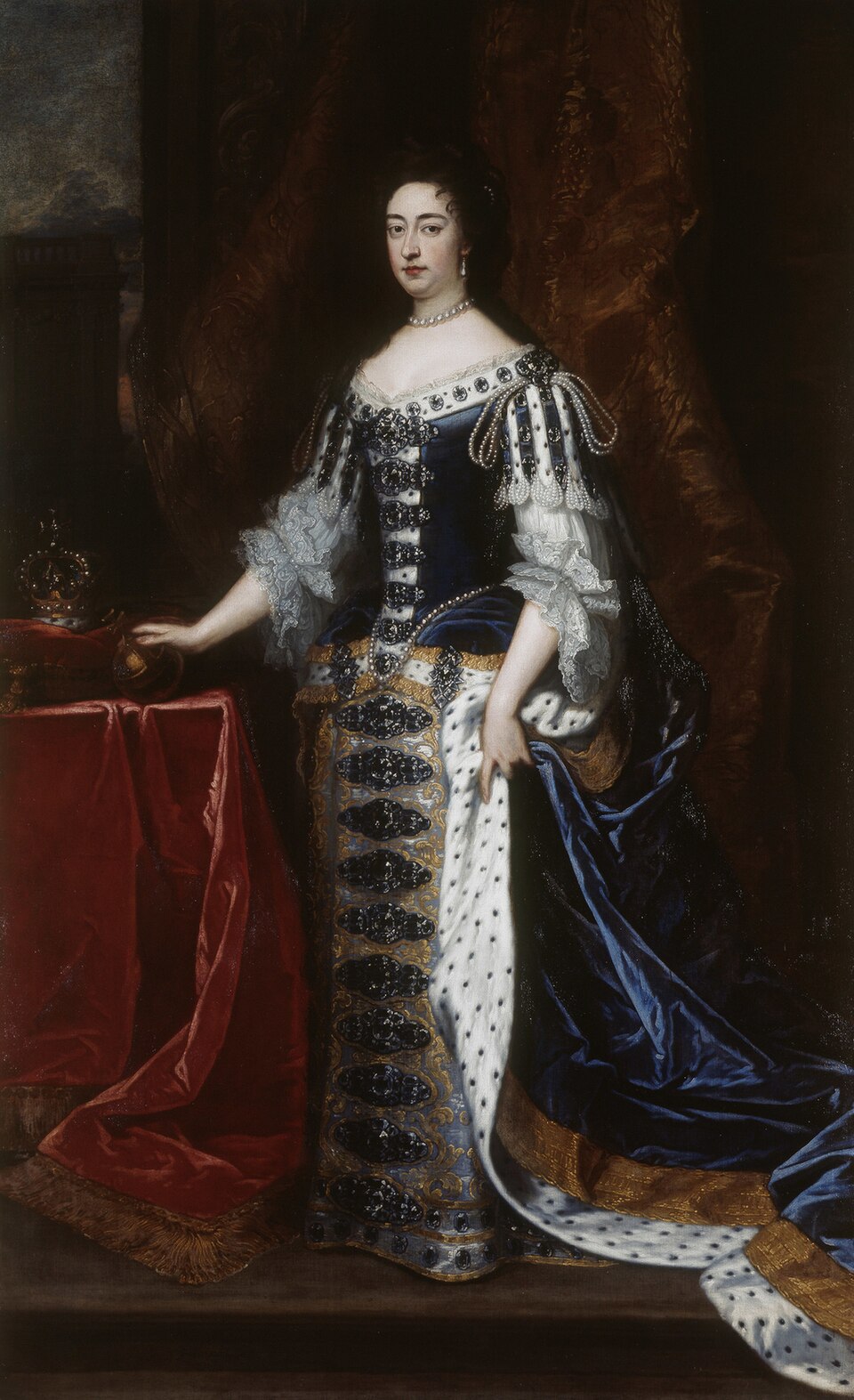
Mary II
Maria II
Queen of England · Queen of Scotland · Queen of Ireland
1662 – 1694
- Born
- 1662
- Died
- 1694
- Reign
- 1689 – 1694
- House
- Stuart
Biography
Mary II reigned jointly with her husband, the only such arrangement in English history. Born at St James's Palace on 30 April 1662, she was the eldest surviving daughter of James, Duke of York, the future James II, and his first wife Anne Hyde. Although her father converted to Catholicism, Charles II ordered that Mary and her sister Anne be raised in the Church of England, a decision with large consequences for the succession.
In November 1677, at fifteen, she was married to her first cousin William III of Orange, stadtholder of the Dutch Republic and son of Charles I's daughter Mary, Princess Royal — a match that reinforced the existing tie between the houses of Stuart and Orange-Nassau. The marriage, initially unwelcome to her, settled into a working partnership, and Mary spent the next eleven years in the Netherlands. She had no surviving children.
The crisis of 1688 placed her at the centre of English politics. The birth of a son to James II and Mary of Modena displaced Mary as heir presumptive and raised the prospect of a continuing Catholic dynasty; William's invasion that autumn ended her father's reign. Mary declined proposals that she reign alone as her father's heir, insisting on her husband's full participation, and in February 1689 the Convention Parliament offered the crown to both jointly. They were crowned in April 1689, accepting the settlement embodied in the Bill of Rights, which conditioned the monarchy on Protestant succession and parliamentary consent.
In practice Mary governed for long stretches. While William campaigned in Ireland and on the continent, she presided over the administration under the Regency Act of 1690, handling a naval war, plots, and fractious ministers with more firmness than her reluctance suggested. She took a close interest in the rebuilding of Hampton Court and the development of Kensington Palace, and pressed the project of a naval hospital at Greenwich, carried forward after her death. She died of smallpox at Kensington on 28 December 1694, aged thirty-two, and was buried in Westminster Abbey. William reigned alone until 1702, when the crown passed to her sister Anne.
Updated June 2026 · How we research
Events
An invitation from seven English peers brought William of Orange and a Dutch army ashore at Torbay on 5 November 1688. James II, lacking confidence in his own troops and forces, fled to France within weeks. Parliament declared the throne vacant by James's flight and offered it jointly to his daughter Mary and her husband William, on conditions later codified in the Bill of Rights. The settlement fixed parliamentary supremacy as the operating constitution of England.
Also there: James II and VII, Mary of Modena, William III
Connections across houses
Place Mary II in the wider world of ruling houses.
Recommended Reading
Affiliate disclosure: the links below go to Amazon searches. As an Amazon Associate, Dynastica earns from qualifying purchases.