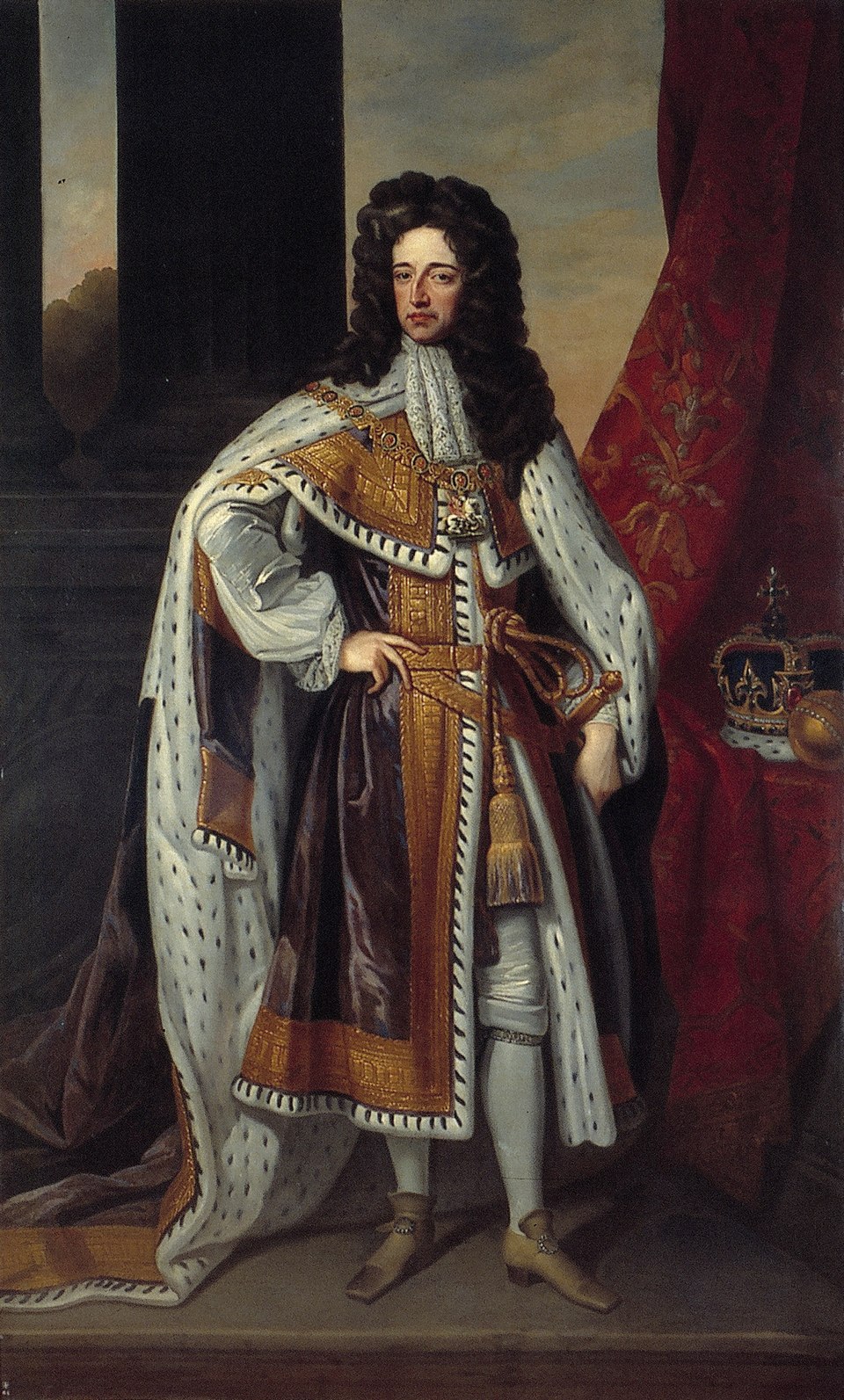
William III
Willem III
King of England · King of Scotland · King of Ireland · Stadtholder of Holland and Zeeland · Prince of Orange
1650 – 1702
- Born
- 1650
- Died
- 1702
- Reign
- 1689 – 1702
- House
- Stuart
Biography
William III united the houses of Orange-Nassau and Stuart in his own person. He was born at The Hague in November 1650, eight days after the death of his father, William II, Prince of Orange; his mother was Mary, eldest daughter of Charles I of England. His early years coincided with the Dutch Republic's stadtholderless period, but the French invasion of 1672 brought him to power as stadtholder and captain-general, and he spent the rest of his life organizing resistance to the expansion of Louis XIV's France.
In 1677 William married his first cousin Mary, elder daughter of James, Duke of York, the future James II. When James's Catholicizing policies and the birth of a male heir in 1688 alarmed the English political nation, seven notables invited William to intervene. He landed at Torbay in November 1688 with a substantial army; James fled to France, and in February 1689 Parliament offered the crown jointly to William and Mary. The accompanying Bill of Rights placed lasting conditions on the exercise of royal power.
The new reign was dominated by war. William defeated James's Franco-Irish forces at the Boyne in 1690 and brought England and Scotland into the Nine Years' War against France, which ended at Ryswick in 1697 with French recognition of his title. His reign also saw the founding of the Bank of England in 1694 and the consolidation of regular parliamentary sessions, driven by the financial demands of continental warfare.
Mary died of smallpox in December 1694, leaving William to rule alone, childless and increasingly isolated. With his sister-in-law Anne's last surviving child dead by 1700, the Act of Settlement of 1701 fixed the succession, after Anne, on the Protestant House of Hanover. William was preparing a new coalition against France in the War of the Spanish Succession when his horse stumbled at Hampton Court; he died of complications on 8 March 1702 and was succeeded by Anne.
Updated June 2026 · How we research
Events
An invitation from seven English peers brought William of Orange and a Dutch army ashore at Torbay on 5 November 1688. James II, lacking confidence in his own troops and forces, fled to France within weeks. Parliament declared the throne vacant by James's flight and offered it jointly to his daughter Mary and her husband William, on conditions later codified in the Bill of Rights. The settlement fixed parliamentary supremacy as the operating constitution of England.
Also there: James II and VII, Mary of Modena, Mary II
Connections across houses
Place William III in the wider world of ruling houses.
Recommended Reading
Affiliate disclosure: the links below go to Amazon searches. As an Amazon Associate, Dynastica earns from qualifying purchases.