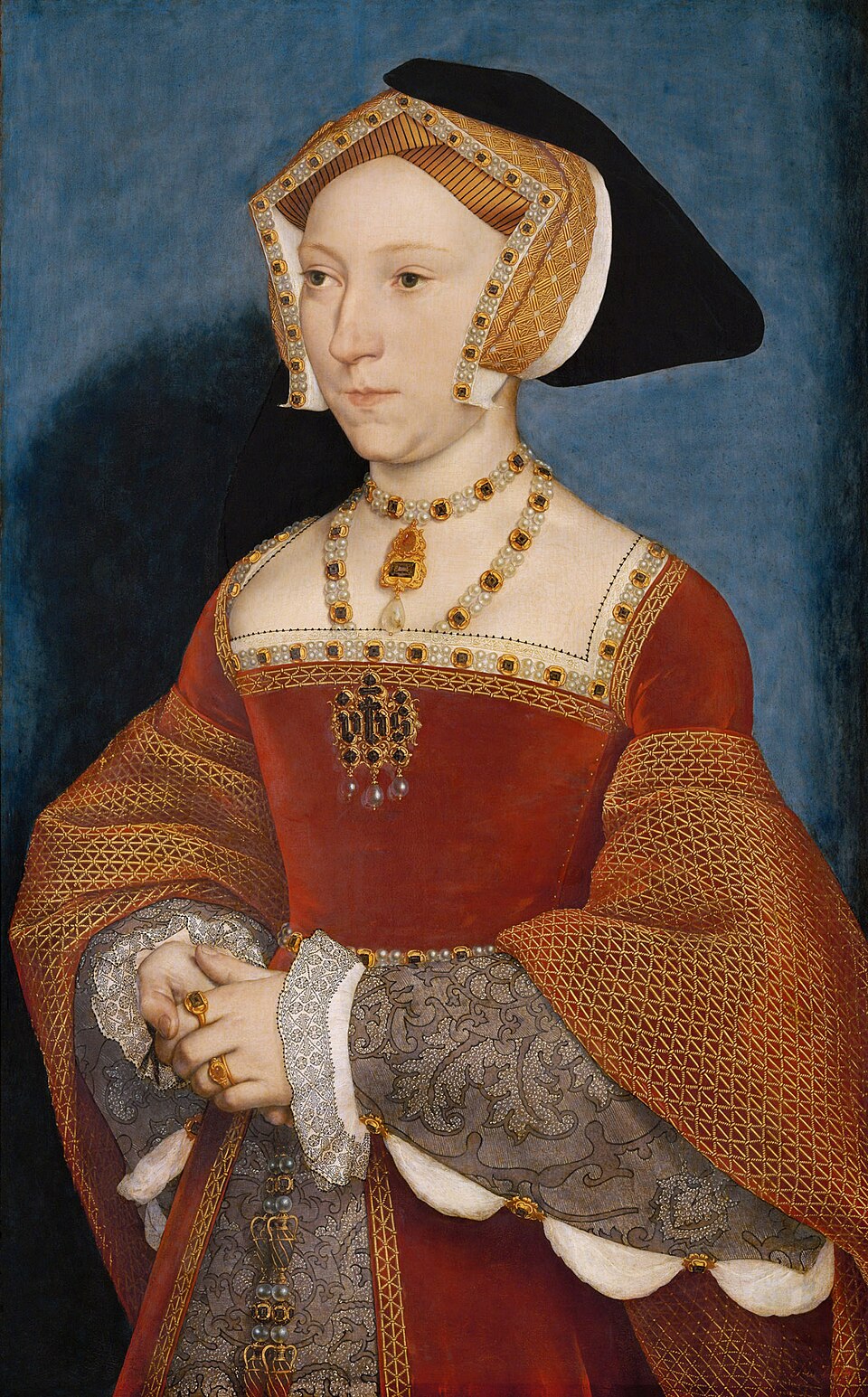
Jane Seymour
Jane Seymour
Queen of England
1508 – 1537
- Born
- 1508
- Died
- 1537
- House
- Tudor
Biography
Jane Seymour served in the households of two of Henry VIII's queens before becoming his third. Born about 1508, she was a daughter of Sir John Seymour of Wolf Hall in Wiltshire and Margery Wentworth, a gentry family of solid but not exalted standing. She came to court as a lady-in-waiting to Catherine of Aragon and continued in the same role under Anne Boleyn, attracting the king's attention by early 1536, while his second marriage was collapsing.
Events then moved with notable speed. Anne Boleyn was executed on 19 May 1536; Henry and Jane were betrothed the following day and married on 30 May at Whitehall Palace. Jane was proclaimed queen in June but was never crowned, her coronation being postponed, in part because of plague in London, and never held. As consort she adopted a conservative and conciliatory style, in marked contrast to her predecessor. Her most visible intervention was to encourage the reconciliation of Henry with his elder daughter Mary, who returned to favour at court during Jane's tenure after submitting to her father.
Her queenship was defined by the succession. In the autumn of 1537, at Hampton Court, Jane gave birth on 12 October to a son, the future Edward VI — the male heir Henry had sought through two previous marriages. The christening was celebrated with great ceremony, but Jane fell ill soon afterwards, probably with puerperal fever, and died on 24 October 1537, twelve days after the birth. She was buried in St George's Chapel, Windsor, and Henry, who outlived three further wives, directed that he be buried beside her, as he was in 1547.
Jane's brief marriage had lasting consequences for English politics. As mother of the heir she raised her family to the centre of power: her brother Edward Seymour later governed England as Lord Protector Somerset during Edward VI's minority, and her brother Thomas Seymour married Henry's widow, Catherine Parr. Henry afterwards remembered Jane as the wife who had given him a son, and she appears beside him, in place of his living queen, in dynastic portraiture commissioned in his final decade.
Updated June 2026 · How we research
Connections across houses
Place Jane Seymour in the wider world of ruling houses.
Recommended Reading
Affiliate disclosure: the links below go to Amazon searches. As an Amazon Associate, Dynastica earns from qualifying purchases.