Tudor
England · 1485 – 1603
Overview
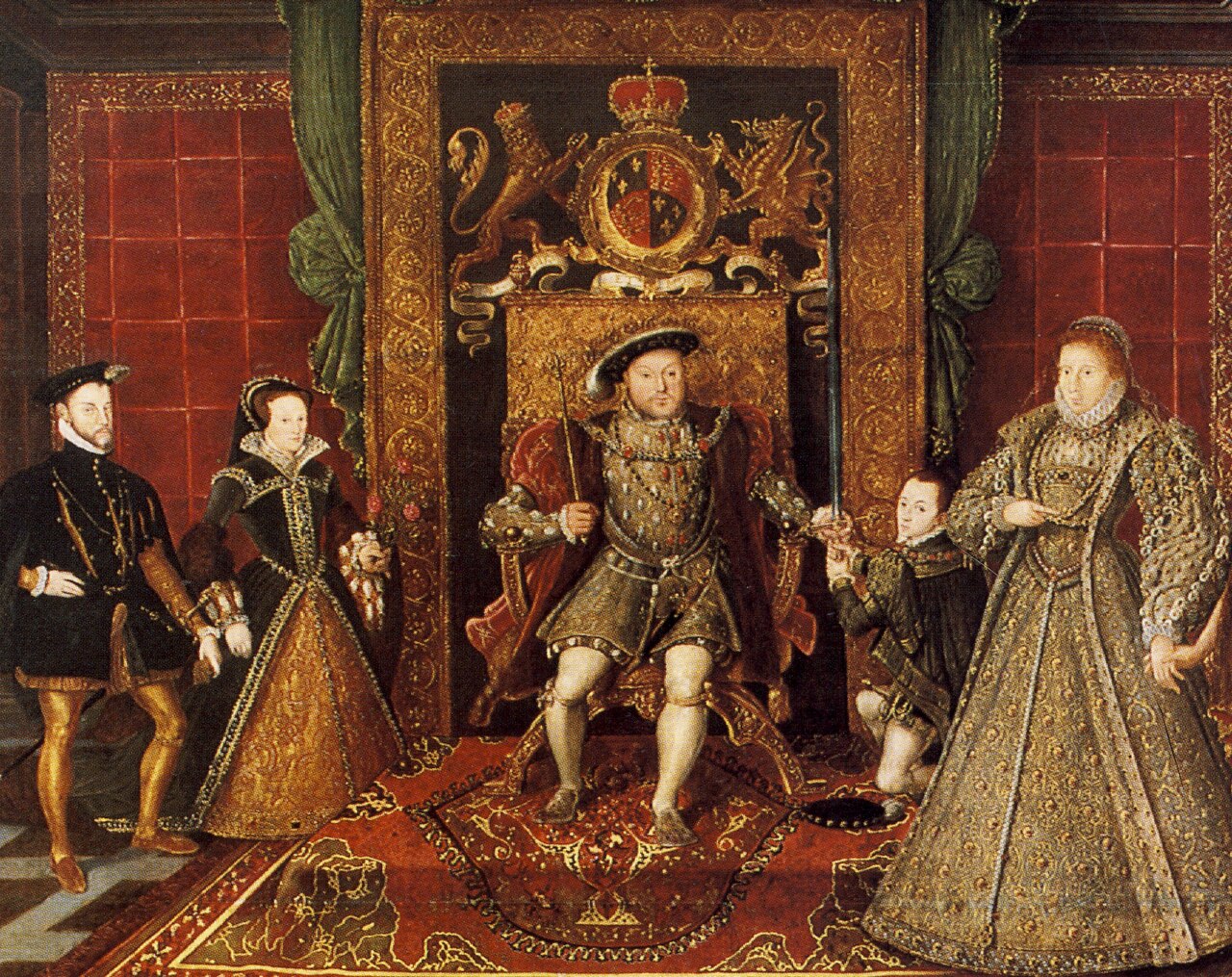
The Tudors ruled England for one hundred and eighteen years across five reigns — fewer years and fewer monarchs than any other major English dynasty — but reshaped England more decisively than any predecessor since the Norman Conquest. Their founder Henry VII won the throne by force at Bosworth Field in 1485, defeating Richard III with a claim of thin Lancastrian descent through John of Gaunt's legitimized Beaufort line. Henry's marriage to Elizabeth of York the following year fused the warring branches of the Plantagenet house and ended the Wars of the Roses by union rather than further bloodshed.
The dynasty's second and most consequential reign was Henry VIII's (1509–1547). His refusal to accept Pope Clement VII's denial of his annulment from Catherine of Aragon drove him to break with Rome, declare himself Supreme Head of the Church of England, dissolve the English monasteries, seize roughly a fifth of the kingdom's wealth, and reshape English politics around the religious settlement his decisions had created. Six marriages produced three legitimate children — Mary, Elizabeth, and Edward — each of whom would in turn wear the crown.
Edward VI (1547–1553) consolidated the English Reformation under his Protestant regents and died at fifteen of tuberculosis. Mary I (1553–1558) reversed the Reformation, married Philip II of Spain, and burned nearly three hundred Protestants at the stake before dying childless. Elizabeth I (1558–1603) restored a moderate Anglican settlement, defeated the Spanish Armada in 1588, presided over a literary golden age that produced Shakespeare and Marlowe, and reigned for forty-four years as a deliberately unmarried queen. Her death without an heir ended the Tudor line and brought her cousin James VI of Scotland to the English throne.
The Tudor genealogical legacy is denser than the brief dynasty's five reigns suggest. Through Henry VII's daughter Margaret, who married James IV of Scotland, the Tudor line transmitted the English crown to the Stuart house at Elizabeth's death; through his other daughter Mary, Queen of France, it produced the disputed Lady Jane Grey claim and the Grey-Suffolk line of Tudor descendants. Cross-dynasty bridges from the Tudor pages reach into the Plantagenet, Stuart, Spanish Habsburg, and (via marriage diplomacy) French royal lines.
Updated May 2026 · How we research
Succession of rulers
- 1.Henry VIIr. 1485 – 1509
- 2.Henry VIIIr. 1509 – 1547
- 3.Edward VIr. 1547 – 1553
- 4.Mary Ir. 1553 – 1558
- 5.Elizabeth Ir. 1558 – 1603
Rulers of the Tudor in order of accession.
Lineage
15 figures- Henry VII1457 – 1509
- Arthur, Prince of Wales1486 – 1502
- Henry VIII1491 – 1547
- Mary I1516 – 1558
- Elizabeth I1533 – 1603
- Edward VI1537 – 1553
- Margaret Tudor1489 – 1541
- Mary Tudor, Queen of France1496 – 1533
- Catherine of Aragon1485 – 1536
- Mary I1516 – 1558
- Anne Boleyn1501 – 1536
- Elizabeth I1533 – 1603
- Jane Seymour1508 – 1537
- Edward VI1537 – 1553
- Catherine Parr1512 – 1548
- Anne of Cleves1515 – 1557
- Catherine Howard1523 – 1542
- Lady Jane Grey1537 – 1554
All figures
- Henry VII1457 – 1509
- Catherine of Aragon1485 – 1536
- Arthur, Prince of Wales1486 – 1502
- Margaret Tudor1489 – 1541
- Henry VIII1491 – 1547
- Mary Tudor, Queen of France1496 – 1533
- Anne Boleyn1501 – 1536
- Jane Seymour1508 – 1537
- Catherine Parr1512 – 1548
- Anne of Cleves1515 – 1557
- Mary I1516 – 1558
- Catherine Howard1523 – 1542
- Elizabeth I1533 – 1603
- Edward VI1537 – 1553
- Lady Jane Grey1537 – 1554
Related events
Thirty-two years of intermittent civil war between the Lancastrian and Yorkist branches of the Plantagenet dynasty, triggered by the recurring incapacity of Henry VI and the rival claim of Richard, Duke of York. The conflict produced six battles in the 1450s–1460s, the murderous reign of Edward IV, the disappearance of his sons in the Tower, and the final defeat of Richard III at Bosworth in 1485. Resolved by the marriage of Henry VII and Elizabeth of York the following year.
Also involved: Plantagenet
On 22 August 1485, Henry Tudor's army of perhaps five thousand met Richard III's larger royal force on Ambion Hill in Leicestershire. The crucial defection of the Stanleys mid-battle, and Richard's reckless personal charge in an attempt to kill Henry himself, decided the outcome. Richard III became the last English king to die in battle; Henry VII was crowned on the field. The Plantagenet dynasty ended on the same hour the Tudor dynasty began.
Also involved: Plantagenet (destroyed)
On 18 January 1486 Henry Tudor married Elizabeth of York, eldest surviving daughter of Edward IV, in Westminster Abbey. The match fused the warring Lancastrian and Yorkist branches of the Plantagenet house, ending the Wars of the Roses by dynastic union rather than continued bloodshed. Their grandson Henry VIII would be the result; through their granddaughter Margaret, the union also transmitted the English crown to the Stuart line a century later.
Also involved: Plantagenet (absorbed via Elizabeth)
- Conflict
Battle of Flodden
1513· this dynasty: Victorious crown; the battle was won in the king's absenceIn 1513 Henry VIII of England joined the Holy League against France and crossed the Channel to campaign in Picardy. James IV of Scotland, bound to France by the renewed Auld Alliance and to England by the 1502 Treaty of Perpetual Peace and his marriage to Henry's sister Margaret Tudor, honored the French connection. In August he led the largest army a Scottish king had ever taken across the border, equipped with modern artillery and continental pike tactics, and took the Norham and Ford castles in Northumberland. The English response was commanded by Thomas Howard, earl of Surrey, the veteran lieutenant left to guard the north. By a flanking march Surrey placed his army between the Scots and Scotland, and on 9 September 1513 the battle was fought near the village of Branxton. The Scottish pike columns advanced downhill across ground broken by a concealed marsh; their formations lost cohesion, and in the close fighting English bills outmatched the long pikes. James fought on foot in the leading division and was killed within reach of Surrey's standard. With him died a remarkable proportion of the Scottish leadership: contemporary accounts count an archbishop, bishops and abbots, around a dozen earls, and many lords and lairds, along with thousands of common soldiers. It remains the heaviest defeat in Scottish military history. The crown passed to James V, seventeen months old. Margaret Tudor, the widowed queen, became regent under the terms of her husband's will, the first of several unstable regencies of a long minority; she lost the office on her remarriage in 1514, and Scottish politics for the next generation turned on the contest between pro-French and pro-English factions. Henry VIII, for whom Flodden was won in absentia, gained security on his northern border but pressed no conquest of Scotland.
Also involved: Stuart (Lost its king and much of the nobility in the defeat)
The Act of Supremacy, passed by Parliament in November 1534, declared Henry VIII supreme head of the Church of England and severed jurisdictional ties with Rome. The break originated in Henry's refusal to accept Pope Clement VII's denial of his annulment from Catherine of Aragon and his determination to marry Anne Boleyn; it produced the dissolution of the English monasteries, the seizure of perhaps a fifth of the kingdom's wealth, and the foundation of the Anglican church.
On 25 July 1554 Mary Tudor married her cousin Philip of Spain, son of the Holy Roman Emperor Charles V, in Winchester Cathedral. The match was deeply unpopular in England — a Catholic prince of the rising Habsburg superpower marrying the reigning queen on terms widely seen as compromising English sovereignty. The marriage produced no children; on Mary's death Philip lost his English title and pursued the throne through war against her Protestant successor Elizabeth.
Also involved: Spanish Habsburgs
On 8 February 1587, after nineteen years of English captivity and three botched plots against Elizabeth I in her name, Mary Stuart was beheaded at Fotheringhay Castle. Elizabeth signed the warrant under enormous Privy Council pressure and later professed bitter regret. Mary's son James VI of Scotland — destined to inherit the English throne sixteen years later — protested the execution but did not break with England over it.
Also involved: Stuart
Philip II of Spain assembled the Grande y Felicísima Armada — 130 ships, 30,000 men — to invade Elizabethan England, depose its Protestant queen, and reclaim the English throne for Catholicism. English long-range gunnery, fireships at Calais, and the great Atlantic gales drove the fleet north around Scotland and Ireland; perhaps half the ships and most of the men never returned to Spain. The defeat ended Spain's century-long dominance of European warfare.
Also involved: Spanish Habsburgs (defeated)
Elizabeth I died childless on 24 March 1603 with the words "my cousin of Scotland" reportedly her last designation of an heir. Her great-grandnephew James VI of Scotland — descended from Henry VII through his daughter Margaret Tudor — inherited the English and Irish crowns the same day, uniting the three British kingdoms under a single monarch for the first time. Each kept its own parliament, courts, and church.
Also involved: Stuart (inherited the English crown)
See also
Same region
- Khosroid
Iberia (Caucasus) · 580 – 786
- Khazar
Caspian Steppe / Eurasia · 650 – 969
- Umayyad Caliphate
Syria / Damascus / Spain · 661 – 750
- Carolingian
Frankish Empire / Holy Roman Empire · 751 – 987
 Rurikid
Russia / Eastern Europe · 862 – 1610
- Argyros
Byzantium / Anatolia · 870 – 1056
Same era
 Bagrationi
Georgia (Caucasus) · 780 – 1810
- Khmer Empire
Southeast Asia / Cambodia · 802 – 1431
- Rurikid
Russia / Eastern Europe · 862 – 1610
 Capetian
France · 987 – 1328
 Plantagenet
England · 1154 – 1485
- Mongol Empire
Mongol Empire / Eurasian Steppe · 1206 – 1368