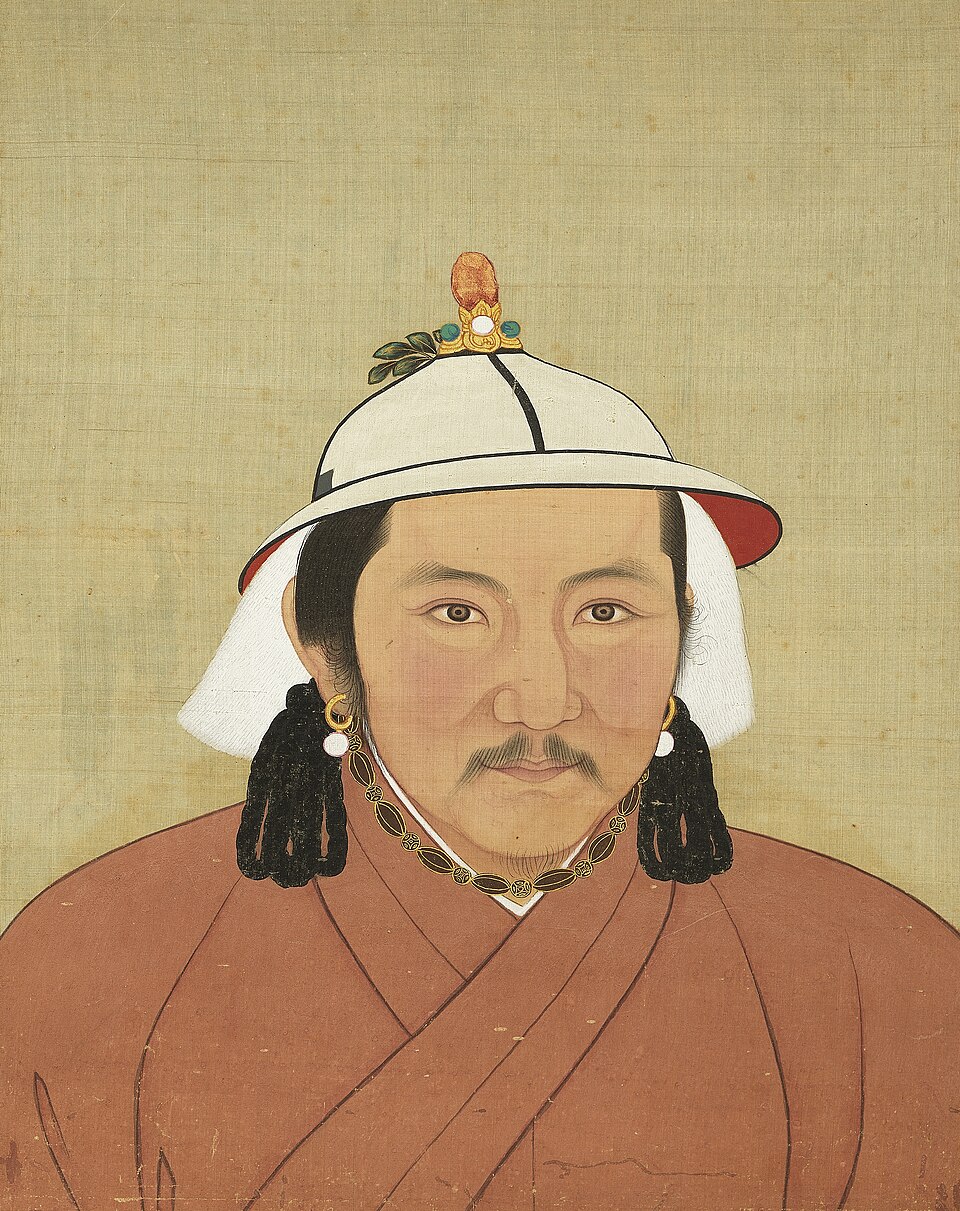
Tugh Temür
圖帖睦爾
Emperor of the Yuan · Khagan of the Mongols
1304 – 1332
- Born
- 1304
- Died
- 1332
- Reign
- 1328 – 1332
- House
- Yuan
Biography
Twice enthroned and implicated in the death of his own brother, Tugh Temür presided over one of the most culturally productive and politically compromised courts of the Yuan dynasty. Born in 1304, he was a son of Külüg Khan and thus a great-great-grandson of Kublai Khan. After his uncle Buyantu Khan diverted the succession to his own line, the sons of Külüg Khan were pushed to the margins; Tugh Temür spent years in effective exile in the south of China, including a period on Hainan, an experience that left him unusually familiar with Chinese culture for a Mongol prince.
The death of Yesün Temür in 1328 transformed his fortunes. El Temür, a Kipchak commander whose family had served Külüg Khan, seized Dadu in a coup and summoned Tugh Temür, who was enthroned there in October. The rival court at Shangdu had crowned Yesün Temür's son Ragibagh, and the War of the Two Capitals followed; the Dadu side prevailed within months. Tugh Temür then yielded the throne to his elder brother Khoshila, who arrived from Central Asia and was proclaimed emperor in Mongolia in 1329. Four days after the brothers met at Ongchaghatu, Khoshila died suddenly. Contemporaries and later historians have generally attributed his death to poisoning arranged by El Temür; Tugh Temür's own knowledge cannot be established. He resumed the throne, taking the title Jayaatu Khan; his temple name is Wenzong.
Real power in his second reign rested with El Temür, who accumulated offices and honors without precedent in the dynasty. The emperor devoted himself largely to cultural patronage. In 1329 he founded the Kuizhang Pavilion academy, which gathered scholars, painters, and calligraphers, and he commissioned the Jingshi Dadian, a vast compilation of Yuan institutions and documents completed in 1331. Himself a practitioner of Chinese painting, poetry, and calligraphy, he was the most thoroughly sinicized of the Yuan emperors.
Tugh Temür died in 1332, aged twenty-eight, reportedly expressing remorse over his brother's death and directing that the succession pass to Khoshila's sons rather than his own. The six-year-old Rinchinbal reigned for two months before dying, after which Khoshila's elder son Toghon Temür, the last Yuan emperor to rule China, took the throne in 1333.
Updated June 2026 · How we research
Connections across houses
Place Tugh Temür in the wider world of ruling houses.
Recommended Reading
Affiliate disclosure: the links below go to Amazon searches. As an Amazon Associate, Dynastica earns from qualifying purchases.