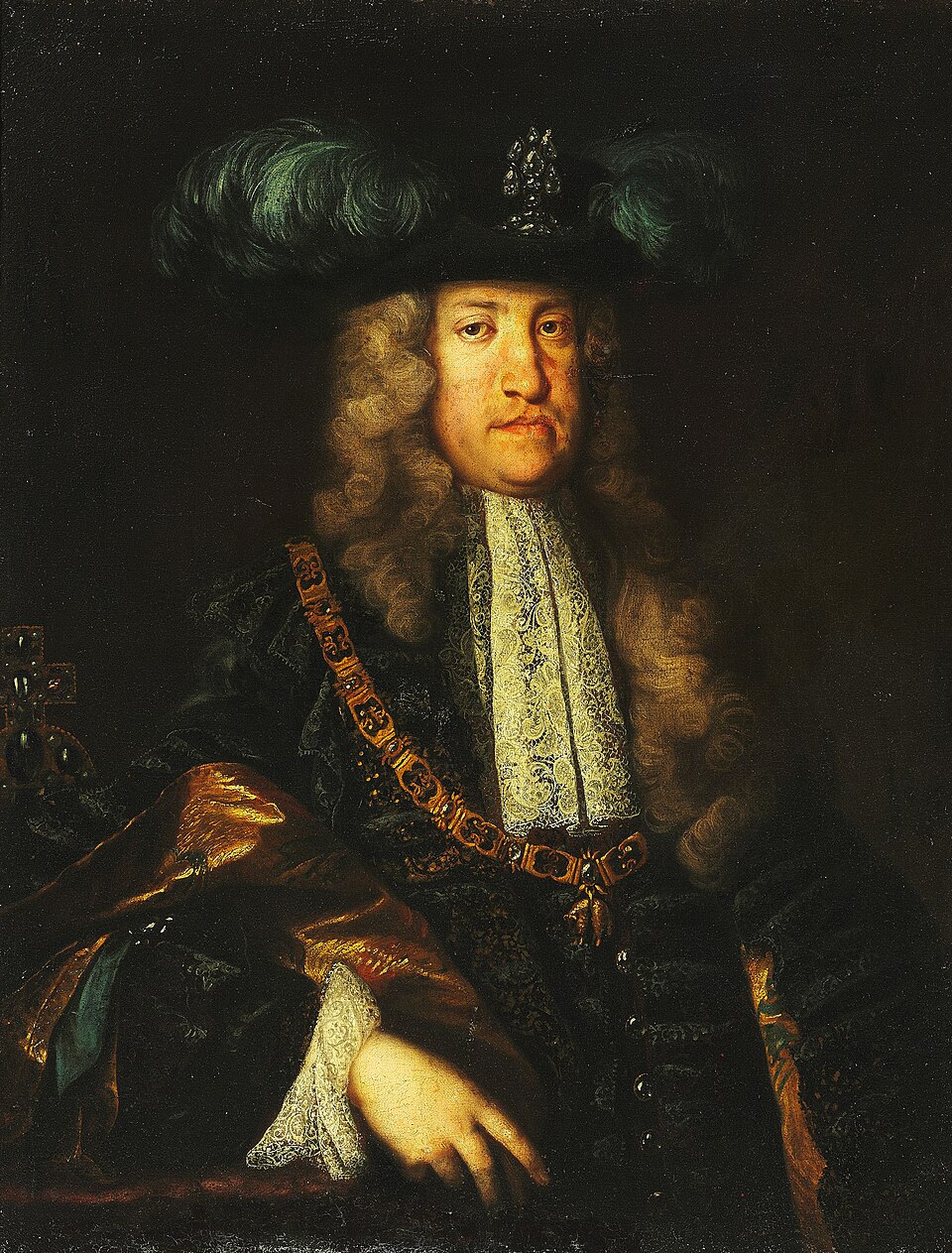
Charles VI
Karl VI.
Holy Roman Emperor · King of Bohemia · King of Hungary · Archduke of Austria · Charles III of Spain (claimed)
1685 – 1740
- Born
- 1685
- Died
- 1740
- Reign
- 1711 – 1740
- House
- Austrian Habsburgs
Biography
For more than a decade before he ruled in Vienna, Charles VI claimed a throne in Madrid. Born in 1685, the second son of Emperor Leopold I and Eleonore Magdalene of Palatinate-Neuburg, he was put forward as "Charles III" of Spain when the death of the last Spanish Habsburg, Charles II, ignited the War of the Spanish Succession in 1701. He fought for years in Catalonia against the Bourbon candidate Philip of Anjou, but the sudden death of his elder brother Joseph I in 1711 changed everything: Charles inherited the Austrian lands and was elected Holy Roman Emperor, and his allies, unwilling to see Spain and Austria reunited under one ruler, made peace. By the settlements of Utrecht and Rastatt he renounced Spain but received the Spanish Netherlands, Naples, Milan, and Sardinia (later exchanged for Sicily).
The central act of his reign came early. In 1713 he promulgated the Pragmatic Sanction, declaring the Habsburg lands indivisible and heritable by a daughter in the absence of sons. When his only son died in infancy, the document became the legal foundation for the succession of his eldest daughter, Maria Theresa, born in 1717 to his wife Elisabeth Christine of Brunswick-Wolfenbüttel. Charles devoted decades of diplomacy to obtaining guarantees of the Sanction from the European powers and the estates of his own lands, often at considerable cost in concessions.
His wars brought mixed results. Prince Eugene of Savoy's victories over the Ottomans, including the capture of Belgrade in 1717, yielded large gains at the Peace of Passarowitz in 1718, but the War of the Polish Succession in the 1730s cost him Naples and Sicily, which passed to a Spanish Bourbon prince, and a renewed Turkish war ended in 1739 with the loss of Belgrade. He also promoted commerce and built ports at Trieste and Fiume.
Charles died suddenly in October 1740, the last Habsburg in the direct male line. The paper guarantees of the Pragmatic Sanction proved fragile: Frederick II of Prussia invaded Silesia within weeks, and Maria Theresa, married since 1736 to Francis Stephen of Lorraine, had to defend her inheritance in the War of the Austrian Succession. Through that marriage the dynasty continued as the house of Habsburg-Lorraine.
Updated June 2026 · How we research
Events
Charles VI, last male Habsburg in the senior line, issued an edict on 19 April 1713 declaring that the Habsburg hereditary lands were indivisible and could pass to a female heir if no male existed. He spent the next twenty-seven years securing the recognition of every European court for the eventual succession of his daughter Maria Theresa. Most of those guarantees were violated within months of his death, plunging Europe into the War of the Austrian Succession.
Also there: Maria Theresa
Connections across houses
Place Charles VI in the wider world of ruling houses.
Recommended Reading
Affiliate disclosure: the links below go to Amazon searches. As an Amazon Associate, Dynastica earns from qualifying purchases.