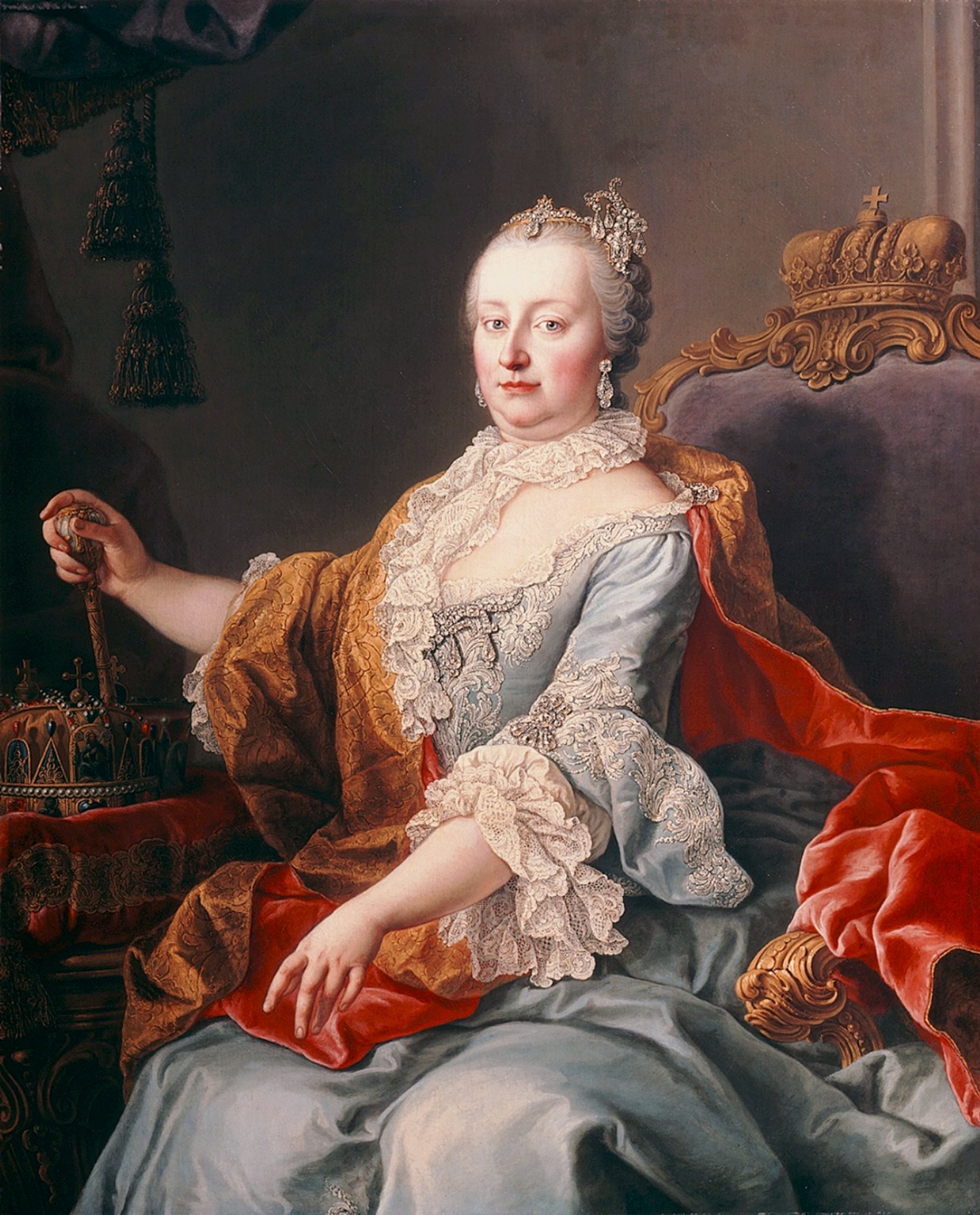
Maria Theresa
Maria Theresia
Archduchess of Austria · Queen of Bohemia · Queen of Hungary · Holy Roman Empress (consort)
1717 – 1780
- Born
- 1717
- Died
- 1780
- Reign
- 1740 – 1780
- House
- Austrian Habsburgs
Biography
The accession of Maria Theresa (1717-1780) in 1740 tested whether a woman could hold together the Habsburg monarchy at all. Her father, Emperor Charles VI, had spent decades securing international recognition of the Pragmatic Sanction, which allowed his daughter to inherit the Austrian lands, but the guarantees collapsed within weeks of his death. Frederick II of Prussia invaded Silesia, and Bavaria, Saxony, France, and Spain joined in challenging her inheritance, opening the War of the Austrian Succession (1740-1748).
Maria Theresa kept her crowns, in part by appealing successfully to the Hungarian estates for military support, but Silesia, one of the monarchy's richest provinces, was lost to Prussia. The Peace of Aix-la-Chapelle in 1748 confirmed that loss, and the attempt to recover the province in the Seven Years' War (1756-1763), fought in alliance with France after the diplomatic reversal of 1756, ultimately failed. As a woman she could not be elected Holy Roman Emperor; the imperial title passed in 1745 to her husband, Francis Stephen of Lorraine, whom she had married in 1736, making her empress consort while she ruled the Habsburg lands in her own right.
Defeat drove reform. With ministers such as Haugwitz and later Kaunitz, Maria Theresa centralized the administration and finances of the Austrian and Bohemian lands, reorganized the army, and curtailed the fiscal privileges of the nobility. Later measures included codification of law, restrictions on the use of torture, limits on peasant labor obligations, and the General School Ordinance of 1774, which laid the basis for compulsory elementary schooling.
Her marriage to Francis Stephen founded the house of Habsburg-Lorraine and produced sixteen children, whom she deployed in the dynastic manner of her ancestors: marriages linked Vienna to the Bourbon courts of France, Spain, Naples, and Parma, most famously through her daughter Marie Antoinette, who married the future Louis XVI. After Francis died in 1765, her eldest son Joseph II became emperor and co-regent of the Habsburg lands, an arrangement marked by friction between the cautious mother and the impatient reformer son; she opposed, though she accepted, the first partition of Poland in 1772. Maria Theresa died in Vienna on 29 November 1780, the only woman to have ruled the Habsburg monarchy, and was succeeded by Joseph as sole ruler.
Updated June 2026 · How we research
Events
Charles VI, last male Habsburg in the senior line, issued an edict on 19 April 1713 declaring that the Habsburg hereditary lands were indivisible and could pass to a female heir if no male existed. He spent the next twenty-seven years securing the recognition of every European court for the eventual succession of his daughter Maria Theresa. Most of those guarantees were violated within months of his death, plunging Europe into the War of the Austrian Succession.
Also there: Charles VI
Connections across houses
Place Maria Theresa in the wider world of ruling houses.
Recommended Reading
Affiliate disclosure: the links below go to Amazon searches. As an Amazon Associate, Dynastica earns from qualifying purchases.